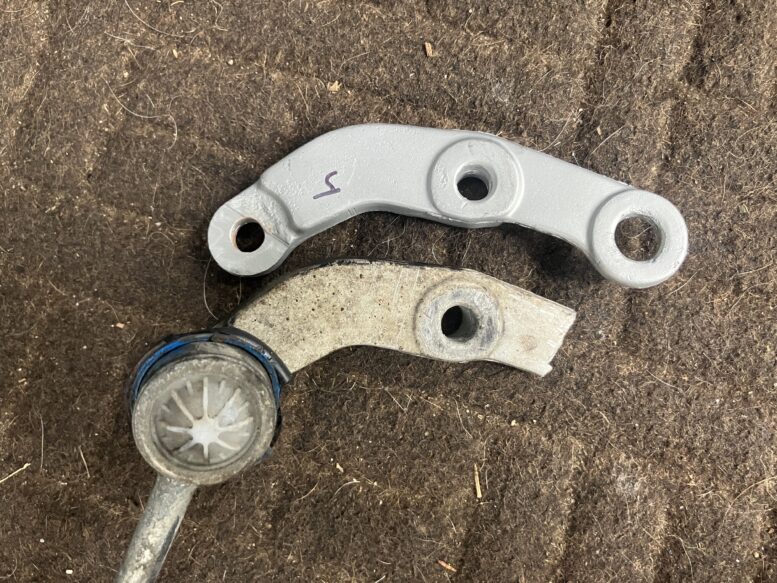
A few weeks ago I wrote about the banging in the front-end of my 2003 E39 being caused by the bracket holding the driver’s-side sway bar link breaking off, trying to remove the nut holding on the dangling link with my newly-purchased induction heater, and accidentally melting the link’s plastic cup. Plus, the broken bracket is NLA, and the only click-and-buy source for a used one that I found was an eBay seller in Latvia. I ordered it and a sway bar link, and waited. The bracket arrived from Latvia in just ten 10. Kudos to eBay seller “bsparts911.”
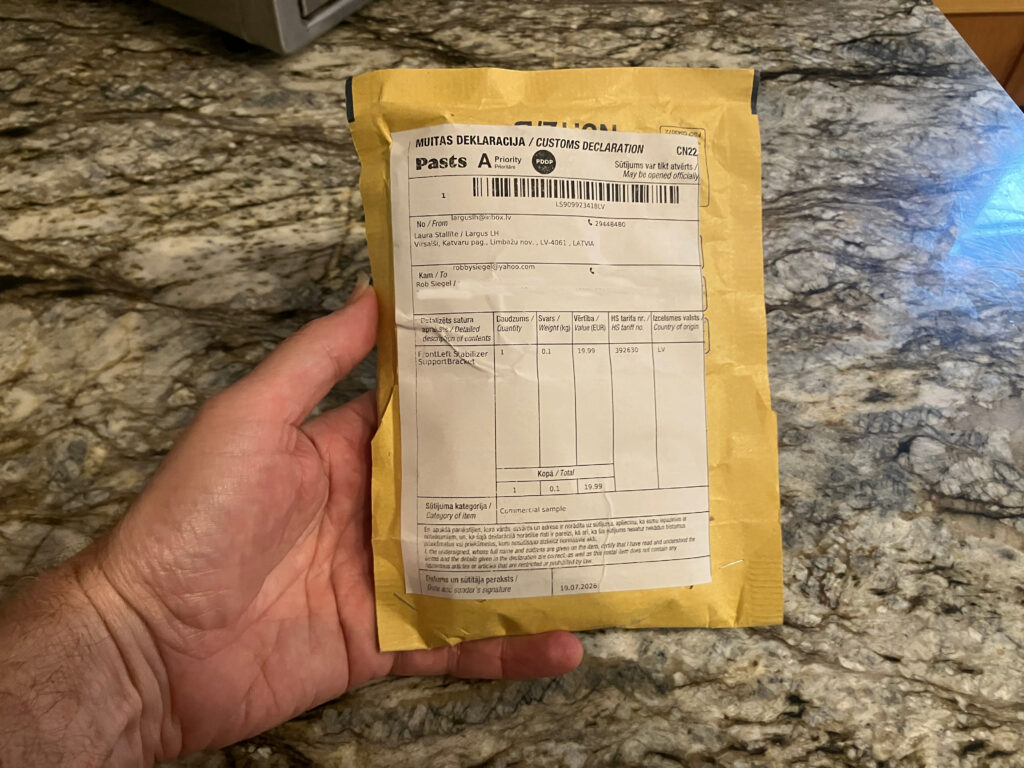
Nice.
Having the replacement bracket, I could compare it with the broken one. Since the upper bolt in mine was missing, I thought that the failure mode was that the bolt had rattled out which then put stress on the bracket. Maybe it did, but seeing the entire bracket made me realize how thin it is at that point.
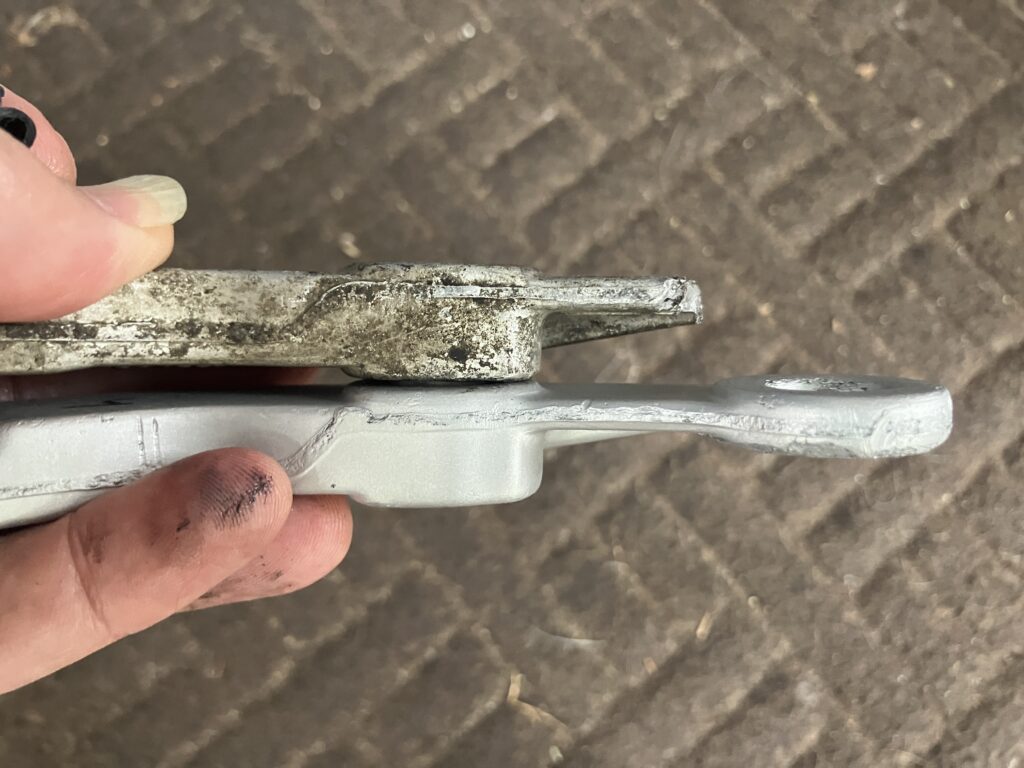
Wow.
With the bracket and the link in hand, I set out to test-drive my somewhat less fragile back and do my first real repair in three months. I knew that to replace the broken bracket, I had to undo the pinch bolt holding the collar onto the strut, and that required more than simply driving the car onto ramps as I did weeks ago. This time, I needed to jack it up and pull the wheel off. I used the compressor and the impact wrench, and moved slowly and carefully.
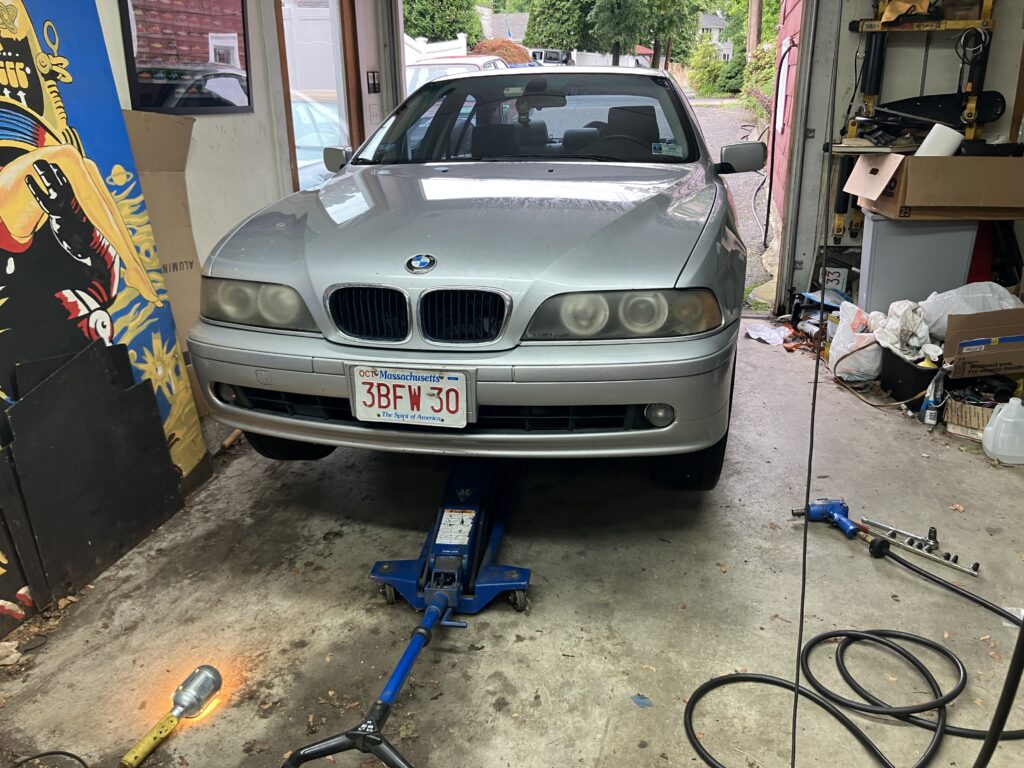
Up you go, big guy.
With the wheel off, I could clearly see where the bracket had broken off.
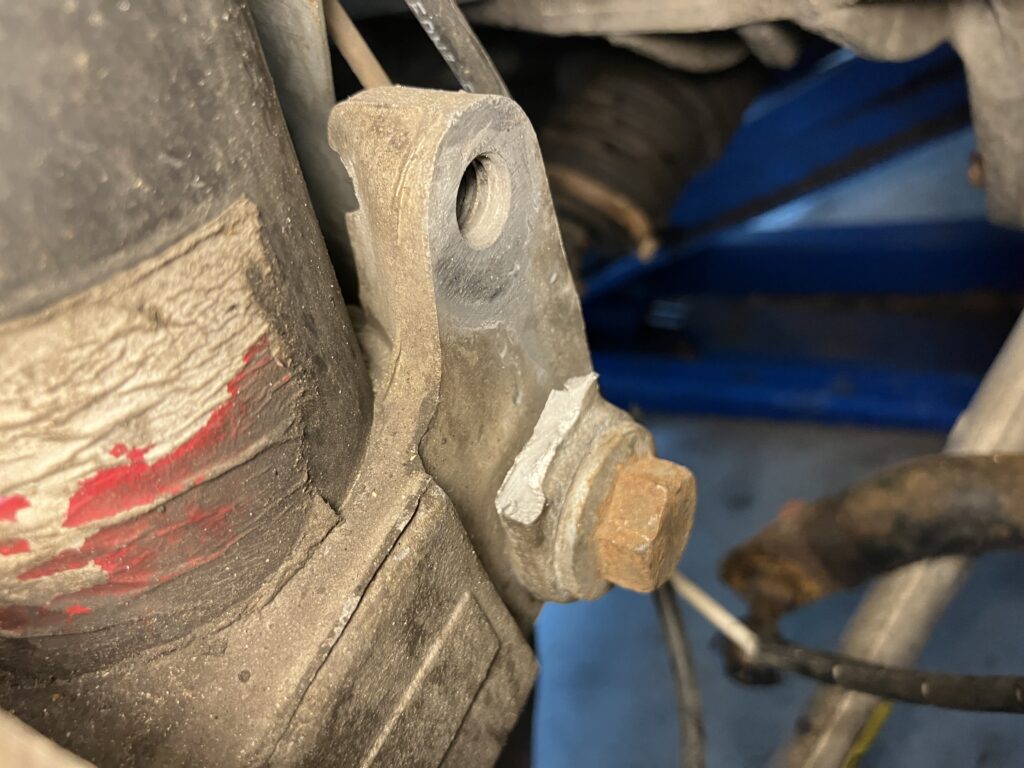
Ker-snap!
I also could see that the nut securing that pinch bolt looked like it wore every bit of the car’s 200,000 New England miles.
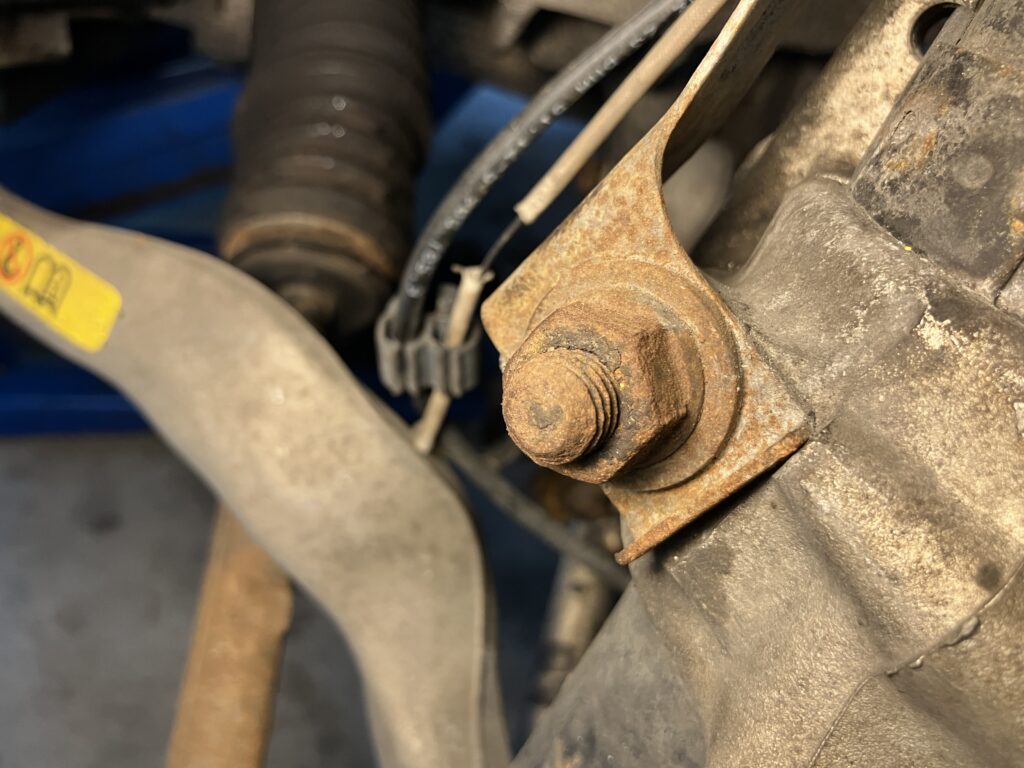
That’s a “stand your ground” nut.
But this is why I have air tools, right? I put on the ear muffs, fired up the impact wrench, and it did the whacketa whacketa whacketa thing, but despite multiple tries, never did the WHEEEE where the nut spins off. It clearly needed heat.
So, back to the induction heater. I didn’t talk much about this two weeks ago, but there are dozens of videos where people show squeezing the trigger of an induction heater, a nut glowing bright red, and it practically spinning itself off and running down the street. The way they work is that they set up an alternating magnetic field whose rapid flipping in direction generates heat. The caveat is that they only work on ferrous (iron-bearing) metal, and the nut or bolt has to be inside the coil of wire, so if something is occluded or recessed down in some hole, it’s not going to work. They come with several different-sized coils, and as I did a few weeks ago, I set it up using the coil that fit easily around the nut. This time I was very careful to verify that there were no plastic or rubber parts in contact with metal that was going to get hot. In the photo below, you can see the wires for the wheel speed and brake pad sensors and their rubber grommets that are held by the metal clip. I moved them before I began heating.
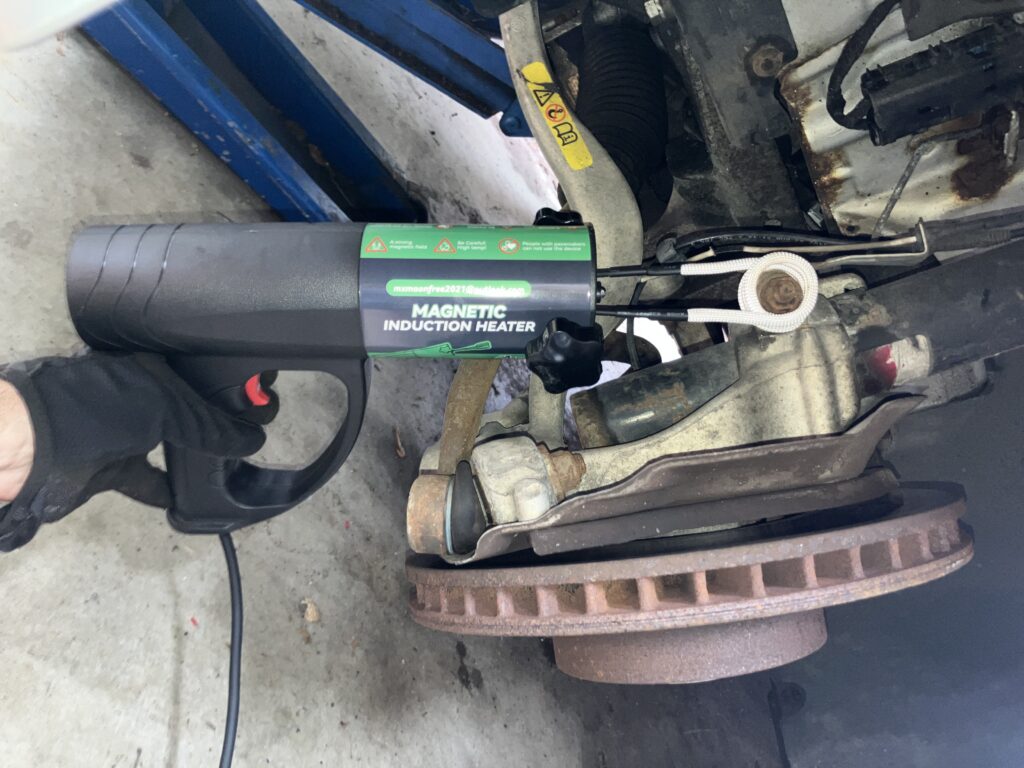
My $200-on-Amazon-$154-on-Temu “Mxmoonfree” induction heater pressed into service.
And… not much. The tip of the bolt began glowing, but the nut didn’t. I began thinking that my induction heater was one of the ones that people complain about in Amazon reviews that it worked once, then died.
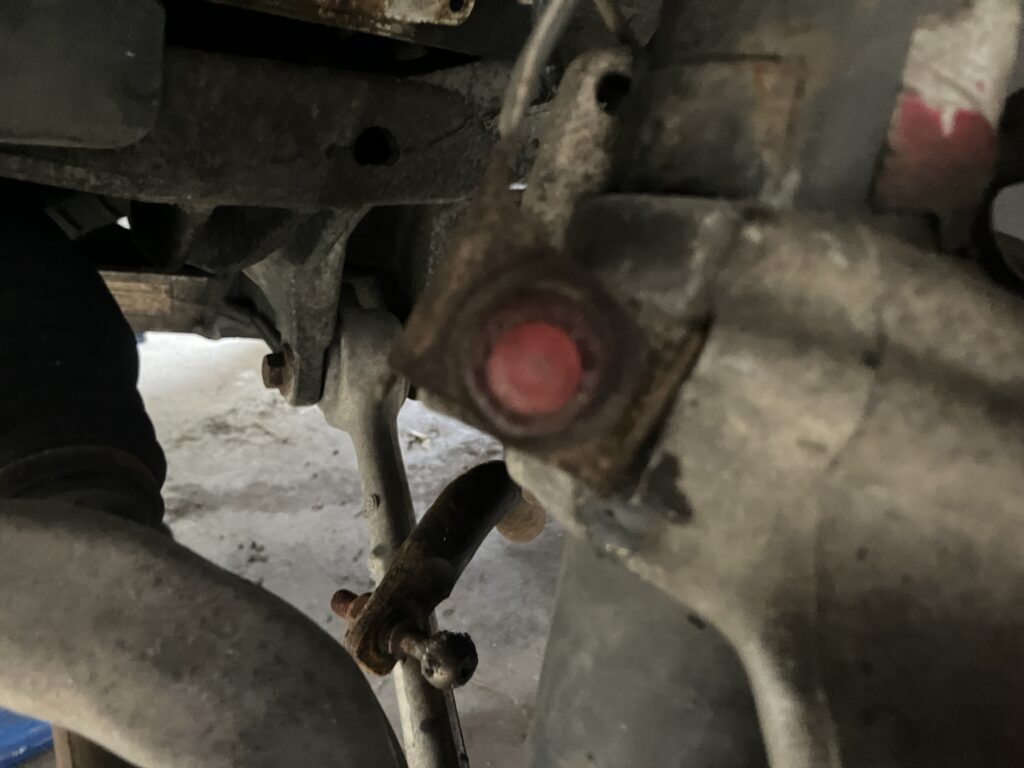
As Zorg said in The Fifth Element, “I am very disappointed!”
Then I thought to try a smaller coil. Initially I didn’t think it would fit, but I pressed it around the nut, and it fit snugly. The results were dramatic. This time, shortly after squeezing the trigger, the nut began glowing bright red.
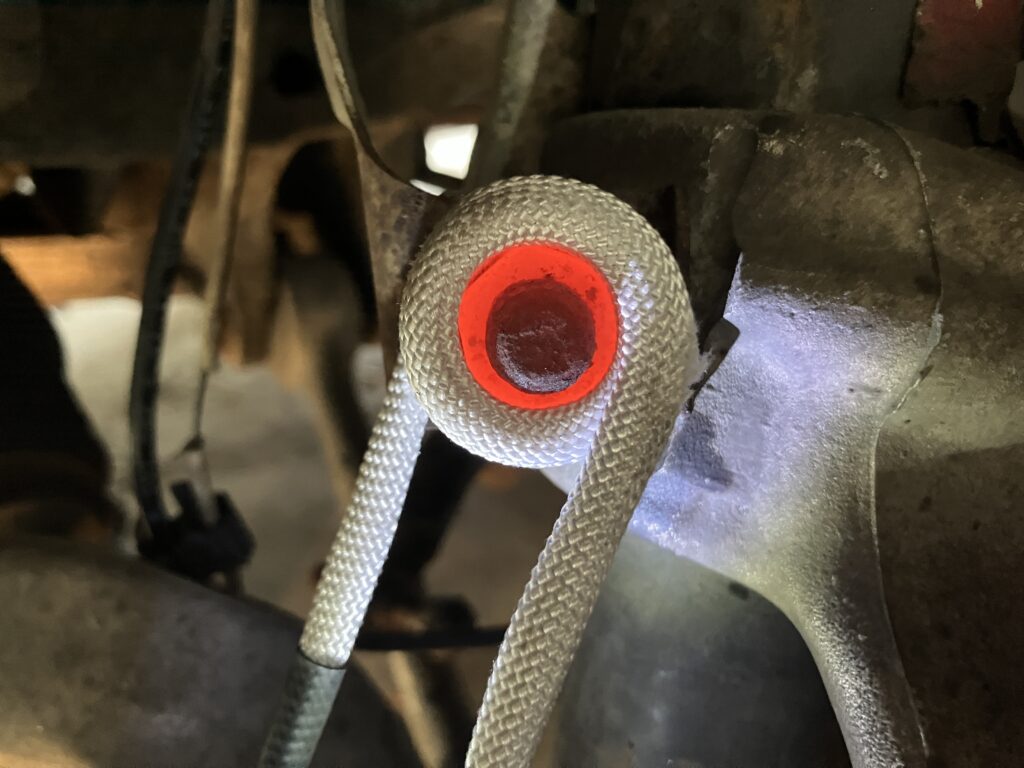
THAT’s more like it.
For grins, I tried spinning the nut off off manually with a ratchet wrench, but it didn’t budge. In fact, even with the nut glowing like the eye of Sauron, the impact wrench still didn’t spin it off.
And so here’s my short take-away on induction heaters: It’s just another source of heat. When I use the oxy-acetylene torch, it’s not unusual to have to try several cycles of heat-and-twist before the thing comes off. It’s certainly safer and more convenient than the torch (I kind of dread hauling out out from the back of the garage, it spitting black acetylene soot when I light it and dial it in, and dealing with the nearly foot-long flame under a car), but it doesn’t make nuts flee of their own volition. And, as the melted-plastic episode two weeks ago showed, it doesn’t have any benefit over a torch in terms of heat localization—it has the same issue of attached metal getting very hot.
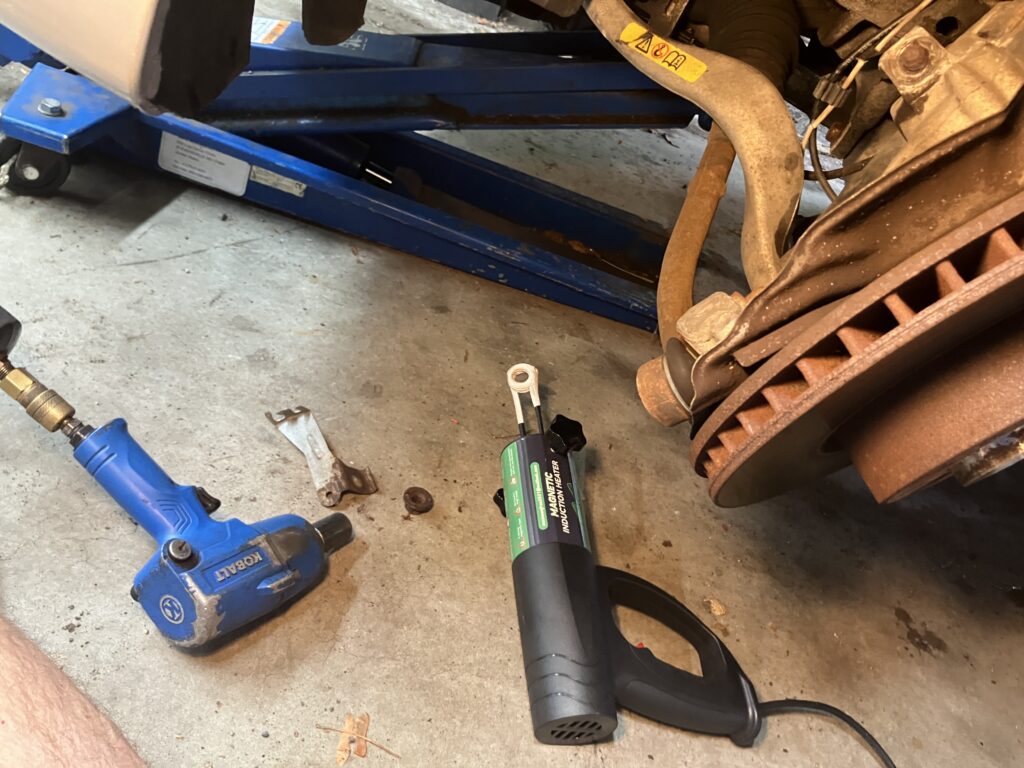
The induction heater and the impact wrench tag-teamed to get the thing off.
With the nut spun off, I thought I could simply withdraw the bolt and replace the bracket, but its egress was blocked by the rubber brake hose. I had to undo the caliper and rotate it to get clearance.
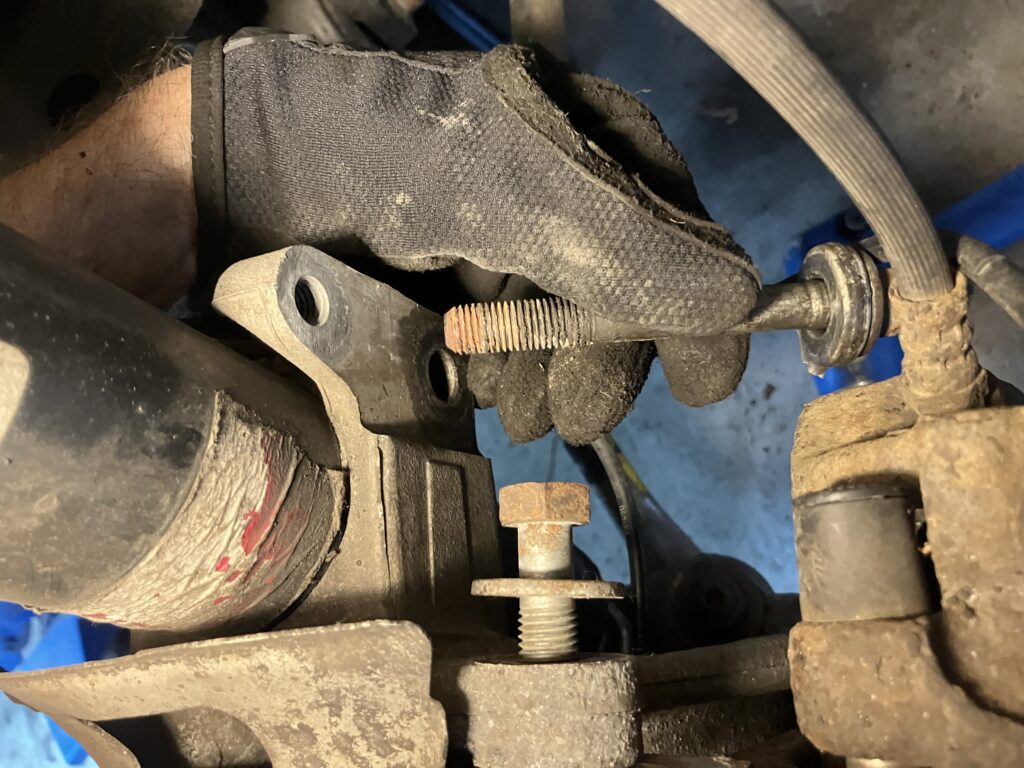
We got the clearance, Clarence.
From there, the replacement bracket and new sway bar link went together easily.
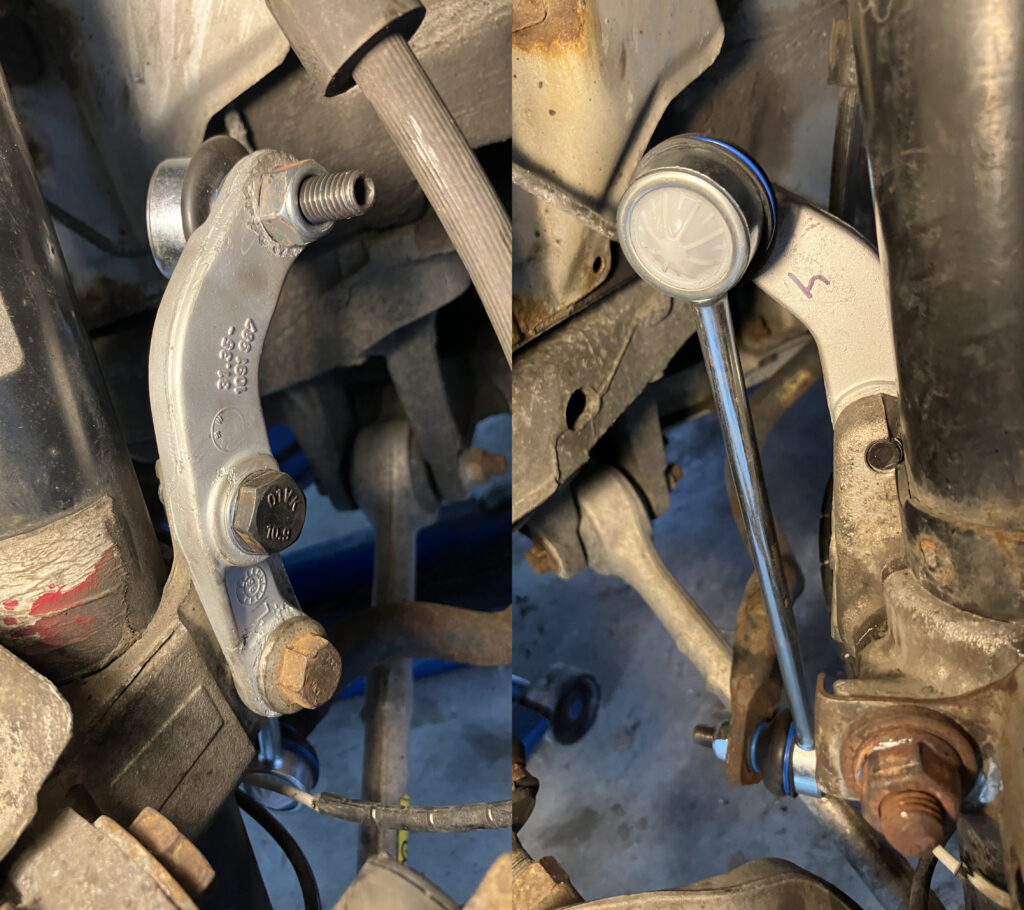
All done.
So, for about $50 in parts, I not only put the broken-and-banging front sway bar link to rest, but successfully used my new induction heater, and got some good data on its performance envelope. I don’t expect it to be a panacea for every hopelessly-rusted nut positioned between you and a removed catalytic converter, but having more tools in the stuckness toolbox is always a welcome thing.
—Rob Siegel
____________________________________
Rob’s newly-expanded book The Best Of The Hack Mechanic™: 40 years of hacks, kluges, and assorted automotive mayhem, is available on Amazon here. His other seven books are available here on Amazon, or you can order personally-inscribed copies (including the new Best Of) from Rob’s website, www.robsiegel.com/books.