At first, the i4 xDrive40 was not in the plan. The lease on my i4 eDrive35 was set to run out in March. There was no way I could wait until next year for an i3, but I definitely wanted another electric. I was high on the i4 from the day I got it; I reported on my early impressions in the October, 2023 Roundel. In January I was considering downsizing; I was a day away from a serious look at an electric Mini Countryman when Flemington BMW, my long-time dealer, called with a deal on another i4 that I could not let pass.
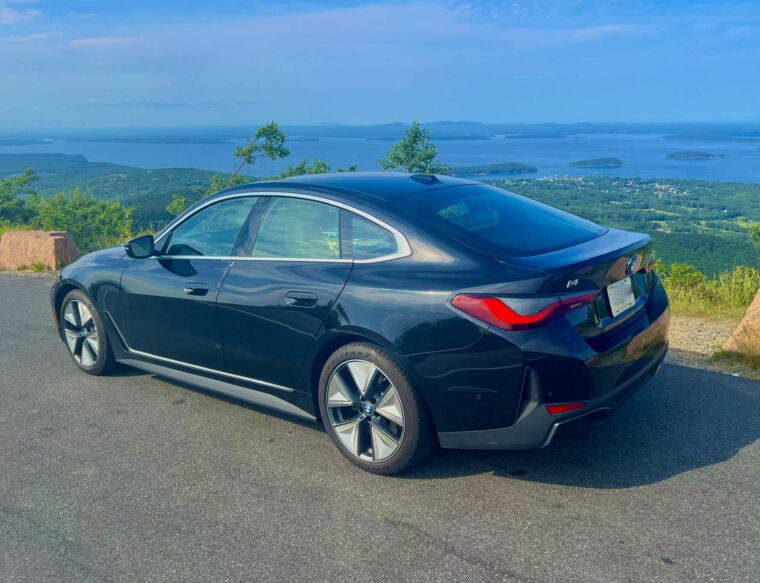
My second i4 is a 2025 i4 xDrive40 that served for a time as a loaner car at the dealership. It had about 5000 miles on the clock when I took delivery in January. What did I get? At first glance it was i4 redux; with black sapphire metallic paint and 19-inch bi-color Gunmetal Grey wheels, just like the i4 I was giving up. My neighbors could not tell that I had gotten a new car. But a closer look revealed the xDrive badge on the back, a new-for-2025 grill, a flat-bottom steering wheel, and Canberra Beige Sensatec upholstery rather than the Tecora Red in my old i4. The new car also has a self-parking option that I do not use, although I value the enhanced cameras that come with the package.
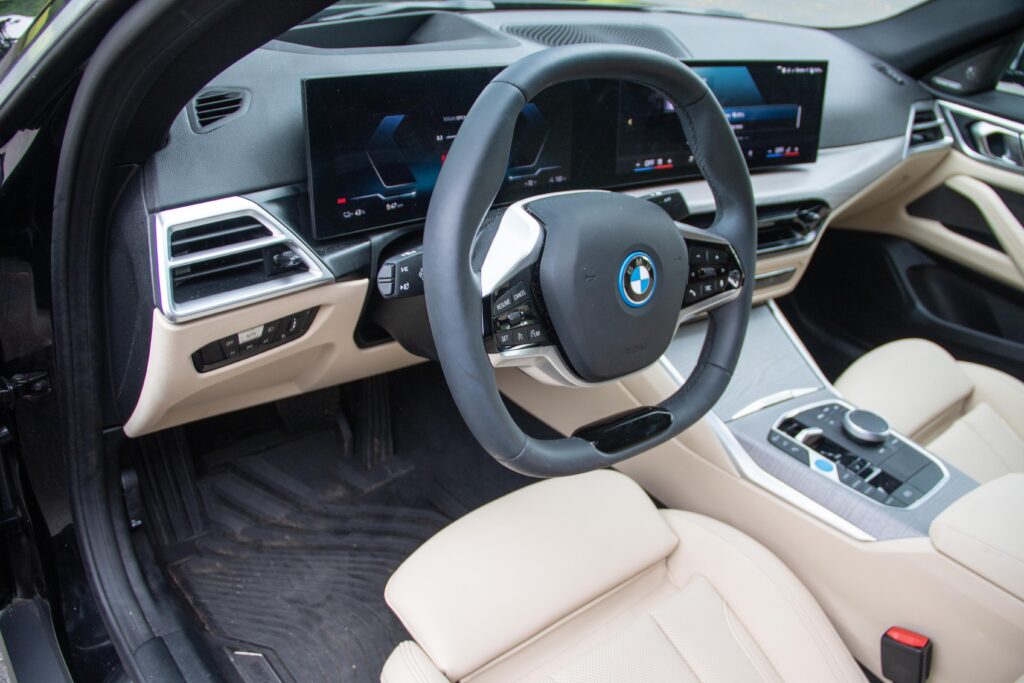
The new car has Canberra Beige upholstery and a flst-bottom steering wheel.
-
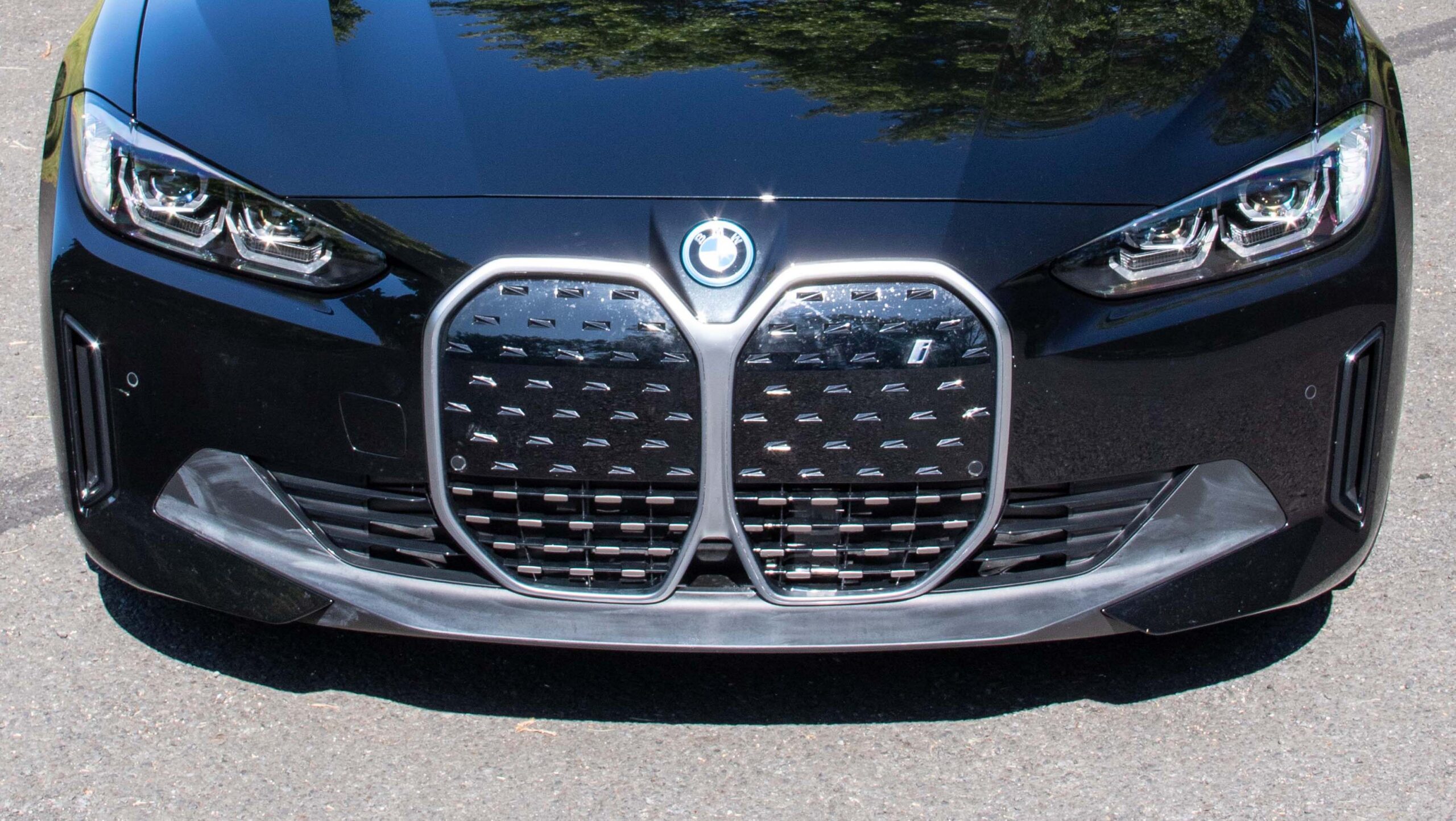
- The ’23 grill looks like this.
-
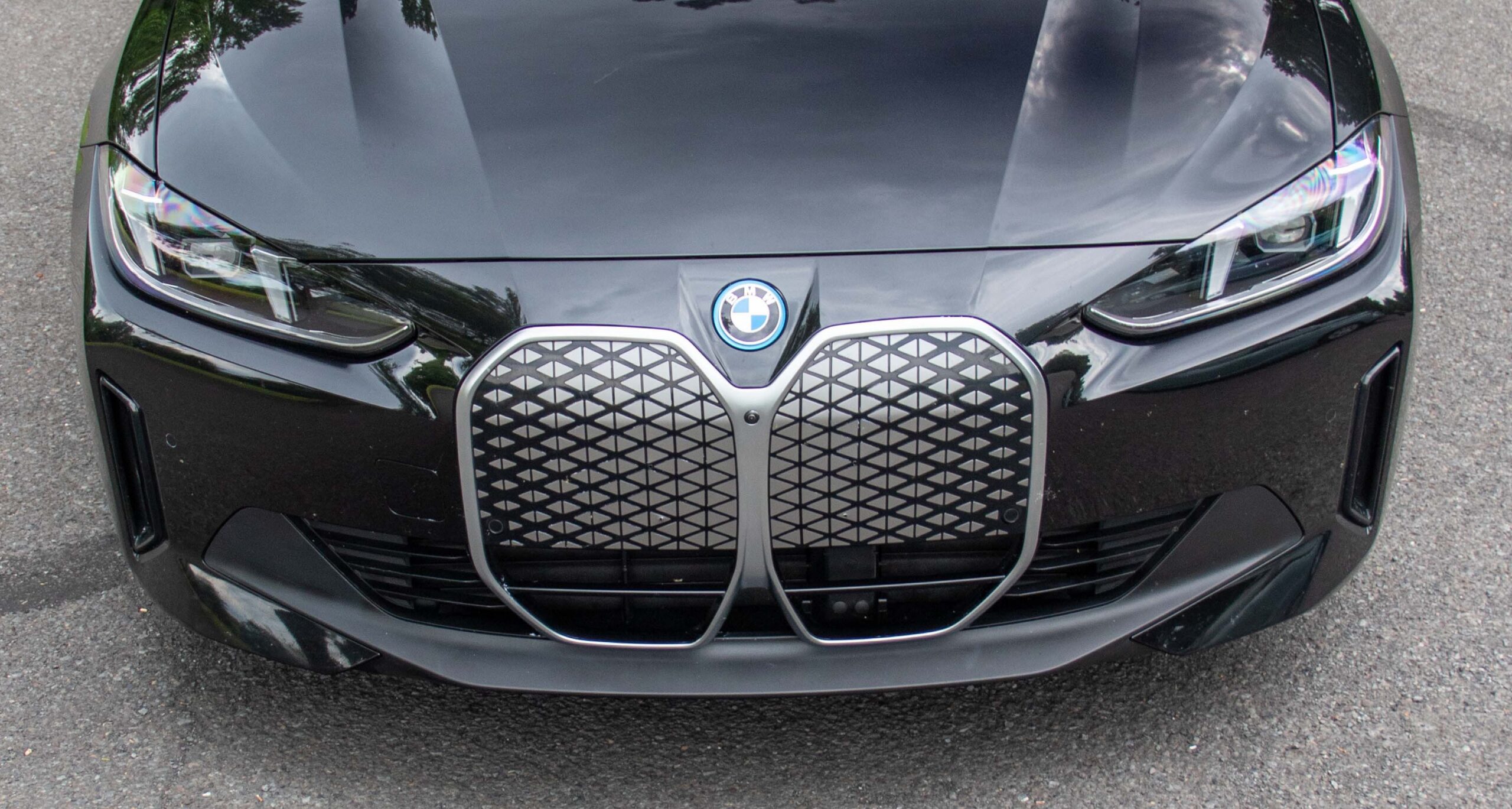
- While the ’25 grill looks like this.
Beyond the visual cues, of course, there are major differences underneath. The new car has two electric motors, one in front and one in the back, delivers 396 horsepower compared to the older car’s 256, has a usable battery capacity of about 80 kwh compared to 67 on the older car, and promises more range (the EPA pegs it at 279 miles—I have seen more than that in real-world driving, but never in the winter, when the range drops dramatically). The new car is heavier than the old one, weighing in at 5022 pounds vs 4552. But BMW does an exceptional job of getting high performance out of heavyweights in both electric and internal combustion configurations. The i4 35 always felt beyond secure in corners and exceptionally quick in a straight line. The i4 40 is quicker, and, if anything, feels even better planted than its two-wheel drive counterpart. Car and Driver concurs, saying in a 2024 review of the i4 xDrive40 that “Its nimbleness, sweetly progressive handling, beautifully supple and jitter-free ride, sharp steering, and effortless speed evoke the best BMW sports sedans of the past. In fact, we think it drives better than many of the company’s current gas-powered products. If you love to drive, you’ll love driving this car.”
BMW now offers access to the Tesla charging network with the purchase of a Lectron Vortex Plus Adapter. With the extended network of charging stations, the car’s greater range, the quiet interior (until the Harmon-Kardon sound system is unleashed), the comfortable seats and the excellent road feel, the i4 looks like a good candidate for a road trip.
Given the car’s promise for a road trip, my wife Francine and I elected to take it to one of our favorite places, Acadia National Park in Maine. My Acadia travel story appeared in Roundel in the February/March 2022 issue. This is not a rerun of the travel report—it’s about the charging experience.

Jordan Pond and The Bubbles are among the many great destinations in Acadia National Park.
I learned before the trip that not all Tesla chargers would work. Some stations say Tesla only, and some will not accept the adapter. I tried the closest one to my Washington Crossing, PA house in June to make sure the adapter worked. It did, and with Shell Recharge on my BMW app all I had to do was plug the car in and wait about 15 minutes for a charge up to 80 percent. But as I developed a charging plan for the trip I soon found that I would be relying on a combination of CCS1 high-speed chargers and NACS Tesla chargers, as well as a much slower level two J-1772 charger in Bar Harbor, where we stayed when visiting Acadia.
Unless I am on the road I charge at home on a 50-amp Chargepoint charger that paid for itself about a year into the life of the i4 35. Our utility says that the fully loaded rate per kilowatt hour at home is 12 cents, but it is really just over 23 cents with generation charges and taxes rolled into the equation.
The PlugShare app is an indispensable planning tool for any electric car road trip. Insert a location and it lists all the nearby chargers along with directions and what turn out to be very accurate reviews. If PlugShare says that some people have problems with adapters at Tesla sites, make sure that you have alternatives available.
Even though availability of chargers is much better than it was a year or so ago, we never let the car run below a 20 percent remaining charge. Note, though, that we never had a problem finding a charger nearby, and never had to wait in line for access to a charger, even in high-traffic locations.
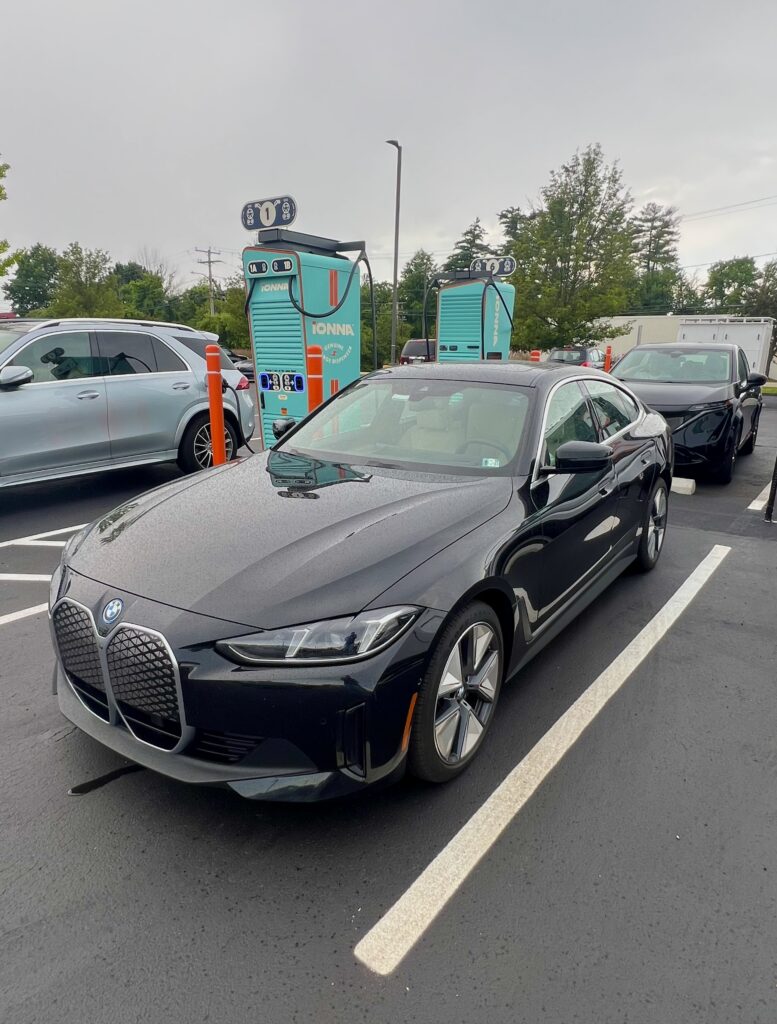
We used the Ionna Rechargery in Portsmouth on the way to Bar Harbor and on the way home.
Our first attempt to charge was at a Tesla site in Southington, Connecticut that we could not get to work. PlugShare had warned us. We had a number of non-Tesla options in Hartford, where we charged at an easy-access Electrify America location in a bank parking lot just off I-84. We spent the night in Portsmouth, 330 miles into the 565-mile journey to Bar Harbor. Over the years we have come to realize that highway traffic in New England is heavy, and that doing the trip in a day is not worth it unless one is in a rush. We charged at the Ionna Rechargery in Portsmouth, an easy-to-use location on the Shell Recharge app. On the next morning we made one additional stop on the way to Bar Harbor at an HPC MRRA high-speed charger in Brunswick, Maine.
For most of the trip we charged to 90 percent. In theory that enabled us to go 250-270 miles, but we never used all of the capacity, trying to charge with about 30 percent remaining. Charging took from 15 to a very rare 30 minutes at all high-speed locations. Food and restrooms were nearby at almost all of our stops. We would have made pit stops along the way in any case, and never felt that charging was adding an excessive amount of travel time.
In Bar Harbor, where the pricey hotels reserve their chargers for registered quests, there were Tesla chargers accessible to the public at the Hampton Inn. We could not get them to work. The College of the Atlantic, about a 15-minute walk from the rental house in downtown Bar Harbor that we have used for years, maintains a bank of J-1772 chargers. Three of the four always worked. The College provides the chargers for free, asking only for a $10 donation at each session. It was easy for us to leave the car there on four occasions over the course of our two-week stay. Charging took from two to four hours. It was a very minor inconvenience and a reliable place to charge. It was our go-to charging location for the duration of our stay, except for one day when we took a 15-mile excursion to Ellsworth for shopping and used a Charge Point high-speed charger.
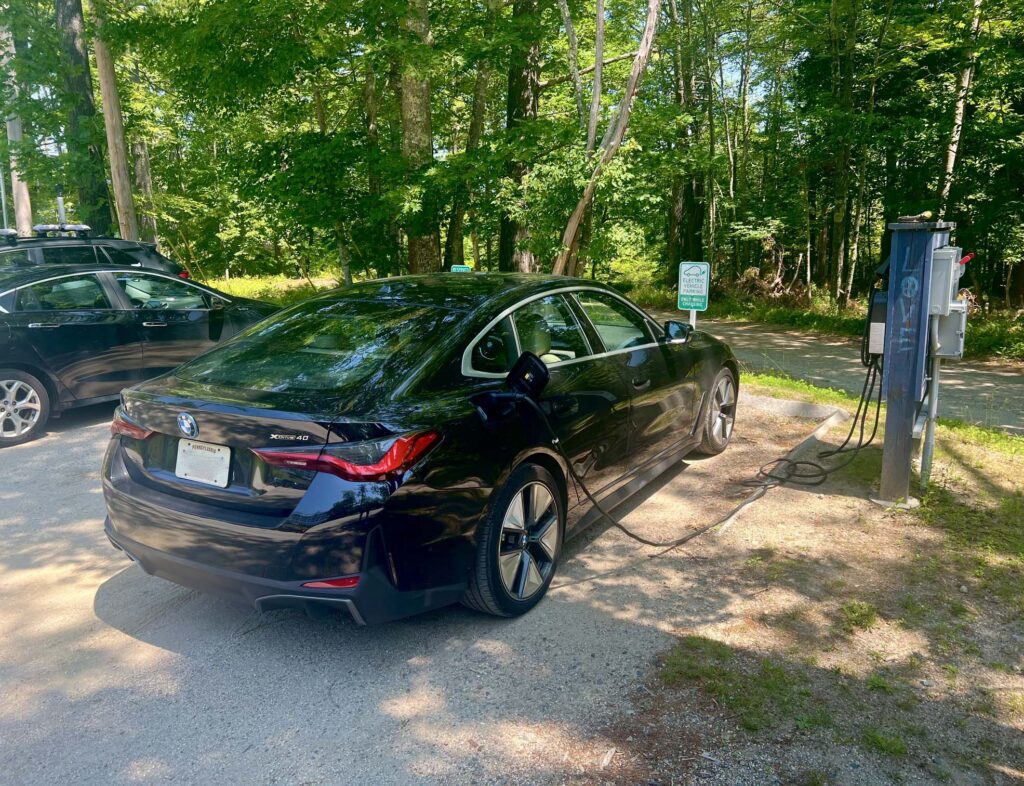
The chargers at College of the Atlantic served us well in Bar Harbor.
We sailed home with no problems, charging once at a Maine Turnpike rest stop and again at the Ionna in Portsmouth on the way to our Saturday night destination, the Publick House in Sturbridge, Mass. The Tesla charger in Sturbridge, about a mile from the hotel, worked as advertised. We elected to charge to 100 percent for the 226-mile drive home. We made the drive in just over four hours on Sunday, arriving at home with a 21 percent charge and an estimated 58 miles remaining.
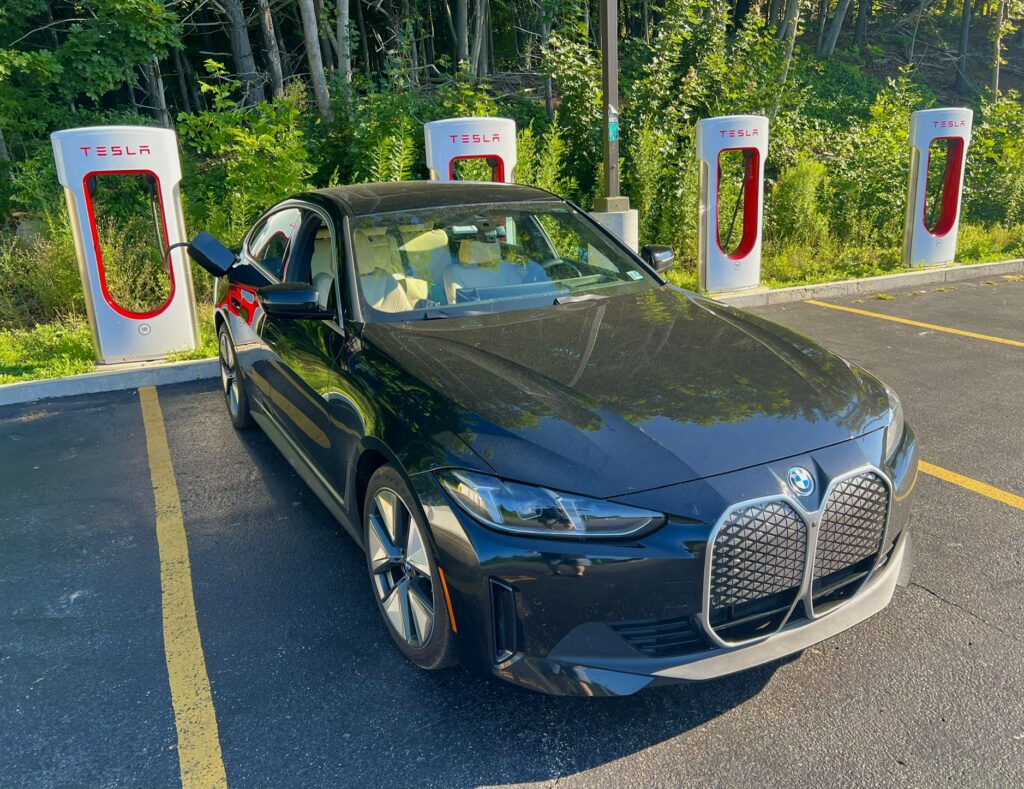
The Tesla station in Sturbridge, Mass. provided the charge for the final leg of the trip.
We put 1326 miles on the i4 over the course of the trip, using 326 kilowatt hours along the way, for a very respectable four miles per kilowatt hour. We paid a total $146 for charging, an average of 44.7 cents per kilowatt hour, almost double what we pay at home.
But what if we had not wanted to deal with the planning and occasional frustration that came with an electric car journey? Let’s say that we had taken the trip in a gas-powered 430i xDrive Gran Coupe. The midpoint of its EPA range is 29 MPG. Using 30 mpg and the average $4.86 per gallon unleaded premium price over the course of the trip, the cost would be $215 for 44.21 gallons of gas, just $69 more than the cost of fueling the i4.
It is not a huge differential. The greatest savings for the i4 come at home, where the 23.1-cent per kilowatt hour price for charging would take the car 30 miles for about $1.87, assuming a conservative 3.7 miles per kilowatt hour, far less than the $4.50 to $5.00 for a gallon of premium unleaded used in a 30-mpg car.
Is the car a good deal at this point in the i4 life cycle? No doubt the next generation of electric BMWs will mark a transformation from the current lineup, with a greatly extended range. But my take is that if one is in the market for a car right now the i4 is a very attractive option. The lease rates are very good, BMW performance is intact, and reliability is exceptional; in almost three years the i435 made one trip to the dealership for routine maintenance that included brake fluid and a cabin microfilter. From this writer’s perspective the i4 xDrive40 is an exceptional choice both at home and on the road.
Lead photo shows the i4 on the Cadillac Mountain Summit Road overlooking Bar Harbor. All photos by Brian Morgan