Welcome to Tech Talk, where our resident BMW tech Nick Owen answers all your pressing BMW technical questions, frustrations, and issues. Have a question for Nick? Email him at techtalk@roundel.org. Let’s get into it.
Tire Pressure Question
I have a 2020 BMW X5 xDrive50i fitted with the stock Bridgestone Alenza (RFT) 275/45R20 tires that came when new.
I noticed today that the recommended tire pressures on the door pillar sticker are different from those displayed on the iDrive screen:
- Sticker: Front – 33, Rear – 41
- iDrive recommended: Front – 39, Rear 46
Why would this be? Does the iDrive change the recommended pressures based on an algorithm?
Thank you,
Tom LaMonte
Member number 29294
That is a great question. I would think that the door pillar label would be the end all be all. I am not aware of any iDrive algorithm.
But now that you got me thinking about it; because you have run flats, it’s possible the B-pillar label is incorrect and shows too low of recommended pressure. The difference of five to six psi can influence how that tire is going to support the car going down the road and I wonder if it’s to help prolong run-flat longevity? If there isn’t enough psi in the tire to support the sidewall during compression, it’s possible the tire can prematurely wear out the sidewall. It’s also possible the tire manufacturer came back to BMW sometime later and said that for the tire to work properly, the recommend psi needs to be higher.
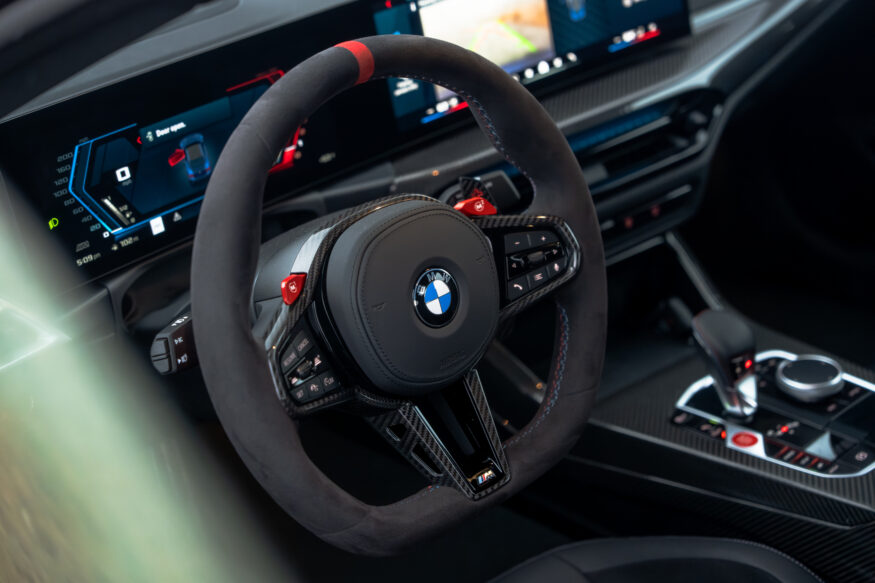
2026 M2 Instrumentation
I have an easy one for you. My son and I have both ordered 2026 M2’s to be delivered at the Experience Center in Greenville, hopefully in the spring. His first BMW and likely my last (I am 72).
My current car is a 2006 997.1 911 with 70,000 miles, which I will keep and give to my son at some future point. As you know, my car’s engine has the dreaded IMS and bore score problems. Accordingly, I change my oil annually or every 6000 miles. Also, I drive very gently and never rev the engine above 3000 rpm until the engine oil temp reaches 190 degrees. The car runs like new and I am keeping my fingers crossed that it remains so.
My question: I have read that many new cars including BMWs “buffer” their instrument read outs because some owners would panic if a gauge readout was above normal.
Can you tell me if the instruments on the 26 M2 give accurate readings or are they buffered?
I hope to be able to carefully monitor the car’s engine temp so that it is fully warmed up before any spirited driving.
Thank you!
Russ DeJulio
Pittsburgh PA
Generally speaking, gauge readings cannot be too buffered because they need to be able to give accurate information. By law, a speedometer cannot show vehicle speed slower than what the vehicle is actually doing. But in situations where a customer used GPS to track their vehicle speed and compare that to the vehicle speedometer reading and noticing a discrepancy between the two, did come in and complain about it. BMW engineering replied that a seven percent discrepancy is deemed acceptable due to the calculation of vehicle speed through the DSC control unit, while considering wheel and tire sizes (which will affect speedometer readings and the final gear ratio). The DSC unit takes the wheel speed signal(s) and uses it to determine the approximate MPH the vehicle is traveling to calculate the mileage. While this is what I learned about 15 years ago with the E8X and E9X chassis, I couldn’t tell you if that remains true with the current models.
If your concern is that the temperature gauge on your new M2 isn’t going to be accurate enough to determine when the engine is warmed for spirited use, I think you can relax on that level of scrutiny. You’re not going to hurt anything; the car won’t let you. The main point here is that you don’t want to take a cold engine to redline. Or demand a lot of high RPMs before the oil viscosity changes with heat. Keeping the engine below 3000 RPM during “warm up” is fine if that makes you feel better. But there is nothing etched in stone anywhere that says 3000 RPM is the magic number to stay below. Personally, I think that’s a number the “forums” made up.
E92 Lights
We have a 2008 328xi with just over 100,000 miles (we have replenished the ‘lifetime fluids’ in the tranny and transfer cases just before it went past 100,000), and have enjoyed the car, and intend to keep it, primarily as a ‘grocery getter’.
We have two check control lights:
- A red service interval light (car outline), which indicates the brake fluid is a few months over two years old (the fluid tests at 2.4 percent water).
- A yellow circle with small ‘spokes’ around the periphery, which denotes a brake light bulb failure.
And so, I will be flushing the brake fluid soon enough.
I can’t figure out the cause of the brake light bulb problem. You can see that only one bulb of the two driver’s side brake lights functions, and that is the one nearest the side of the car. The bulb that doesn’t light up with the brake pedal does indeed illuminate with 12v applied, after I remove it and test it. There is no obvious damage or corrosion to the entire plastic/metal assembly, and every bulb tests good for continuity between the individual leads up to it (I tested the plastic/metal/bulbs for continuity within the assembly).
So, I removed the ‘black box’ indexed wires’ lead-in, and I find that every wire’s lead tests 12v appropriately (there are four) with the brown wire as ground except the green stripe on blue wire (which is the nearest pin to the brown wire pin). There is no voltage drop to speak of between the brown and green/blue leads. That tells me that there is no voltage sent to the green/blue wire. Can you help me? My Mommy always does. The internet, always a treasure trove of information but no answers, has proven to be useless in this instance, and I do indeed lack the wiring diagram for our car.
Best regards,
Quentin Peterson
Tucson, Arizona
(I referred him to the dealership for a diagnosis using BMW ISTA)
Yesterday, the technician scanned the OBDII of our 2008 328xi with ~100,000 miles, and found that the FRM has an internal short circuit. So that would indicate that the FRM needs replacement to return the entire brake light circuit to good order. I have joined the two driver’s side brake light bulbs together at their power-in wires with a short section of sturdy wire (stuck in the back, contacting the pins). Without this connection, only one bulb, the outer one of the rear quarter brake lamps will light up when the pedal is pressed. Since that doesn’t cause an increase/decrease of current to either bulb, I figure that is okay.
Now, obviously, I can’t verify that the “Sharp Brake light, Left side” does or does not work. That is the only error code (CCID 372) I now get, other than the time to flush the brake fluid service indicator…
I do wonder at this point, what is the harm from leaving it as it is now, absent any quick and cheap replacement of the FRM? If I could find a cheap replacement FRM, and if that replacement goes quickly, I would like to do that. If it’s a relatively expensive part and must be brand new, as well as something I would rather pay someone else to do (I am officially elderly and have limited amounts of time available HA!), perhaps it’s advisable to wait for another FRM failure before proceeding with a replacement. What do you think now?
Best regards,
QP
Alright, well, at least we know where we’re at. I would run the car as-is and wait for another FRM failure. The issue here is that the FRM is fragile. They can go out randomly. They used to go out when we would plug the ISTA ICOM into the car back in the day, thus requiring extended warranty coverage of the FRM. I have reason to believe you’re out of that extended coverage window. A new FRM starts at about $650 and after installation and programming, you’re at $1000+ if going to the dealership. An independent shop could save you some bucks, but the bottom line is that you’re better off replacing the FRM with a new one than finding a used one.