Like all manufacturers, BMW is always implementing ways of streamlining production and boosting productivity. One is with AI, which has a hand in the assembly process’ various stages of quality control. Another is the use of humanoid robots, which we saw in a demonstration during the 2027 X5 reveal covering how they’re being trained and implemented in real time at BMW’s Spartanburg Plant.
In partnership with tech firm Figure AI, BMW says that this technology has already had a hand in the production of several thousand X3s that have come down the line. A tremendously minor hand, as a video demonstration showed. But what’s the outlook on utilizing this tech? We decided to dig a bit deeper.
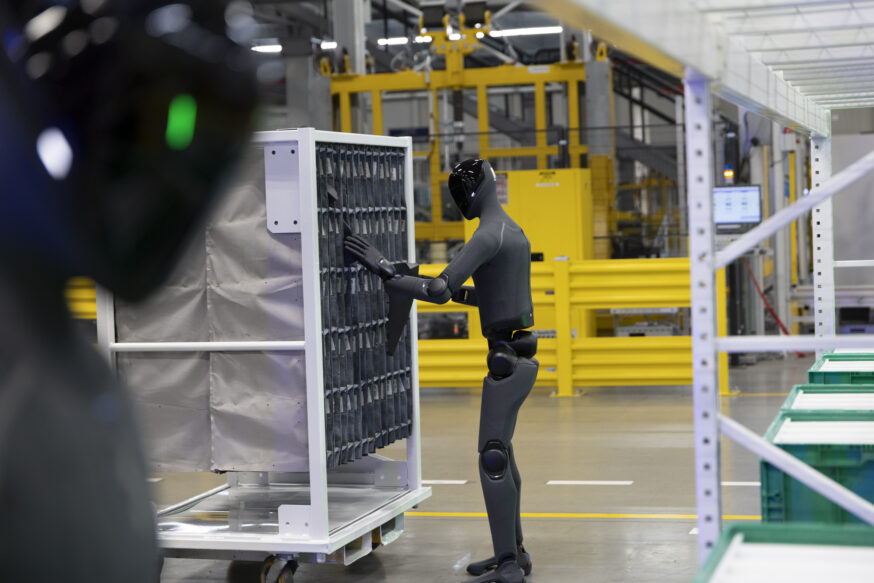
At one of the final portions of the tour, five Figure3 humanoid robots stood on their stands, awaiting direction from personnel. Once the demo was underway, one of the robots detached from its stand and calmly walked over to a cart located to its right. It pulled the cart towards us a few feet, then proceeded to sort through different bins on a nearby table and place certain parts in different sections of the cart. We reckon these parts were either interior trim or part of the X5’s unibody chassis. It then pushed the cart back to where it was, walked back to its stand, did an about-face, and walked backwards onto it. But not without a bit of an awkward shuffle in the process.
When asked what the estimated runway is for these humanoids to become a regular part of the production process, integrated into the plant’s various departments, it sounds like this tech is a ways off from full integration.
“We’ve been working on this project for more than two years now, and we’re amazed at what they can do,” one member of BMW’s personnel shared. “How good their hands are, how good the movements are. For very specific use cases, it will take a month [to implement them], but for tricky work, such as on the production line, that’s going to take a very long time.”
Then, another journalist asked simply, why? Especially in light of humans being so good at, and integral to, making cars. Personnel responded that robots are good for tremendously repetitive tasks. For human workers, these tasks over the course of a shift can lead to mistakes, whereas, when the robot is taught how to perform that same task it will never make a mistake. It also means that humans can focus on more fulfilling jobs, leaving the ultra-simple stuff to the bots.
Later in the day, another journalist shared that, during their tour, the robot suffered a clear malfunction. Then, during our demonstration, its movements were incredibly slow—how is this noticeably faster and thus more efficient than a trained human, especially considering the fact that the plant currently has the ability to produce 1500 vehicles per day? Sure, simple tasks are simple tasks, but time is still very much of the essence.
Additionally, one cannot help but ask: why are they human-shaped? Robotics have been a regular fixture of automotive production for decades at this point, but the plant still employs 11,000 personnel on-site. During the X5’s official unveiling, a major portion of the event focused on the amount of local labor that BMW employs, with several dozen folks joining in the presentation straight from the line. BMW is proud of this, and the effect that the plant has had on the local economy since the mid-’90s has been great.
Humanoid integration into various parts of the production process—beyond very simple tasks—seems like it’s a very down-the-road thing. But we still can’t help but wonder how this will affect the local workforce. For a portion of X line owners, there’s a sense of pride that their cars are assembled by fellow Americans. There will surely be mixed feelings if that’s no longer a thing in years to come.