
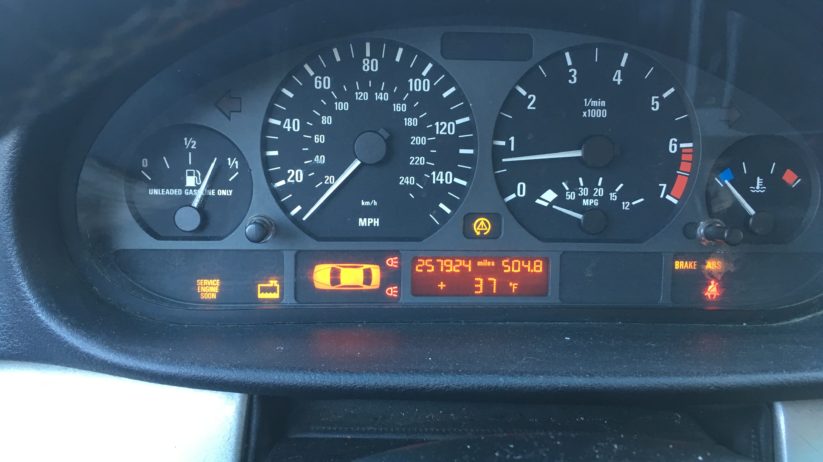
There’s one question I’m often asked: “Can’t you just plug into the car and let it tell you what’s wrong?” And while those that are skilled in their trade will say: “it’s not that simple,” the perception is that we know what the problem is once we plug in. We don’t. Figuring out the problem is step two.
The process of elimination is how you fix a car, because you cannot fix a car if you don’t know what’s wrong. You need to know what is working and what is not working. You could throw parts at a car all day and still not fix the issue, wasting time and money in the process. Fault codes are simply bread crumbs that you follow to eliminate possible causes of the issue you’re after. It is one of the many tools that technicians must interpret to determine if the system they are working on is functioning properly or not.
Fault codes are set by parameters. And when certain parameters are encountered, the fault is logged and stored. If the fault recurs too many times, that’s when you get a light on the dash. Mark my words, you do not fix a fault code by clearing faults. All that does is reset the computer and make it start all over again. Fault codes are stored because something caused them to be stored. Sometimes directly, sometimes indirectly, and sometimes as redundancy. But 99 percent of the time, they are stored because something in the system was outside of its parameters.
Let’s take a look at an example: a BMW F15 X5 with an inline six-cylinder N55 engine and 85,437 mile. Bank 1 refers to cylinders one through three and bank 2 refers to cylinders four through six. Now, this part is important: Pay attention to the fault code description. Most assumptions by the untrained are that if there is an oxygen sensor fault stored, the oxygen sensors must be bad. And needs to be replaced. This would be accurate if the fault description read something like: “Oxygen Sensor Bank 1 Heater Short to Positive” or “Oxygen Sensor Bank 2 No Response.” And after inspecting the wiring and determining that was not the issue, then it is probable the sensor is failing internally and thus going bad. But if the fault says “Oxygen Sensor Bank 1 Too Lean” then you don’t have an oxygen sensor problem, you have a fuel trim problem. There is not enough fuel being delivered or burned to satisfy the parameters of the oxygen sensor.
By the time we retrieve fault codes and begin down the diagnostic path, we are implementing the process of elimination. If there is a lean fault on bank 1 but not bank 2, then it is safe to say the fuel delivery system is working. Obviously, the fuel pump has power and must be working enough if the engine starts and idles. For the most part, I can rule out bad wiring, inoperable fuel pump, or restricted delivery to the engine. If there was a fuel delivery issue then both banks would have faults stored, in theory. So, we can eliminate the fuel delivery system as being the cause of the lean fault and turn our attention to the affected bank.
From here I would start looking at the Bank 1 components which would consist of the spark plugs, coils, injectors and cylinders themselves. The chances are that either I have a vacuum leak (unmetered air) entering the engine at the Bank 1 intake manifold to cylinder head area or failing injectors. After using a smoke machine to determine I do not have a vacuum leak anywhere in the engine, I would use my best judgement to condemn one of the bank 1 fuel injectors or replace all three at the same time. Reason for condemning all three is that since my faults stored do not point to a misfire on cylinders one through three, there is no obvious failure of the injectors to determine which one is not delivering enough fuel. Which draws the conclusion that all three are starting to fail by not being able to deliver enough fuel, resulting in the lean fuel mixture fault set by the oxygen sensor parameter.
Ok, Got it? Great. Pretty easy right?
We’ll see. Come back next time for the actual test.