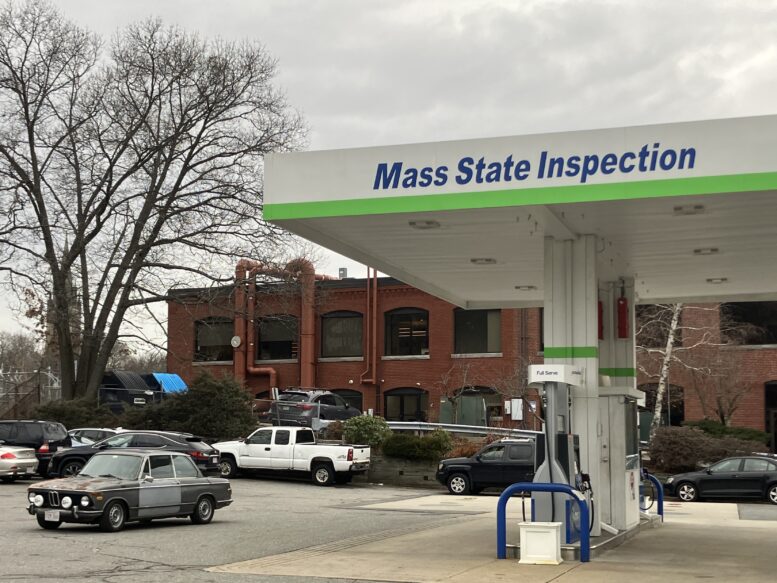
If you own a vintage car and live in one of the 10 states with annual motor vehicle inspections, or one of the four with bi-annual ones, you know the drill. While I have nothing against keeping unsafe cars off the road, safe versus unsafe is never a binary thing, and here in Massachusetts, the amount of hassle and stress engendered by annual motor vehicle inspection is a pain (to be clear, my beloved home state of Massachusetts has many other redeeming qualities). In addition to the basic lights, horn, wipers, handbrake, they can fail you if you have any rust holes in the body, if the exhaust isn’t sealed, if there are any stone chips in the windshield larger than an inch or cracks longer than three inches, and if there’s any discernible play in the front end. If you have a post-OBD-II car, the check engine light being on is an automatic fail. And if you ignore inspection, driving with an expired or missing sticker is a $50 fine. And it’s a surcharge-able offense that increases your insurance.
So, when your sticker expires, before you subject the car to the vagaries of inspection, you do an at-home check to see if something hasn’t gone south on it since last year.
And, on a vintage car, of course something has.
Since Bertha had spent most of the past five years living in storage, first in Fitchburg and then in Monson, I’d get it inspected annually out there. In both locations, the nearby service stations were a bit on the lax side. The backup lights on the car haven’t worked since I resurrected it, and no one ever checked them. But with the car at home, I was at the mercy of local stations in a much more populated area.
When I stepped through my own lights-wipers-horn check, I found that my right directional wasn’t flashing. I recalled that, on both front directionals, I sometimes needed to reset the screws holding them to the fenders so the turn signal housings were properly grounded, but its parking light was illuminated, so that wasn’t it. I pulled the thing off, verified visually that the neither filament on the dual-filament bulb was broken, checked for voltage with my multimeter on both terminals feeding the bulb, got conflicting readings, traced the wiring all the way back to the fuse box, and found nothing wrong. But when I looked at the curved brass contacts at the bottom, I saw they had a fair amount of corrosion on them. I tried to pull the bulb out, but couldn’t. Fortunately, passing a fine sheet of sandpaper between the contacts and the round solder blobs on the bottom of the bulb fixed it.
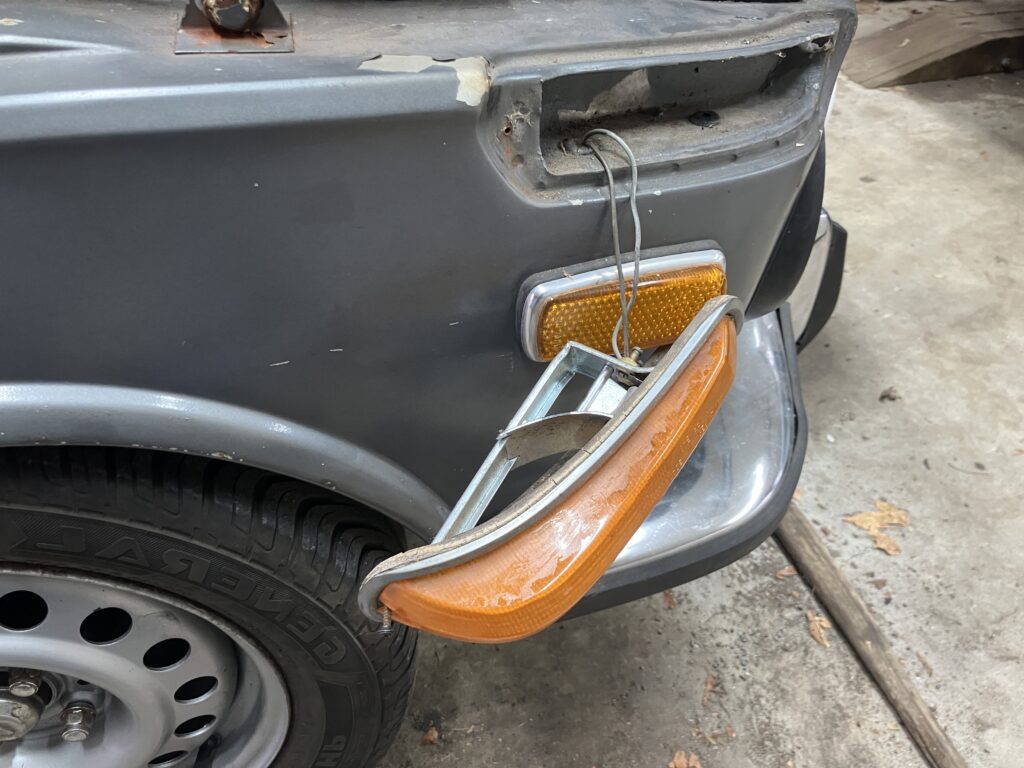
One down, and then back up.
I re-checked the lights and found that now, the left directional wasn’t working. I went through he same rigmarole, but this one had a bigger problem: The curved brass contacts didn’t seem to be making good physical contact with the solder blobs unless I actively pushed the bulb down onto them. I tried to bend them upward, but the bulb itself was in the way of moving them far enough that the deformation would stay.
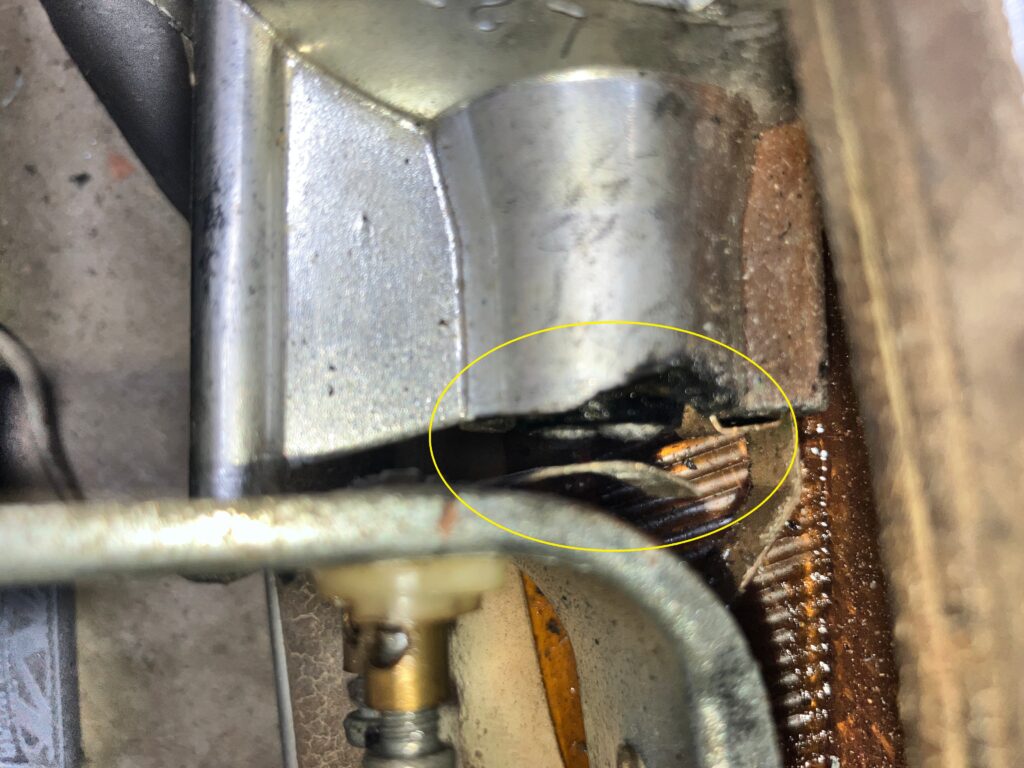
You can see the gap between the contacts and the bulb base.
No big deal, I thought—I’ll just pull the bulb out, then bend the contacts.
I had forgotten what an utter pain in the butt it is to replace these bulbs. It’s not like a 2002 taillight where the top of the bulb is completely accessible. The bulb is blocked by the orange lens of the directional assembly. It’s almost impossible to get three fingers on the bulb to push it down, twist it, and pull it out. You could if you could take the lens out of the metal frame, but it’s permanently attached, so you can’t.
I probably spent an hour and a half on the stupid bulb. Although I could push it slightly down and back up, I could not twist it. I sprayed the stuck base repeatedly with SiliKroil. I tried both a pair of plastic-jawed and foam-jawed pliers on the bulb itself, but neither could reach into the space inside the directional to grab it.
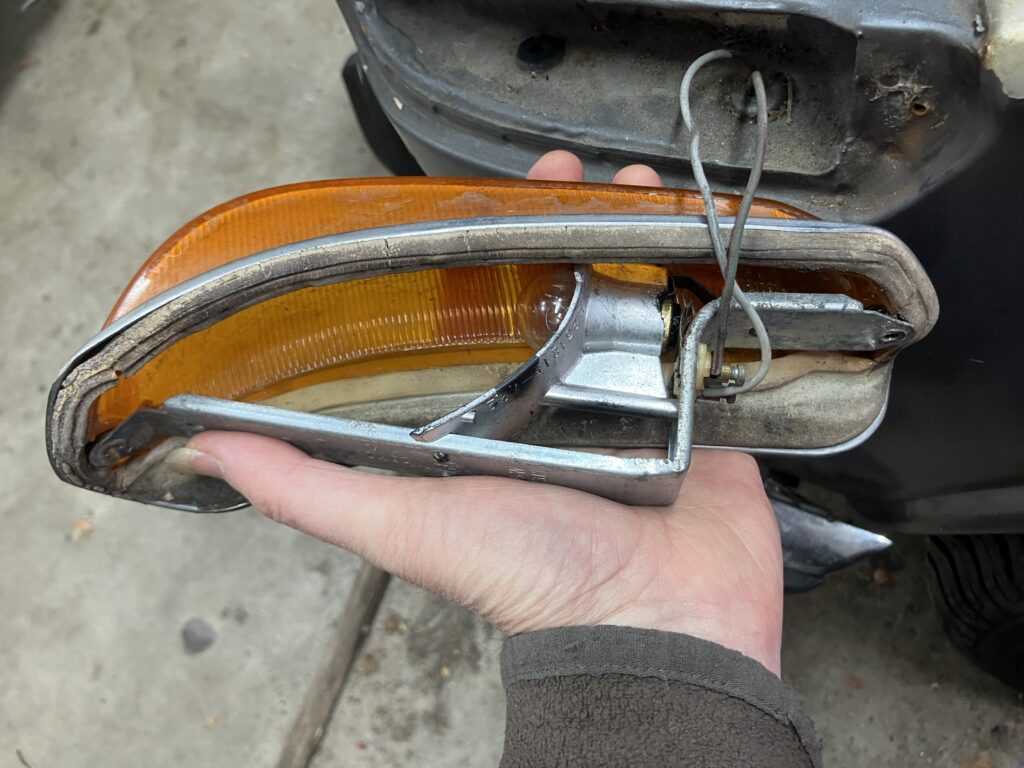
The troublesome left directional. You can see that you’d need to have the fingers of ET to be able to get three of them gripping around a stuck bulb.
Thinking “The hell with this one; I must have another one somewhere,” I dug through a box of old 2002 lighting parts and found several other directionals. One had no bulb. The second was damaged, but had what looked like a good bulb that I could get get out either. The third looked good, but its bulb glass was hanging from the base by the filament wires. And was stuck.
Okay, I thought, all I really need is another two-filament bulb. I can clean up the bulb-less directional, put a new bulb in it, and Bob’s your uncle.
I searched through my garage and basement, and discovered that I probably had twenty single-filament bulbs but could not find a spare two-filament bulb anywhere.
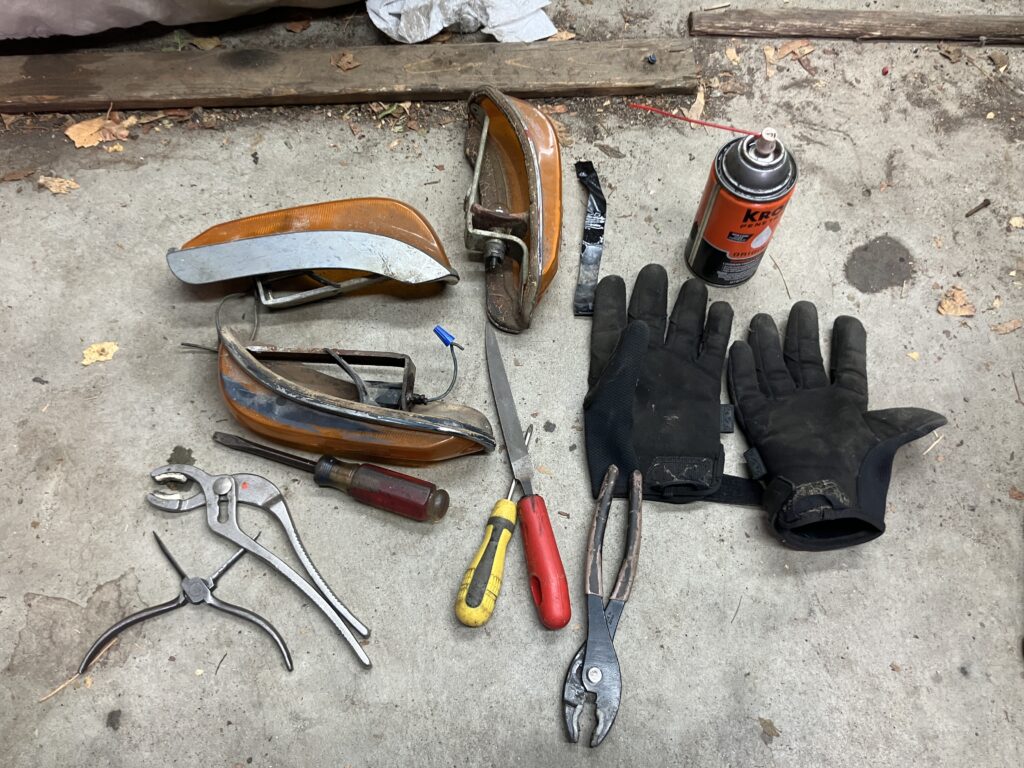
Still life with reminders that the simplest task can turn into hell.
If you’re like me (and you probably are), you get into this mental rut where, rather than taking the 40 minutes to drive to Autozone or to the hardware store and back to buy some bulb or fastener or other part that you need, you keep looking for the thing that you don’t have, or keep trying to fix the thing that’s not working. That was me.
With multiple applications of SiliKroil, finally was able to free the bulb and get it out. That let me clean the brass contacts, bend them up, and reassemble the foolish thing. I screwed it back onto the fender, tested it, verified that it worked, and then drove to the inspection station. Before I pulled in, though, I stopped on a side street to test the directional one more time, just to be sure.
It didn’t work.
Back home I went, took the thing apart again, tested again, fine, back to the inspection station, did the pre-test, and the same thing happened.
Crikey. (Only I didn’t say “crikey.”)
I give up. I need a bulb. I’m an idiot. I should’ve done this two hours ago. Bertha and I had a nice little drive to Autozone where I picked up a two-pack of Sylvania 1157 dual-filament bulbs for about eight bucks.
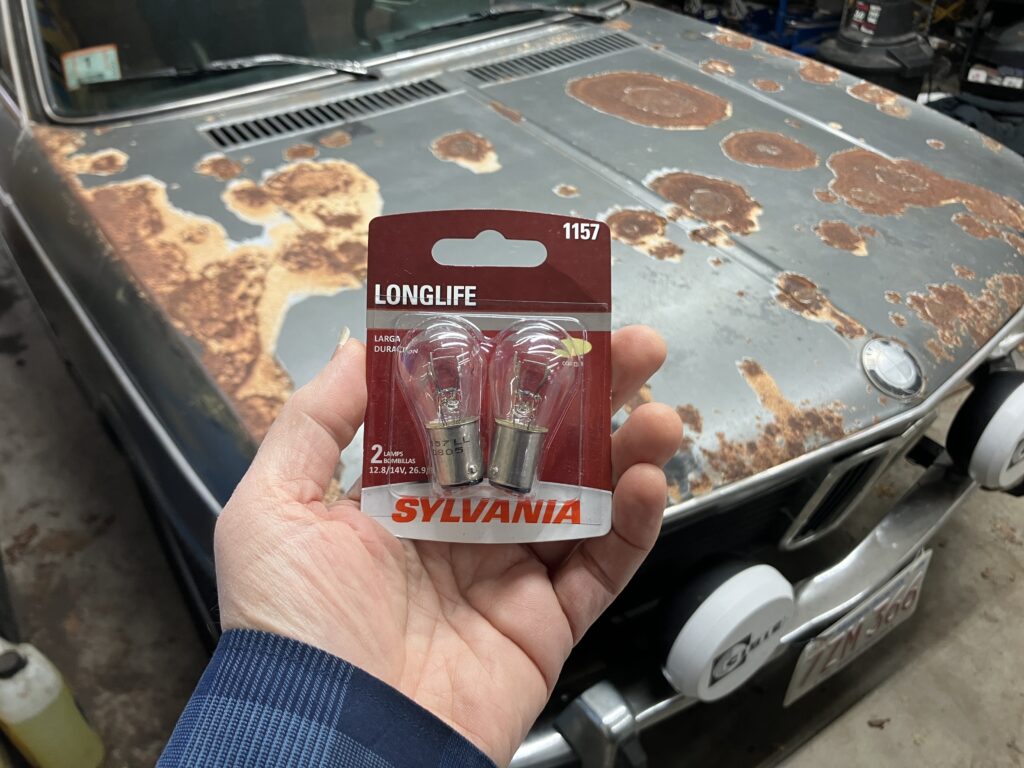
Score.
For some reason, on the drive back home, I decided to pull over and checked the left directional.
It was working.
Inspection. Station. Now!
This is the place I have most of my cars inspected. They know me well, but they’re very visible and on a busy street in Newton, certain portions of all inspections are video’d and monitored by the state, their facility sometimes gets visited by an, uh, inspection inspector (they’ve occasionally waved me off and mouthed “come back later”), and so they don’t have much leeway. When I pulled in in Bertha, I had a flashback to getting the car inspected there right after I’d resurrected it six years ago, the guy stared at it, and gave me this look that unmistakably said “That? You want us to inspect that?”
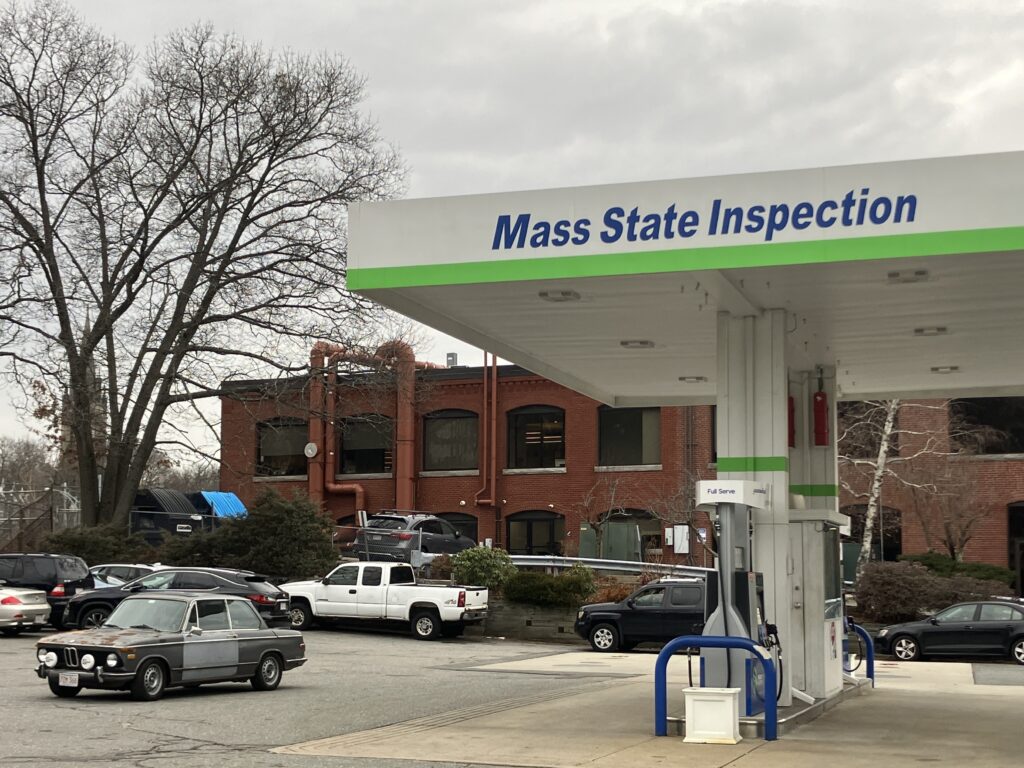
Abandon hope all ye who enter here.
I verified functionality one final time while I was waiting in front of the service station bay door, then surrendered my keys and registration. After I waited for about five minutes, they called me in.
“Your backup lights aren’t working.”
Busted.
“It’s the one thing I didn’t check,” I said. That was true, but I didn’t add “Because I already knew they didn’t work.”
“Do you want the rejection sticker,” the guy began to ask, “Or…”
I expected him to say “Or do you want us to fix it?” That would’ve been a hard “no,” as I don’t want anyone but me monkeying around with the switch on the Getrag 245 five-speed, or seeing the hand-sized rust hole in the floor.
“…or do you want to promise that you’ll fix it?”
I was stunned.
“Yes,” I honestly said, “I promise that I’ll fix it.”
And, with that, Bertha got stickered.
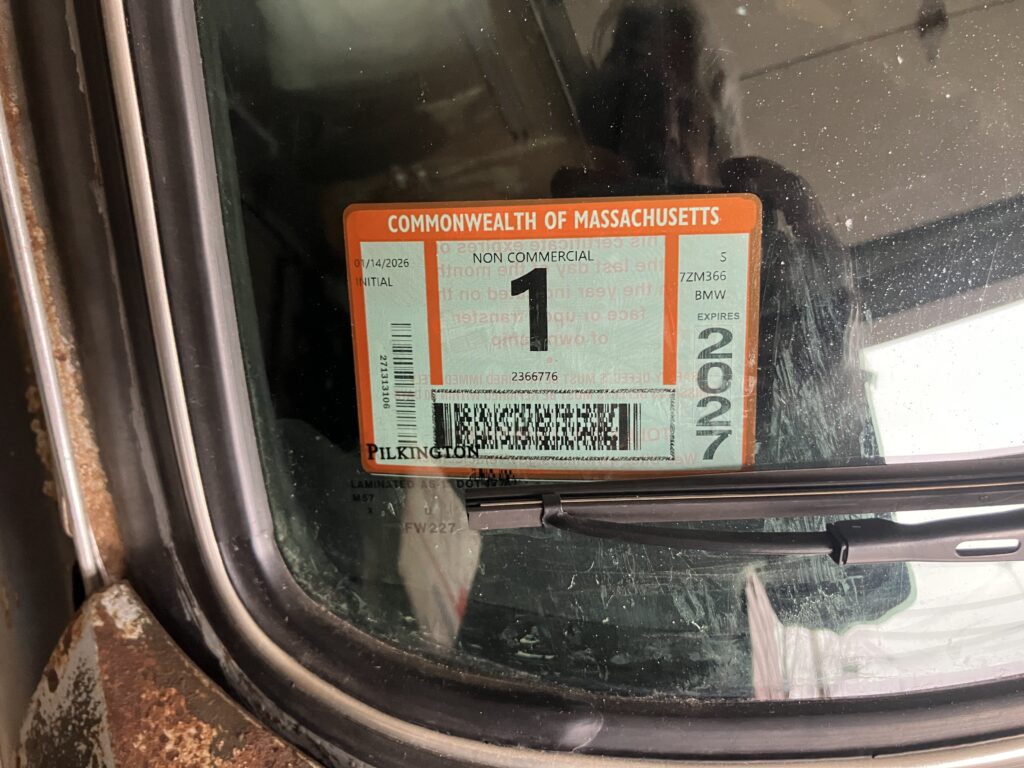
Whew!
So, new winter project: Fix Bertha’s back-up lights. A promise is, after all, a promise.
And I now have a pair of spare dual-filament bulbs.
—Rob Siegel
Rob’s most recent book, The Best of The Hack Mechanic, is available here on Amazon, as are his seven other books. Signed copies can be ordered directly from Rob here.