
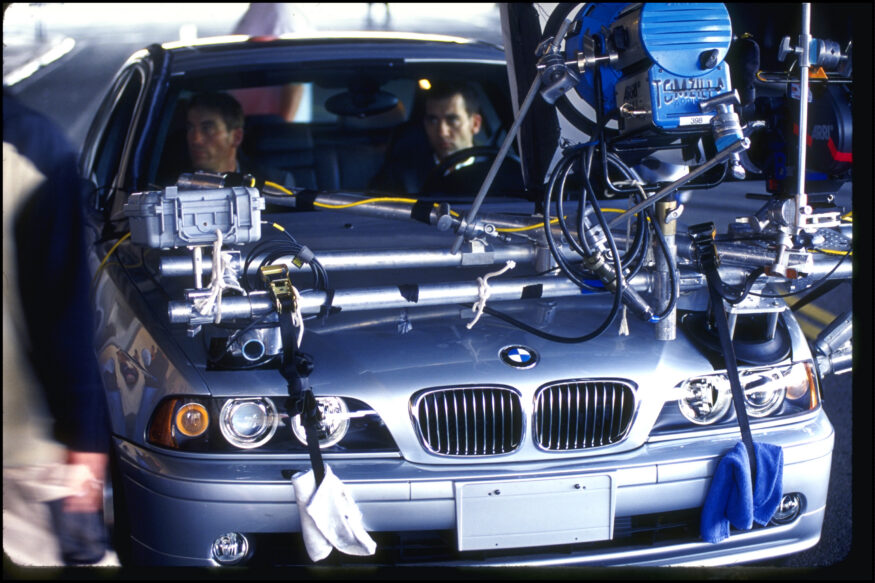
I’m convinced that virtually no one who writes for movies, for television, for publication as fiction, or for any non-motoring outlet knows anything of significance about cars—even their own car. Put gas in it, press the button to start it, keep it on the black stuff between the trees. Look up from the phone occasionally so you don’t hit anything, or at least don’t hit anything square. That’s about all I count on any more, and any competence beyond that is societal gravy. I’ve even stopped complaining about it.
Sort of.
But this lack of knowledge continues to makes me crazy—or crazier, anyway. In the last couple of weeks I’ve been binging on automotive content via streaming services, since Stephanie is up to her eyeballs in book proposals, presentations, and upcoming art shows. She’s professionally engaged, so I have some free time on my hands. I’ve found these automobile-related shows to be generally entertaining, yet often appalling at the same time.
Yes, in the fictional universe, all the bad-ass drivers can drive cars with manual transmissions, but if the writer puts them behind the wheel of a specific car driving a manual, it might be nice to check to see whether that car was even offered with a manual in the real world; I’m looking at you, C8 Corvette. You too, Chrysler 300C.1 And while the writer definitely gets points for having the main characters root around in a salvage yard looking for a Pitman arm, it would help if one of them didn’t claim success and crawl out from under a rusted heap bearing a pristine tie-rod end.2
Finally, if, as a writer, you don’t know the difference between starting a drift with a clutch kick and starting a drift with the handbrake, you may want to figure out whether the car you’ve given your character to drive has a clutch to kick, or a brake that can be engaged by hand. I’m talking to you, P71 Crown Vic.
To be fair(ish), it’s not just cars that get short shrift in the context of fiction; anyone who has specific expertise in any area can get all wiggy when writers screw up the details. One of my friends, a retired airline pilot after a military aviation career, has real issues with almost any flying scene when something unexpectedly goes all cattywampus. His take is that outside of combat, at least three things need to be FUBAR3, and at least two of those things should have set off one alarm or another before the plane turns into a dramatic device or a statistic.
Another friend, a retired FBI agent and firearms instructor, just rolls his eyes during those scenes where no one ever reloads and seems to have an unlimited number of rounds in the clip. Also, how dirtbag criminals have expensive weaponry but can’t afford to launder their T-shirts eludes him, as does their ability to get anywhere near where they need to be for effective use of that weaponry while wearing that T-shirt and carrying that weapon. That oversized duffle bag it’s in? Dead giveaway. Blow-molded case for the sniper rifle? Ditto.
And don’t get me started on the legal idiocy that makes its way to the screen. At least there’s a reason for that. Litigation—civil lawsuits and criminal actions—makes up the vast majority of the fictionalized legal content we see. Here’s a secret which those outside the profession don’t really know, and which those inside the profession rarely talk about: Almost all of the time, litigation is stultifyingly boring. Civil litigation—lawsuits among private parties—is as dull as dirt. (Actually, dirt is probably more interesting.) Basically, civil litigation amounts to a couple of lawyers arguing about money after one or both of them have asked poorly phrased questions of other people, most of whom have a vested financial interest in being something less than forthcoming in response. One of my more jaded colleagues has regularly described it as, “Like being married, but without the sex.” He’s not wrong.
Am I going to be able to change any of this? Can you? Nope, not a chance. Reality is, by and large, mind-numbing, and by its very nature, not well suited to verbatim recitation for entertainment. Which is why fiction is there in the first place; it’s just like real life, but with all of the boring parts left out.
Setting aside the disconnect between the initial idea and the final product, as well as the sheer number of people needed to get that final product to the public—people who just aren’t concerned with those details—it is never going to happen. My being in Virginia instead of LA or New York won’t help, either. On the other hand, despite being in LA for more than 40 years, I can count on no hands the number of times my motoring experience has helped the genre.
Everyone I know in this club and in every other car-related group I’ve ever belonged to won’t—or maybe can’t—shut up about cars. It makes our Significant Others crazy. As I write this, the M2 CS and the Corvette ZR1 have just been released, and Stephanie’s eyes are already more thoroughly glazed than a Krispy Kreme donut. It isn’t even lunchtime yet.
So to change the narrative, maybe we should talk to other people. It may be futile, but at least we might save those we care about from our never-ending motorcentric yammering. Tell yourself that it’s all in the pursuit of truth in media. That’s not completely true, but at least it sounds better that raging narcissism.
- Yes, I know the Challenger Hellcat had a limited number of manuals available. The 300C? Not as far as I can tell.
- Even if said character is unduly attractive with an endearing grease splotch on their cheek. In that writer’s defense, in the context of the show, the vehicle in question actually would have had a Pitman arm.
- Fouled Up Beyond All Recognition