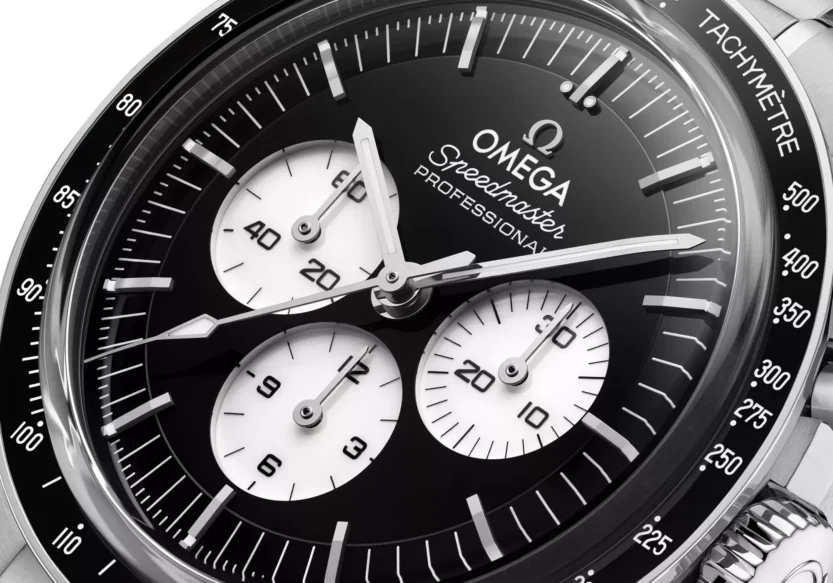
Got a chronograph watch? You know, with a bezel around the outside with numerals running from 60 maybe up to 700? One that says “Tachymeter” on it somewhere? One you paid real money for because of how cool it looks? One that you either have no clue how to work it and even less clue what it’s for in the first place? Get in line. In an informal survey of club members and some guys at a local Cars & Coffee, about half fit into the category of, “WTF is a tachymeter?” The other half, with one exception, knew what it was but had no clue how it worked. Only one guy—a long-retired race engineer for Carroll Shelby—could explain it. And everyone I asked had one on their wrist.
Based on the premise that everyone should know how to use the tools that they have, a little time and attention should make you comfortable. For those of you who as are math averse as I am, you may want to sit down for part of this. It’s not difficult math, but still, no need to risk fainting. Alternately, you just can drive faster to avoid the math. Really.
A tachymeter (pronounced “tack-KIM-uh-ter”) is a feature of most chronographs with a stopwatch that allows you to calculate average speed, distance at a constant speed, or event frequency. Its base unit is 60, which makes a miles-, kilometers-, or anything-else-per-hour calculation fairly simple. Think of that latter ability as the state fair pie-eating calculator.
Let’s do the original speed calculation first, move to distance, and finish with pie eating.
Speed Calculation
For the speed calculation, you need a fixed distance from which to measure. For racing, most tracks have landmarks at fixed distances—generally one mile or one kilometer apart. On freeways, mile markers are used for the same purpose.
- Start the Chronograph: Begin timing when the car passes the first landmark.
- Stop the Chronograph: Stop timing when the car has passed the second landmark.
- Read the Tachymeter Scale: The second hand will point to a number that indicates the speed of the car in units per hour.
Example: If it takes 30 seconds for the car to travel one mile – from the first to the second — the second hand will point to 120 on the tachymeter scale, indicating a speed of 120 MPH. If you’re on the track, nice work. If you’re on the street, you’re probably about to be arrested. Since the tachymeter is based on a unit of sixty, lower speeds can’t be directly measured, but they can be calculated. You know, with math. To calculate, divide the number by the second hand by 2. For example, if the number is 80, divide that by two to figure out your speed is 40.
Distance Calculation
Distance calculations are far more boring as you need to maintain a constant speed of at least sixty for it to work
- Start the Chronograph: Begin timing when the car is at the constant speed.
- Stop the Chronograph: Stop timing when the second hand reaches your constant speed on the tachymeter scale.
- Note the Distance: Where you stopped timing is exactly one mile (or one kilometer) from where you started timing.
Example: If your speed is seventy-five kilometers an hour, you have driven 1 kilometer once the chronograph hand hits the tachymeter value of seventy-five. If you’re driving seventy miles an hour, you’ve driven 1 mile when the chronograph hand hits seventy.
Again, since the tachymeter is based on a unit of sixty, shorter distances can’t be directly measured, but they can be calculated. You know, math again. Here’s the calculation. If your constant speed is 40 kilometers an hour, you double this number to 80 (to get a value over 60) and stop the timer when it points to 80. Now, divide 80 by 2 and the answer is 40. This means that you have traveled 1 kilometer at the point where you stopped the second hand.
State Fair Pie-Eating Calculation
If you want to know how many pies any competitor is consuming per hour, the calculation is fairly simple.
- Start the chronograph: Begin timing as soon as the pie eating starts.
- Stop the chronograph: Stop timing immediately when the first pie is finished.
- Note the second hand: The number it points to on the tachymeter scale will be the total number of pies consumed during the hour, assuming the rate of consumption remains constant.
Example: If it took 45 seconds to finish the pie, the tachymeter reading will be 80, meaning that contestant will eat 80 pies an hour. If the contest is less than an hour, you get to math again. If the contest is 30 minutes long, divide by two, or 40 pies. Fifteen minutes? Divide by four, or 20 pies. Ten minutes? Divide by 6, or 13-1/3 pies.
Yes, you can modestly demonstrate your new-found skills and shame those with timepieces better than your own. Extra points if you can drive a manual and they can’t.