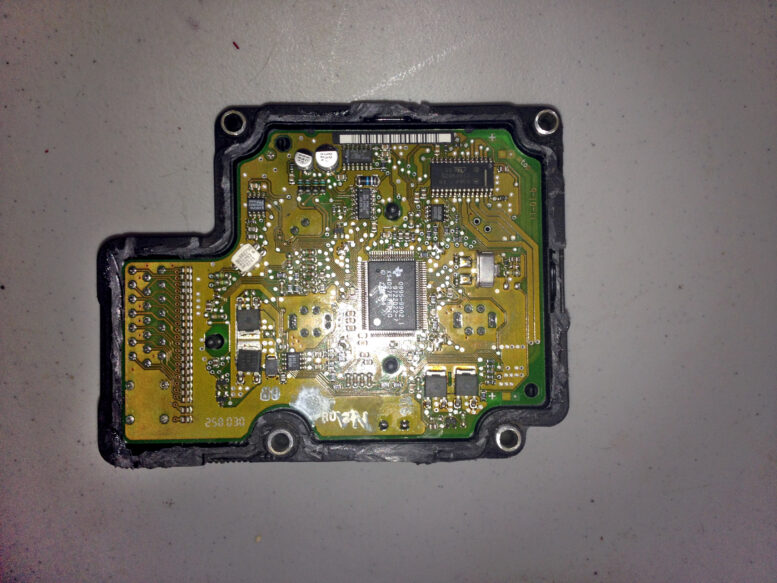
I probably told this story a decade ago when it happened, but I can’t find any evidence of it online, and I’m still largely sidelined with back issues, so…
When I bought my 1999 Z3 2.3 back in 2013, it had been sitting for long enough that the battery was completely drained and the interior was mildewed. I jump-started and test-drove it, and it did what modern cars with multiple control modules often do—it ran for a bit, then all the dashboard lights came on and/or began flashing, began bucking, then died. It was CCA guru Terry Sayther who first explained to me that “they all do that” when I test-drove a dead E34 5 Series with a flatlined battery that did the same thing. Charging systems in modern cars are designed to supply the car’s electronics with accurate stable voltage levels and to keep the car’s working battery charged. They’re not designed to recharge completely-drained batteries. When you try to make them do that, the voltage levels seen by the control modules are often too low, and they wig out, causing the flashing lights and the bucking. Pull the dead battery out, drop a new or freshly-charged battery in, and the problem often goes away.
So I bought the Z3 in this hobbled state for $3000 (which, in 2013, was probably the lowest price for a running intact non-salvage six-cylinder Z3 anywhere in the country, at least according to a web search). The next day, my son Ethan drove me out there with a spare fully-charged battery, I dropped it in, the car started and ran fine, and I drove it home without event.
Except that the ABS and DSC lights remained on.
I knew enough to inspect the wheel speed sensors and verify that none of the wires were torn. I eventually bought a scan tool that was good enough to report wheel speed data, and all four sensors appeared to be reporting.
This was when I was still working at Bentley Publishers, so at some point I borrowed their expensive AutoLogic pro-level scan tool, and sure enough, it coughed up code 071 for failure of the ABS pump. I learned that if you take the car to a dealer, they charge you thousands of dollars to replace the entire ABS pump and the control module bolted to it, but I read up on the problem on forums and learned that the pump itself is usually fine, and that the culprit is usually the control module which is easily detached from the pump and rebuildable for a reasonable cost by aftermarket vendors.
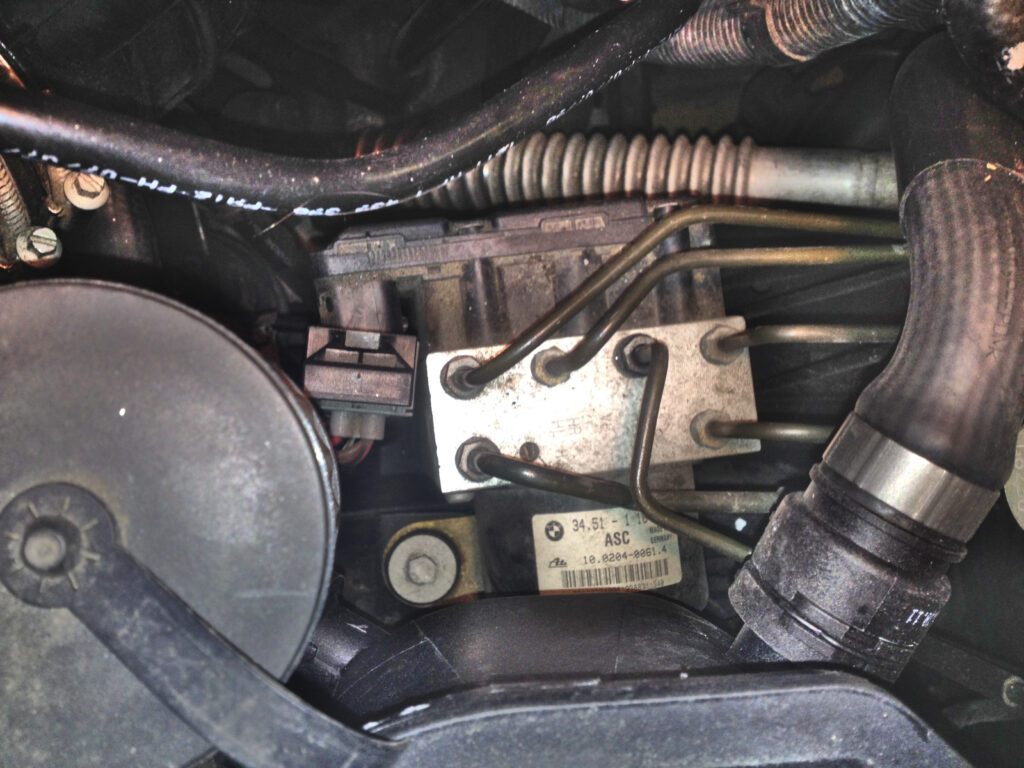
The ABS pump and control module down inside the engine compartment.
I drove it that way until the previous owner’s inspection system expired and I needed the ABS lights to be out for it to pass. I found that, by removing the big electrical connector and four E5 Torx-head bolts, the module pulled right off. I then covered the exposed face of the pump with a plastic bag and zip-tied it in place.
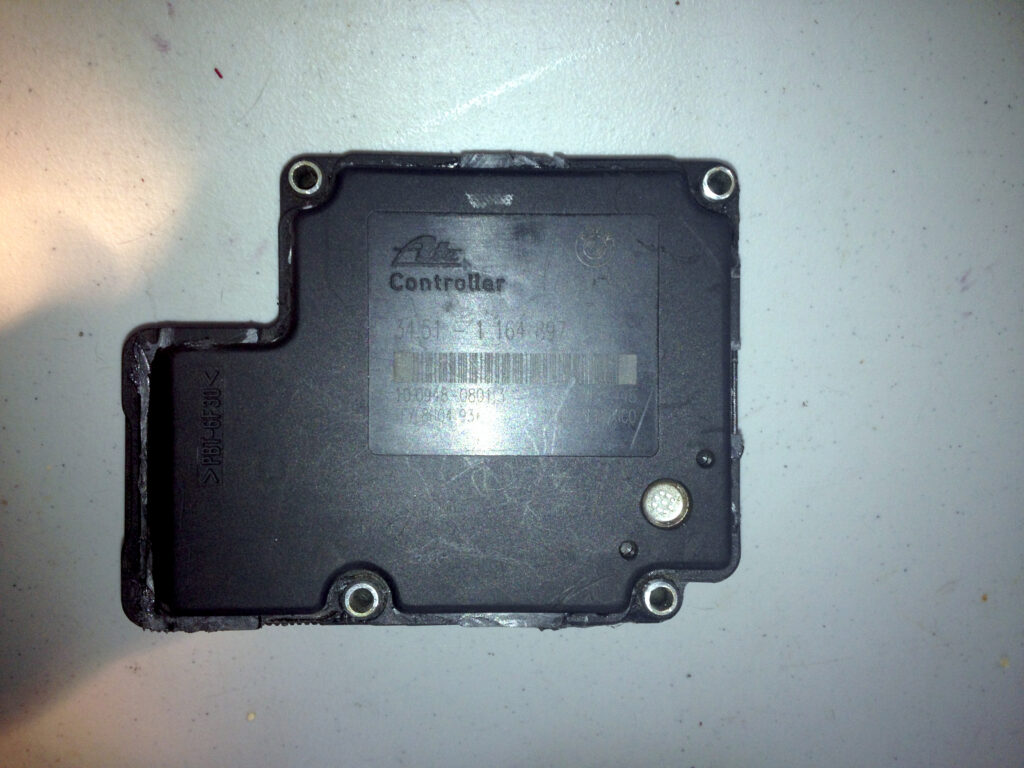
Pulling this off was way easier than I expected.
Although it was only a few hundred bucks to send the module off and get it rebuilt, I learned that this module was a fairly simple one, manufactured by ATE and shared with Volvos. And the Volvo forums reported that the failure was usually due to cracked solder joints that could often be seen with the naked eye and the solder reflowed.
Once you open the thing up, that is. And that’s not easy because it’s designed not to be opened. It’s not like there’s a seal or gasket. There’s nothing. Reading the forums, I learned that people use utility knives, hot knives, and Dremel tools. I found a video of a fellow doing the latter, and went all-in. It was a crude ugly hack. Which is to say, it was just my speed.
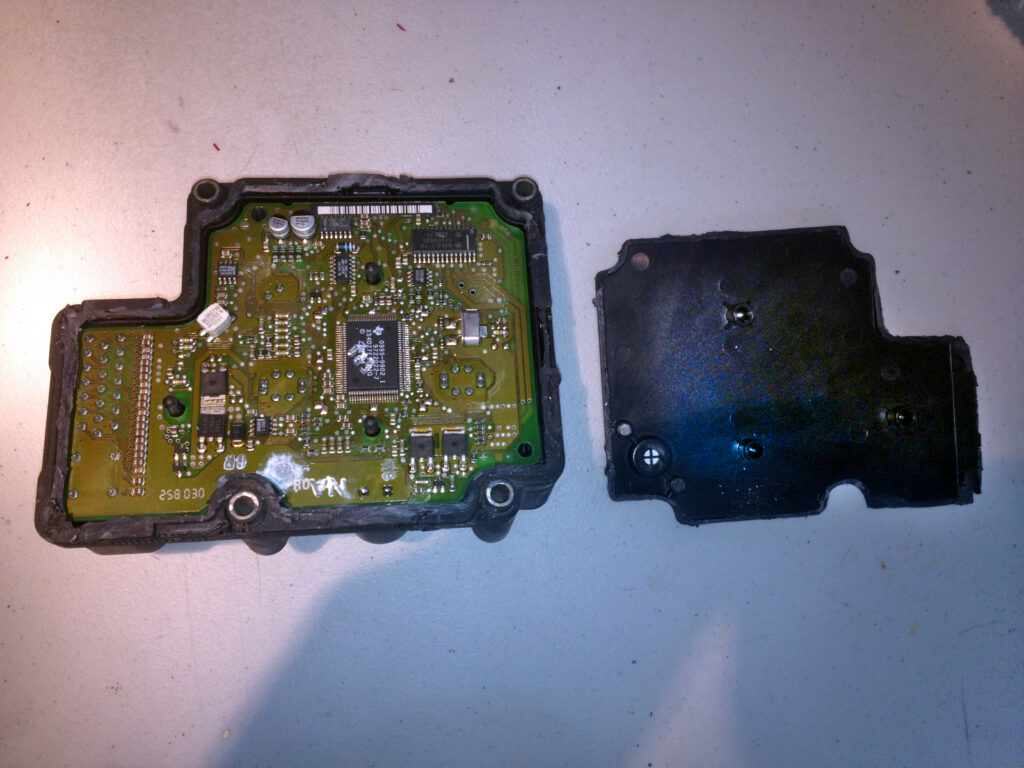
Gutted like a fish.
I found post on a Volvo forum that did a very good job showing exactly which joints tend to crack (the ones leading to the ABS pump). Armed with this intel, I carefully looked at the solder joints with a magnifier. Sure enough, I saw two of them that were cracked, looking a bit like petals on a flower. You can’t see the cracks in the pic below, but these were the joints.
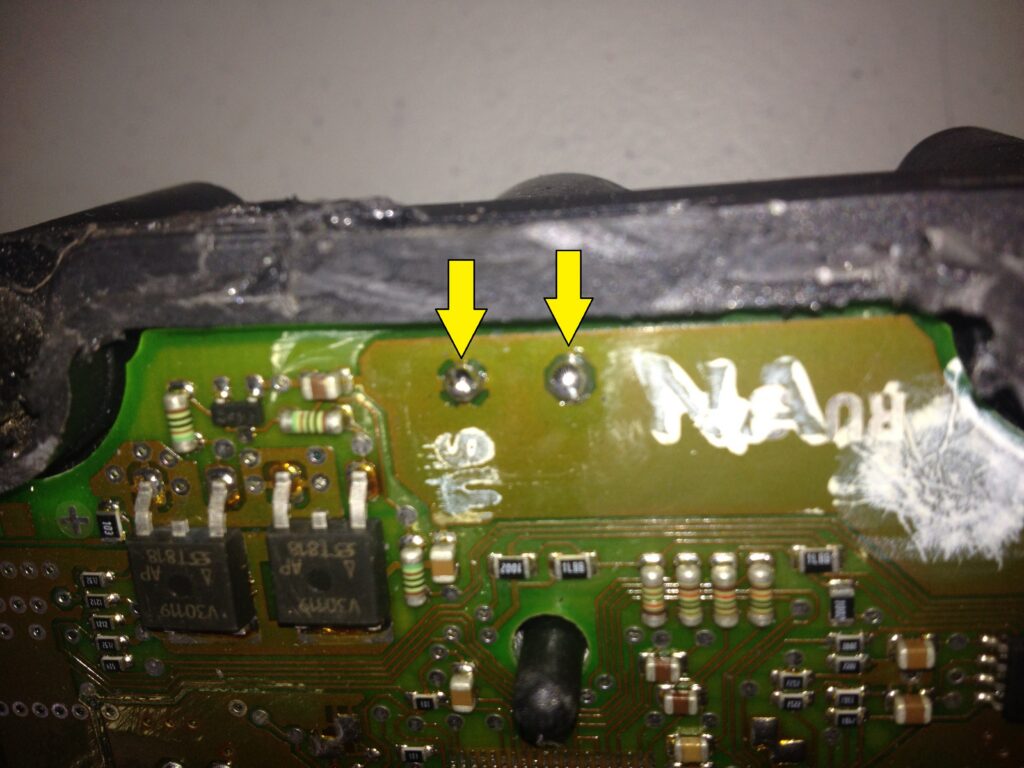
The two cracked solder joints.
I used my soldering iron to carefully heat up the joints and reflow the solder, adding a dab of new solder for good measure.
One of my Hack Mechanic tips is to verify a repair as soon as possible (for example, if you’re replacing the blower fan in a 2002 heater box, connect it to a voltage source on the benchtop to verify the fan spins without interference, then do it again once the box is installed but before you reinstall the console and everything else you took out). So in this case, with the top still cut off the control module, I carefully installed it on the ABS pump, put the bolts in, attached the connector, fired up the car, and was bummed to see the ABS and DSC lights remain on.
But then I remembered that, with ABS errors, there need to be a bunch of wheel revolutions for the system to see valid data and reset itself. All of this was actually happening during the winter, so I taped a baggie over the exposed module and drove the car down the street. After about half a block, both lights went out. Booya!
The remaining task was to seal the module back up. Videos and forum posts showed people using RTV and silicon, but I opted for hot glue. In copious quantities.
This was 12 years ago. It’s still in place today.
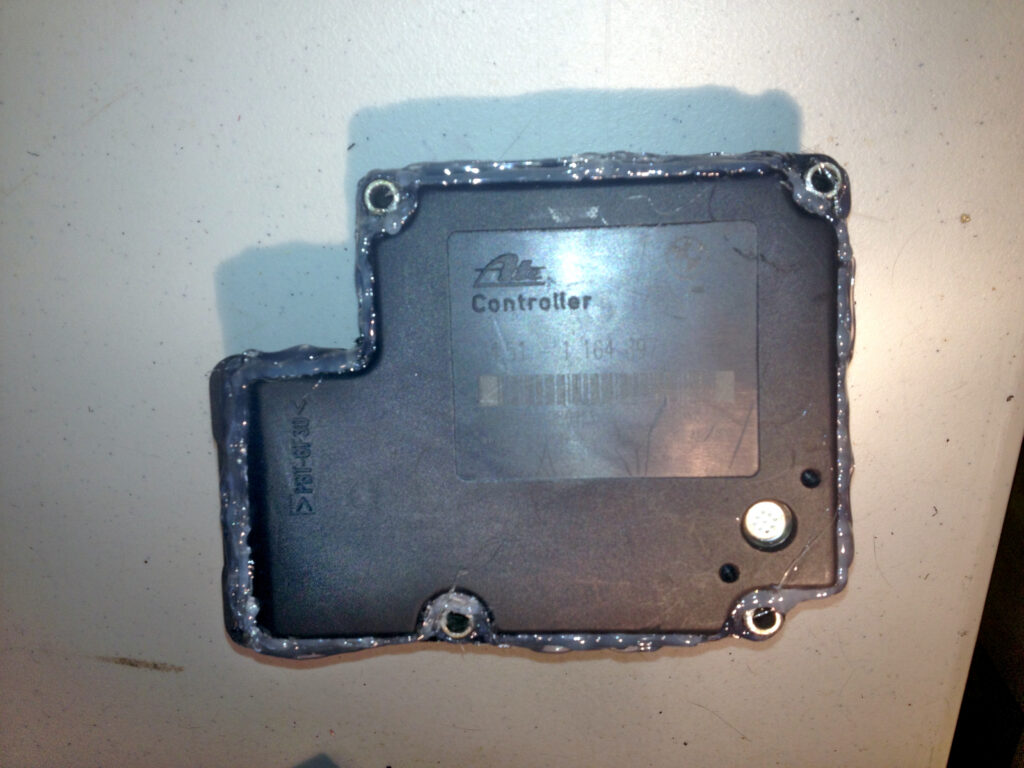
Hot glue to the rescue.
Years later, I had the same issue on my E39 530i, and thought I’d try the same trick. Unfortunately, when I cut open the module, I found that its circuit board was different: It was much smaller, encased in some sort of goo, connected by thin gold wires, and I couldn’t see the two big obvious joints that I did on the Z3’s ABS module. I found Auto Truck and Electronics (ATE) on eBay. I contacted them first to be certain they’d take on a module that I’d already cut open, but for $150 plus shipping both ways, they repaired it, sent it back to me quickly, and it solved my problem. I was a happy customer.
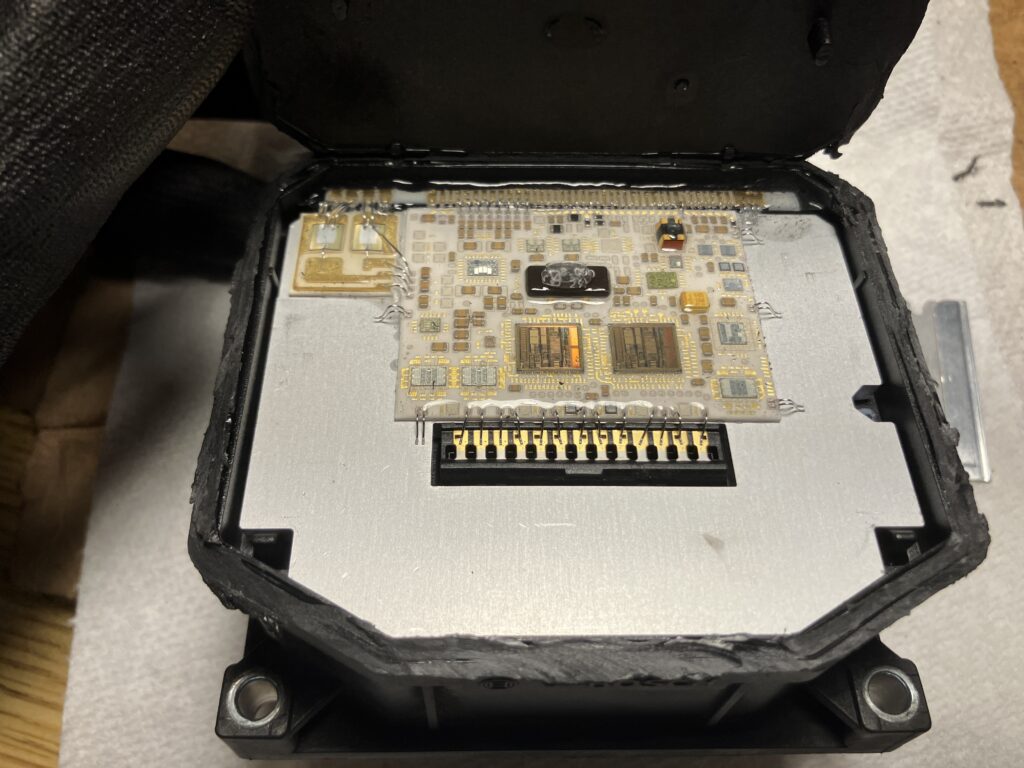
How automotive nature says “don’t touch.”
This summer marks the 50th anniversary of when I bought my 1970 Triumph GT6+, which means I’ve now been working on cars for 50 years. Like may people, it all started with being broke and needing to fix my car myself because I couldn’t afford to pay someone else to do it. Over the years, that morphed into doing anything to avoid taking the car into a dealer. These days, with things like failed ABS control modules or the unreadable display in the E39’s instrument cluster, I’m really perfectly happy to save one big chunk of money by removing and installing the thing myself and a second big chunk of money by sending it to a rebuilder instead of having a dealer perform a cash-ectomy by charging me for both. So considering that the Z3 ABS module repair cost me absolutely nothing and completely restored functionality (that is, it’s not like I figured out how to bypass the ABS warning lights simply to get the car through inspection), it may have been my favorite Hack Mechanic repair ever.
—Rob Siegel
____________________________________
Rob’s newly-expanded book The Best Of The Hack Mechanic™: 40 years of hacks, kluges, and assorted automotive mayhem, is available on Amazon here. His other seven books are available here on Amazon, or you can order personally-inscribed copies (including the new Best Of) from Rob’s website, www.robsiegel.com/books.