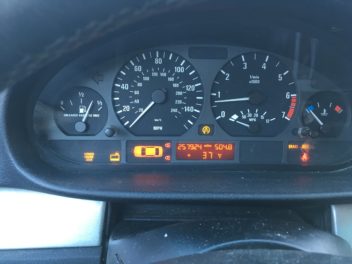
Last week, the Bosch alternator in my daily driver 2003 E39 530i died due to a broken brush on the voltage regulator I’d installed in 2022 when it died the last time (and this time looked like it trashed the slip ring). I was all set to buy a new SEG alternator from FCP Euro for the overstock price of $240, but overnight the overstock price went away and I was looking at almost a hundred dollars more. So I instead bought what was advertised as an 81,000-mile Valeo alternator from a 2001 Z3 at a local salvage yard I’ve used before. I drove out to central MA, grabbed it for $100, and was about to install it when I had the epiphany that it’d never be easier than now to pull the back cover off it, lift out the voltage regulator, and inspect the brushes and slip rings. I did, and what I saw sure didn’t look to me like an alternator with 81k on it. That surprise was followed by a sucker punch—the going cost of a new Valeo regulator was about another $100. I elected to button the alternator back up and install it to make sure that it worked and make the car mobile again. I did, and it did, and it was.
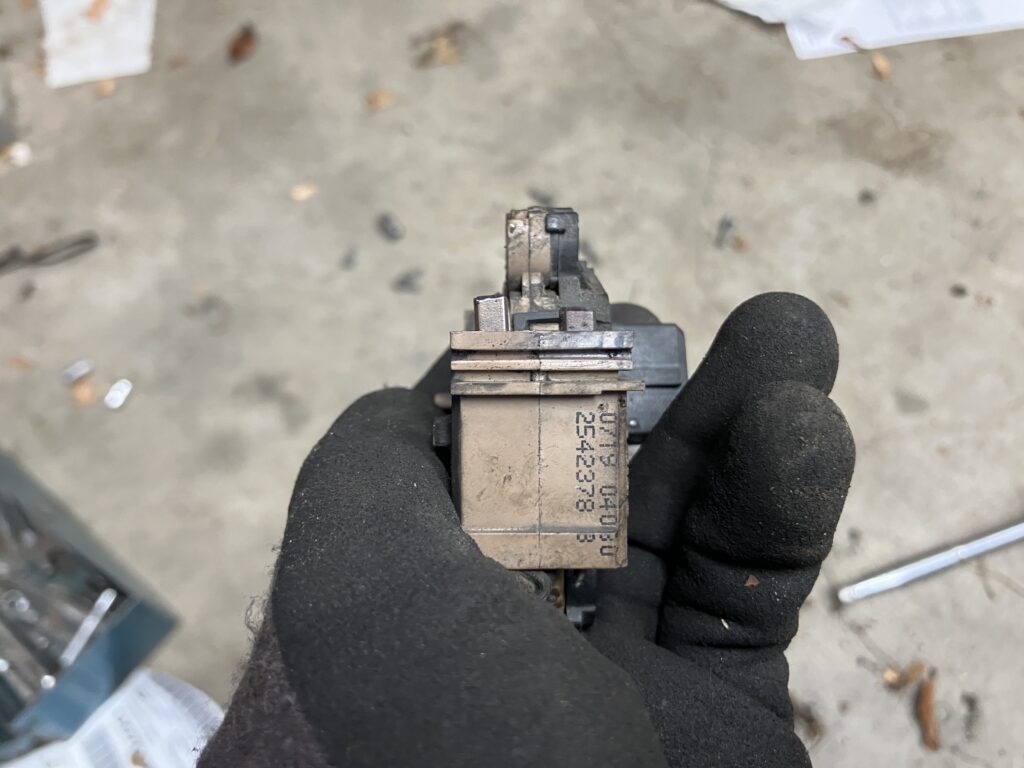
81,000 miles? I am dubious.
Getting the car running again for a day’s work and a hundred-dollar alternator wasn’t a bad outcome, but with this now being the second time I’d been stranded or nearly so by a non-charging alternator in this car, I really didn’t want it to happen again. I usually ridicule people when they say “I don’t trust the car anymore” (my mental response is “So fix it and then you’ll trust it again”), but I’ll admit that I was a bit spooked by the fact that a) the alternator died with Maire Anne in the car with me, and b) a few days prior, I was about to drive the car to New York, and only changed my mind at the last moment due to weather.
So, as I mentioned last week, I searched for a better price on the Valeo regulator, and found it at AutohausAZ for $79 shipped. It arrived a few days before New Years, but we had company over the holidays, so it took me a while to install it.
During that pause in the work, I gave some thought to this issue of what it means to not trust a car even after you’ve fixed it. Granted, this was a self-inflicted wound, but my feeling this way is unusual. When I road-trip the old cars to The Vintage, I’ll typically pack a spare alternator. Why? Because they do break, I have a spare one, and on old cars, they’re easy to replace. I began to think that maybe I should simply do that with the E39. That is, the used Valeo alternator with the worn brushes was already installed and running. Why not just leave it there and pack the new regulator in the trunk? Although replacing it isn’t the five-minute job it is on a E24, E28, or E30 (literally two Phillips screws), it’s doable at a rest stop. Or (or maybe “and”), why not just buy a second used spare alternator? That way, if the car dies on the road and you’re not able to swap the alternator yourself due to cold weather and lack of a place to work, any repair shop could swap it in for you.
The more I thought about it, the more I realized that this was stupid. I’d bought a part (the used Valeo alternator) that I didn’t entirely trust, and I then bought a second part (the new Valeo regulator) to, if not eliminate, at least mitigate that lack of trust. I’d be an idiot to be driving around worrying that it was about to die instead of just taking the 30 or 60 or even 120 minutes in the comfort of my garage to install the new regulator.
So, after New Years, that’s what I did.
I first need to make room. The combination of winter, a garage packed with enthusiast cars, and needing to do work on the daily driver is always problematic. Plus, the old cars are sitting with 20W50 oil in them. And some of the carbureted ones don’t rouse easily in the cold. I really hate to fire them up only to move them 40 feet, but I had no choice. Bertha my ratty 2002 was in the space nearest the roll-up door. Fortunately, despite the dual Weber 40DCOEs and the Iskendarian 300-degree cam, the car is surprisingly easy to start, even in winter. Connect the battery, choke it, stab the pedal a few times, and it rises. I hated to put the old girl outside, but it wouldn’t be there long.
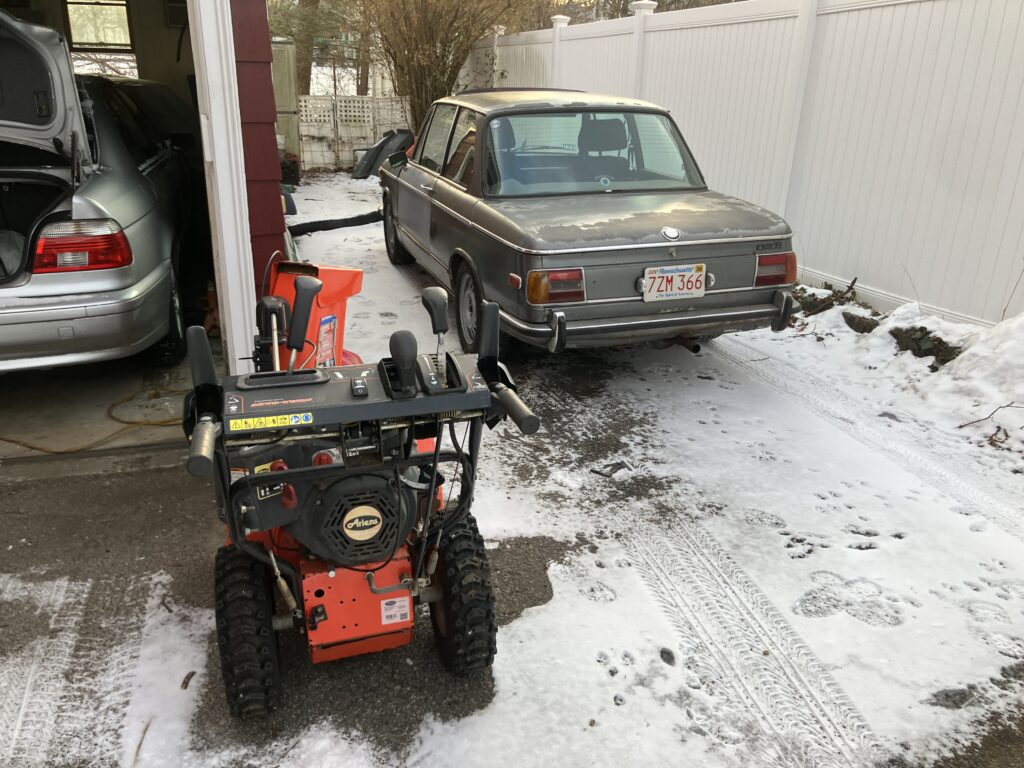
Don’t call the Society for the Prevention of Cruelty to 2002s just yet. It’s only temporary.
Next, there’s the issue of fitting the E39 inside. The garage is 31 feet long. Two little cars, like two 2002s, or both vintage Lotuses, easily fit nose to tail. While I don’t think of the E39 as a big car, it is quite a bit longer than the tiny old ones. I have my ’69 Lotus Elan +2 sitting over the mid-rise lift with its nose just inches from the back wall of the garage. I pulled the E39 as close as I dared to the tail of the Lotus, and looked at where its butt was relative to the garage door. It just made it.

Yes…
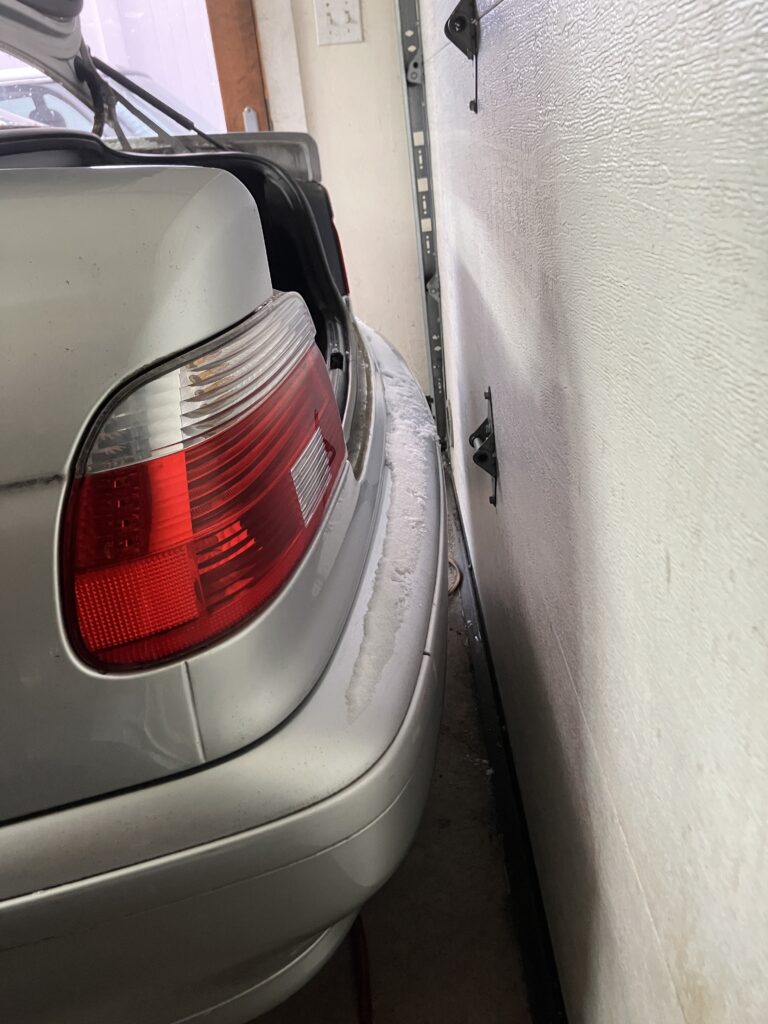
…and yes!
Having removed the broken Bosch alternator and installed the Valeo just last week, I felt like I could do this in my sleep. Oh—why not just install the new regulator with the alternator in place? I should add that, during the previous removal, I’d discovered that the idler pulley had more play than I liked, and had ordered a replacement. Since the pulley is held in by one of the two 16mm bolts securing the alternator, when you remove the pulley, you’re just one bolt away from removing the alternator, so it made sense to pull it and replace the regulator with it out.
So, disconnect the battery, yank the airbox, undo the connectors to the alternator, relieve the tension on the serpentine belt, undo the two 16mm bolts, out it comes. Again. It couldn’t have taken me more than 15 minutes.
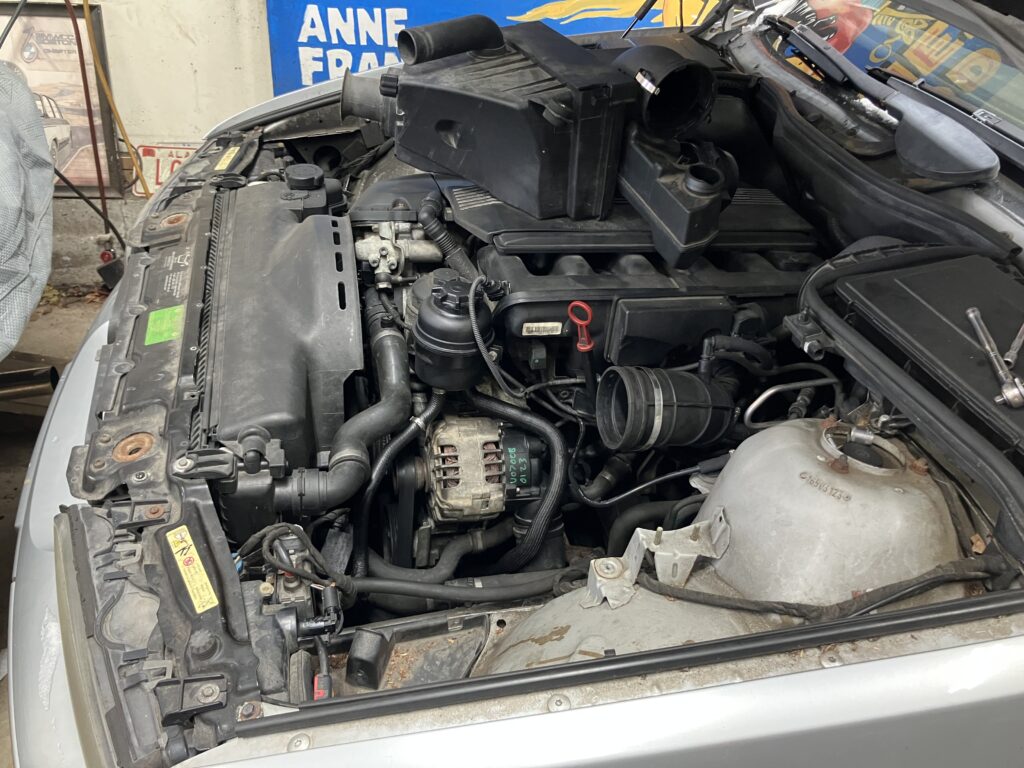
To quote CSN, we have all been here before.
As I said last week, the Valeo is a little different than the Bosch. The back cover is held on not by Phillips screws and a large nut but by three screws with 7mm heads.
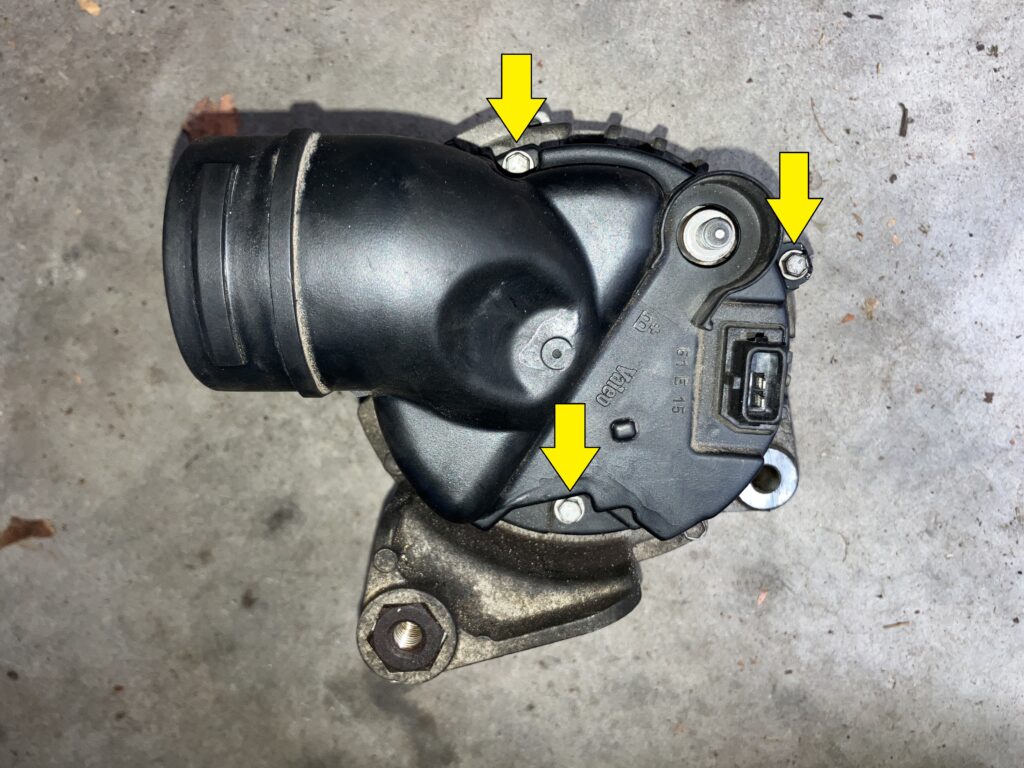
Easy enough.
The regulator is also held in by three 7mm-head screws, but unlike the regulator on the Bosch whose brushes slide inside to make contact with the slip rings, the slip rings on the Valeo protrude out the back, and the regulator has a cylindrical dust cover (arrow below) that protects them and the brushes. With mileage, the brushes wear grooves into the slip rings, so if you pull the regulator straight up, you risk cracking the brushes. Because I didn’t know this, I did pull it straight up last week when I wanted to examine the brushes, and since the regulator in the Bosch died because it had broken a brush off, this specter of failure was in my mind, and was one of the reasons why I wanted to replace the regulator with a new one.
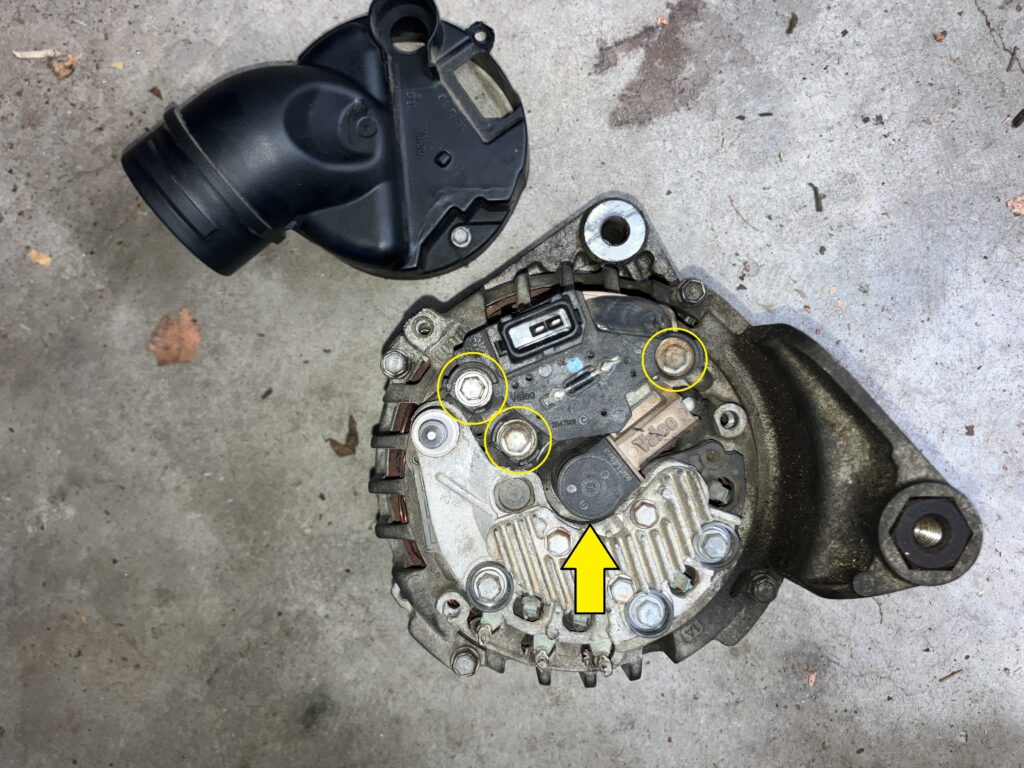
Careful!
When I unboxed the new regulator and looked inside the dust cover, the brushes weren’t visible. I didn’t understand what I was seeing.
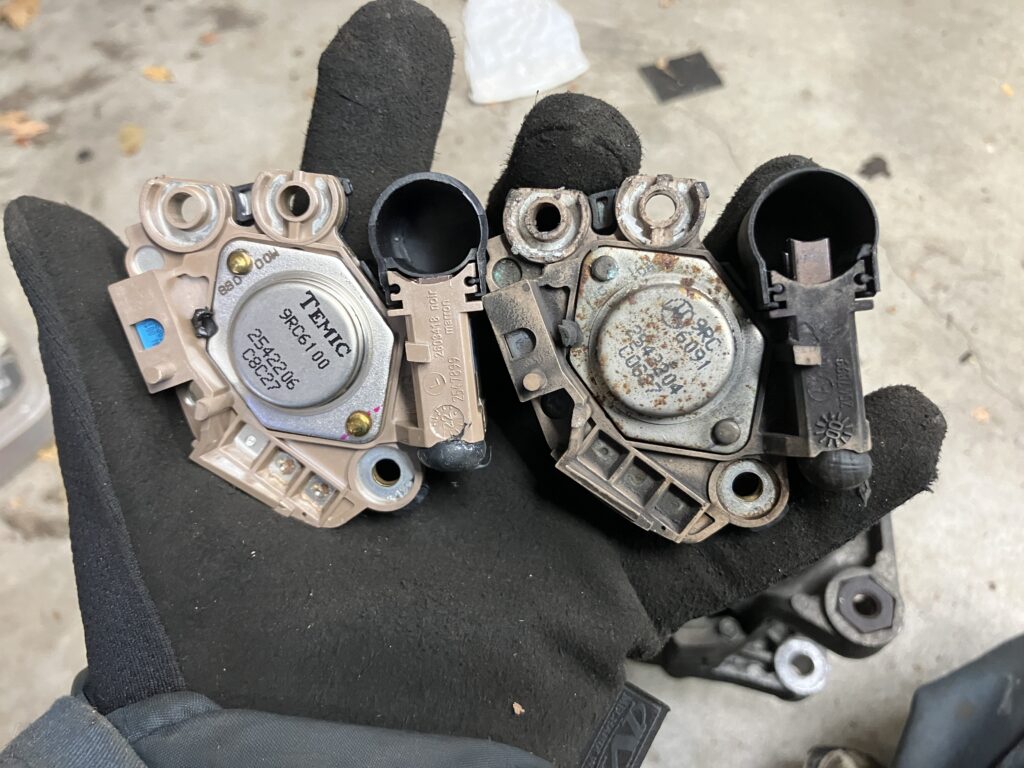
New (left) and old (right) Valeo regulators. Whaaaat?
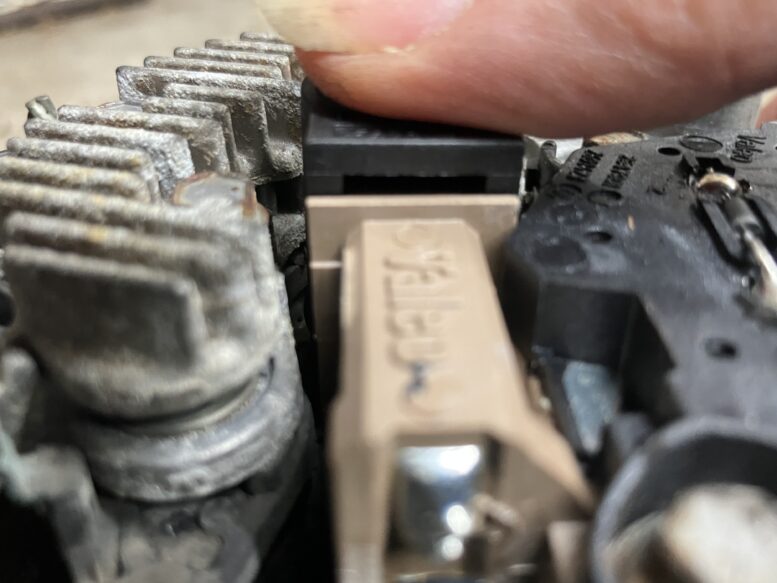
But when I looked closer, I saw a clever bit of design that addressed the possibility of cracking the brushes: The inside of the dust cover had slots in it for the brushes, and was shipped with the cover slid upward so the edges of the slots held the brushes in a retracted position. What you clearly needed to do was mount the regulator, and then push down on the top of the dust cover to allow the brushes to be pushed forward by the springs behind them and contact the slip rings. I was surprised that it came with no instructions to this effect. I can easily imagine someone installing it, not knowing you needed to do this, and reassembling everything only to get a no-charge result.
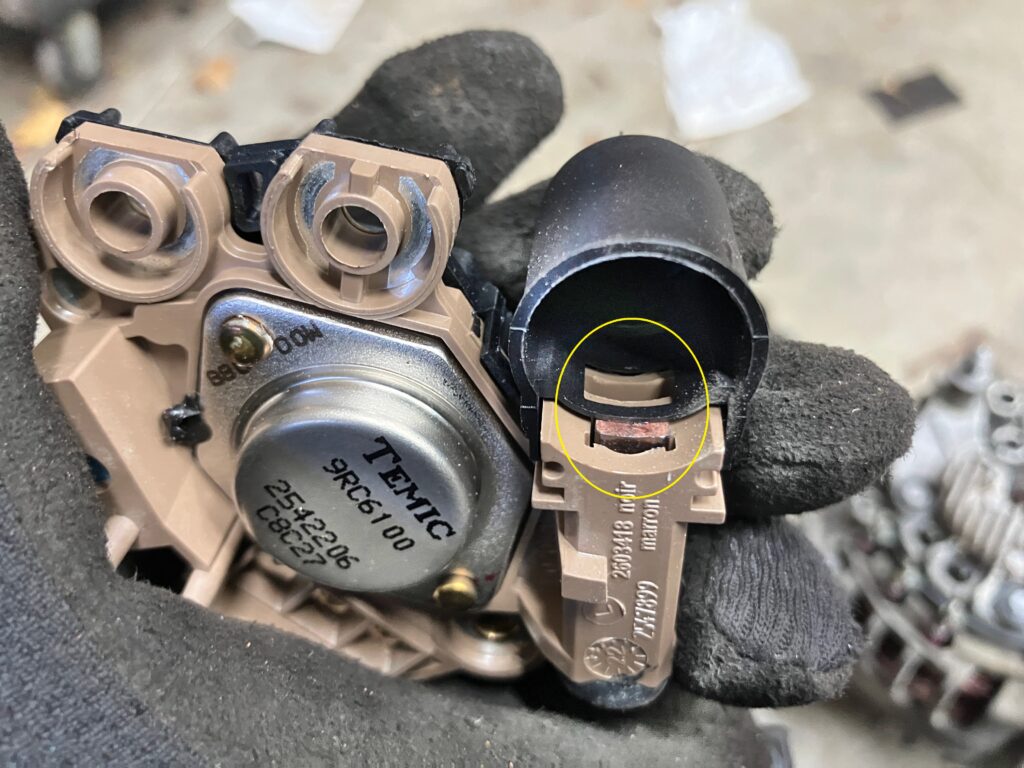
A-ha!
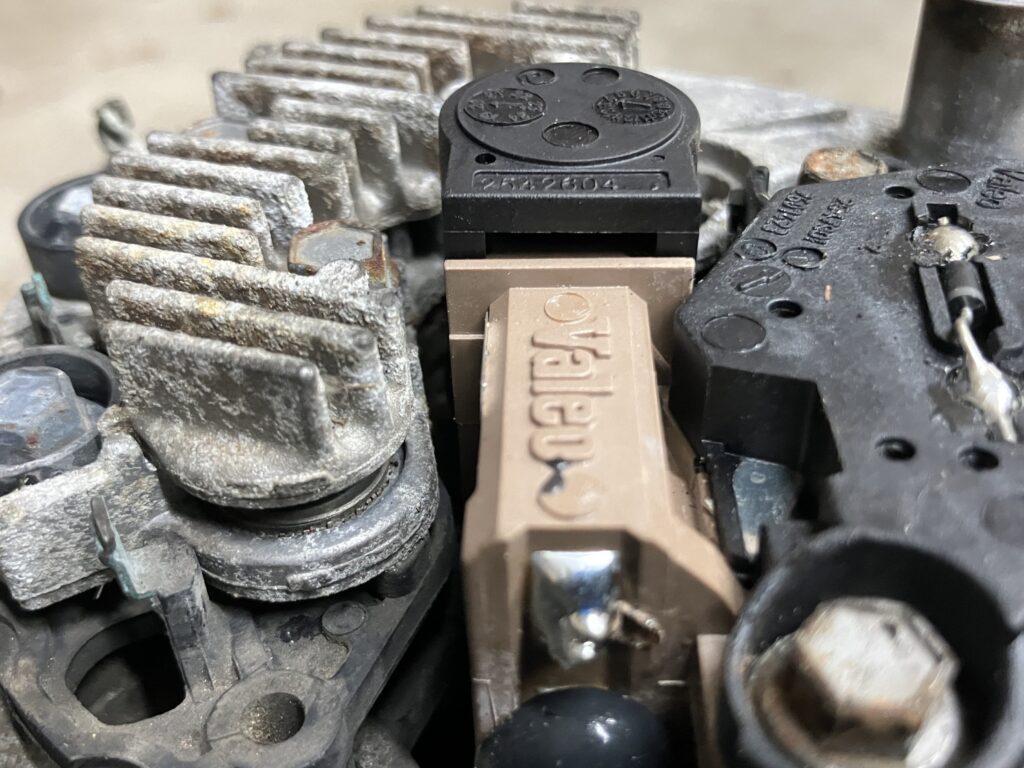
Before the thumb treatment…
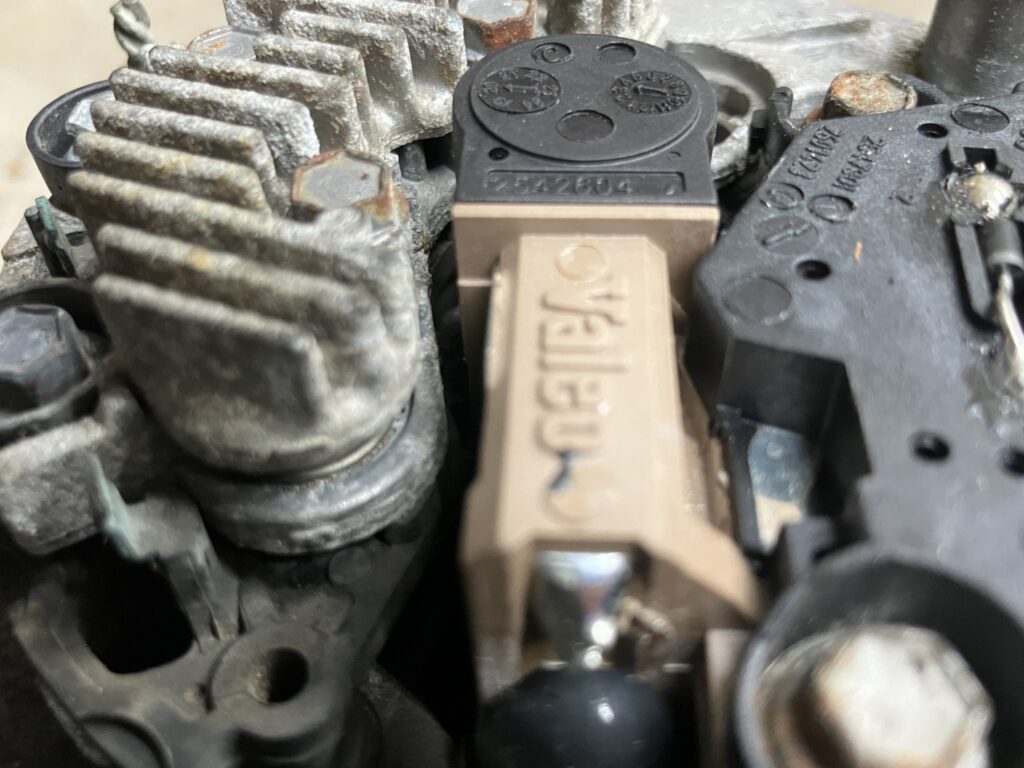
…and after.
I’m including a lot of detail here, but the voltage regulator replacement couldn’t have taken more than 10 minutes. All that was left was to reinstall the now hopefully-more-trustworthy Valeo back into the car, along with the new idler pulley.
And then my morning repair session ran into molasses. De-tensioning the serpentine belt to pull the alternator is easy, but I often find it much more challenging to get the belt back on due to the lack of clearance and visibility. It really needs to sit exactly in the grooves of the crank, power steering, and fan pulleys while you work against the tensioner to slip it over the alternator pulley. I had to jam a variety of pieces of wood between the pulleys and the fan in order to keep the belt in place. This step alone probably took me half an hour.
Also exasperating was getting the air box back in. The big rubber boot has two ports on it. The large one is held to the air-mass sensor with a clamp, but the smaller one underneath snaps onto a ridged port on the rear-pointing extension of the air box. I reassembled all this with ease last week, but for some reason, this go-round I had the toughest time getting the rubber to snap over the ridge and seat on the port. This is important because since this port is between the air-mass sensor and the intake manifold, a lack of seal here would be a huge unmetered vacuum leak.
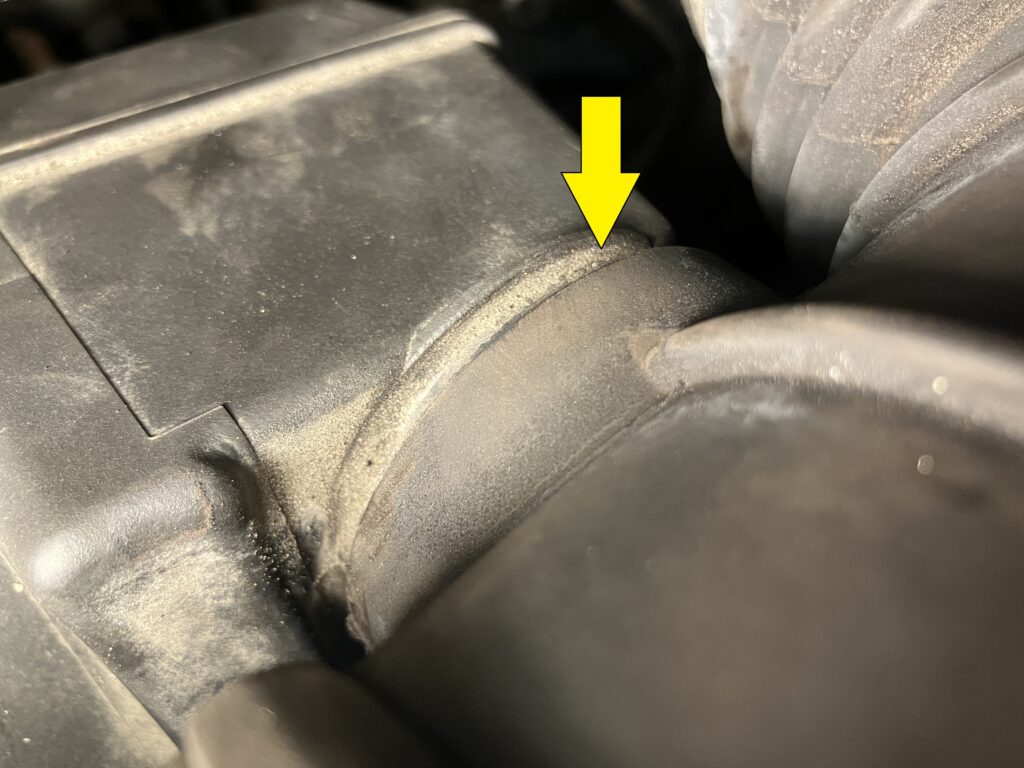
Note how the boot isn’t completely seated here.
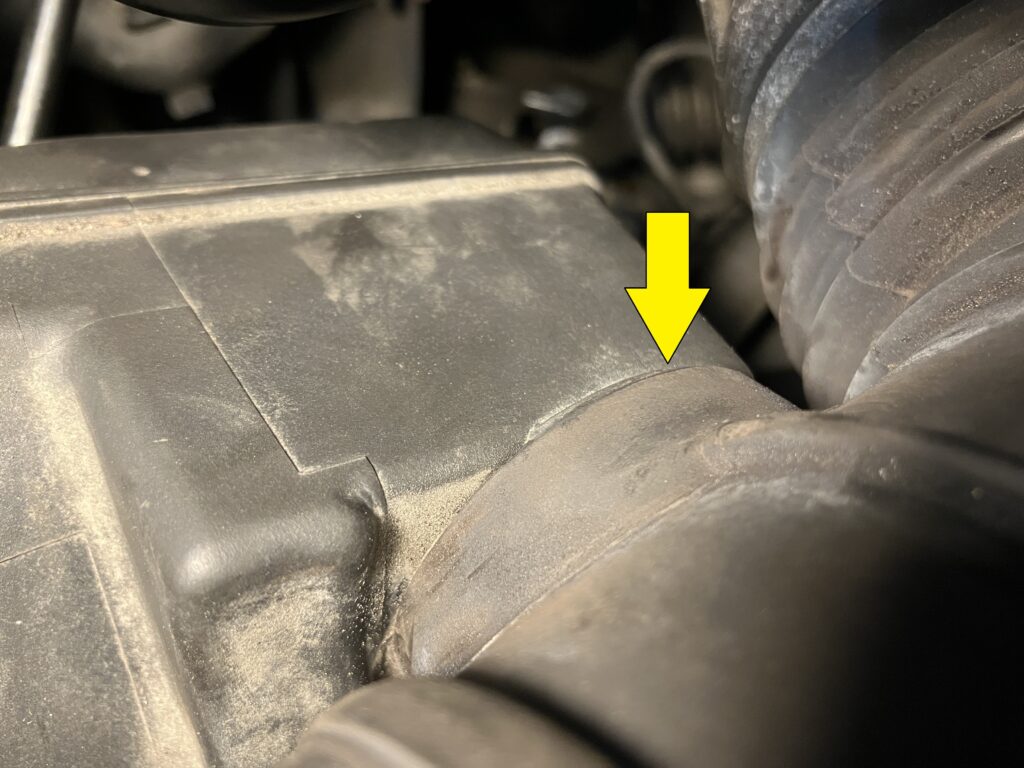
That’s how it should be.
I didn’t photograph it, but compounding the difficulty of the airbox reinstallation was the fact that I’d been running without the thick rubber o-ring between the box and the air-mass sensor. Since this is before the sensor, not after it, the missing o-ring doesn’t create a vacuum leak, just a possible unfiltered air leak, but a while ago I’d ordered the o-ring so I could have it around, and had forgotten to install it last week when I had the alternator out. The new o-ring was not just thick, but also stiff (*chortle*), and getting the air-mass sensor back in place and seated was surprisingly time-consuming.
With the car buttoned back up, I reconnected the battery, started it, and verified the presence of 14.2 volts with the engine running.
Installing the new regulator took longer than expected, but it was done in a morning, and now I won’t worry about it. Plus, because it was a surprising pain in the butt, I feel like I clearly called the whole “or I could wait for it to break and just replace it at a rest stop” thing correctly.
But if this thing breaks and strands me, I’m going to be pissed.
And I did put Bertha back in the garage. I’m not a monster :^)
—Rob Siegel
Rob’s new book, The Best of The Hack Mechanic, is available here on Amazon, as are his seven other books. Signed copies can be ordered directly from Rob here.