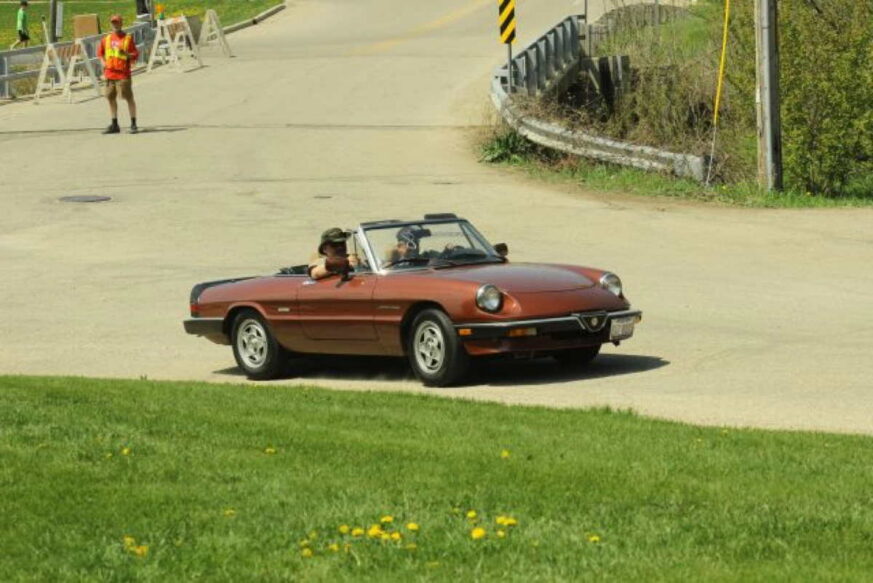
The paradox of restoration was rattling around my brain the other day. This neuronal ricocheting of appreciation and curiosity was triggered by an event that has become a May ritual for me, the first non-avian sign of spring, the Alfa Romeo Club Hill Climb in the quirky Wisconsin town of New Glarus.
By Dave Farnsworth
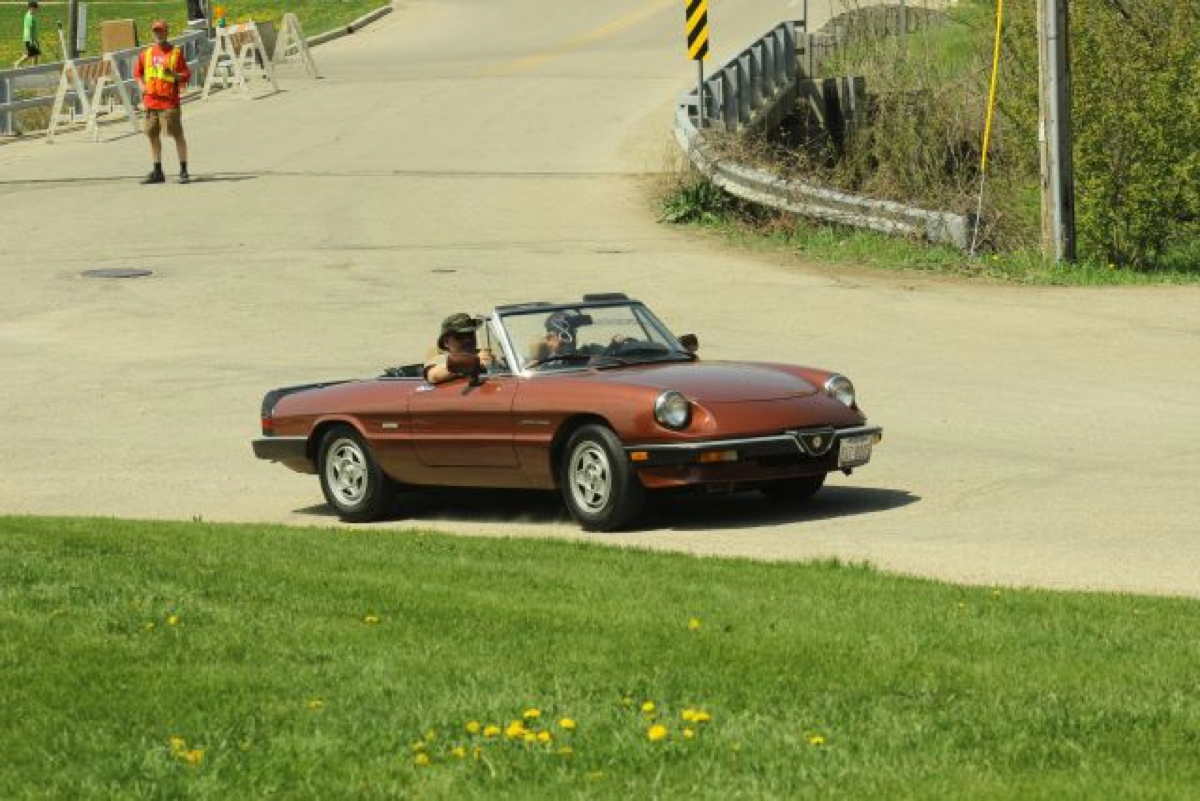
Unlike other, more notable, hill climbs, this one is very relaxed and competitive leanings are discouraged. How discouraged you might ask? Well this year they dropped timing altogether, which actually made for a smoother flow of vehicles. Further evidence of the laid back nature is the prohibition of acceleration on the only relatively straight stretch of road near the top called “The Saddle.” This is enforced by having a couple radio equipped safety workers stationed at the start and end. If they hear your RPMs rise you’re finger wagged at the end. A second time and you’re politely asked to leave. They are, after all, gentlemen of a certain vintage and decorum is a virtue. As one of the organizers points out at the Saturday morning safety talk, “This is a rolling car show, not a race.” Given the narrow, winding, somewhat broken up pavement with significant drop offs that are rustically free of guard rails it’s a wise policy and has kept it incident free for the last decade I’ve attended.
New Glarus is a fascinating little town I discovered (using “discovered” in the same sense Columbus did) decades ago when looking for nearby places to tour by motorcycle. It was in a little book, a pamphlet really, on bicycle tours in the Wisconsin area. For years I continued to periodically ride up there, stay at the Chateau Landhaus as a base and do clover leaf style tours of the picturesque southwestern Wisconsin backroads. Time and life’s side roads caused the town to fall off my radar.
About a decade ago it magically reappeared when a couple of racing buddies–and major Alfa fans–proposed the early May trip to participate in the hill climb. I didn’t have an Alfa, or even a car old enough to participate but it sounded like a fun, low pressure chance to see some cool cars. It was and still is.
Fast forward to about six years ago (or was it seven? COVID has a tendency to distort time and even led to a rare cancellation of the event in 2020) and John Saccameno, owner of Sport and Specialty, a widely recognized shop that has turned out quite a number of nationally awarded restored classics, signed me up as co-driver and I started taking runs up the hill in a variety of very neat cars: one year an Austin Healey 3000, next year an early 70’s Alfa Romeo Spider and a Porsche 356C among the more memorable. It continues to be an event I look forward to every year. But I told you this story as a lead in to the subject it got me to pondering, that being the world of classic sports cars. More specifically I wondered about how their owners decided to relate to their rolling artifacts.
The hill climb course is no race track as I said, but a public road, and one that looks like it’s been through quite a few Wisconsin winters without much intervening maintenance. As I scampered up it this year, mixed in with the rising thrum of the air cooled engine was the staccato rhythm of loose bits of broken road beating on the undercarriage. Cruising the back road transit return to the start line the windshield, and presumably the entire front became the final resting place of a variety of entomologic specimens. The car was gloriously impervious to this environmental assault. I like to think the merry elves of Stuttgart that built it would have smiled and applauded.
Bringing a classic sports car to its factory new condition is a common goal in the world of vintage cars but I was wondering how an owner decides between hermetically sealing it up, rolling it out only occasionally for show and tell or doing what the happy participants in this annual automotive dance freely do, drive them as they would have back when they were just another car and patina was neither sought nor avoided.
There is no trophy, no awards and certainly no money to be won here, just the simple joy of hearing old engines wind up and seeing unique vehicles disappear up the road and around the bend with gradually diminishing echoes spattering through the trees.
Talking with owners the answer to my question is always some variation of “That’s what it was designed for,” a thought I both appreciate and applaud each and every year I return.
I’ve seen and marveled over restorations that often frankly improve on the factory’s original production (looking at you British Leyland) and realize the incredible work and expense that goes into them. But I guess in the end, if they never really move again, as they did in the days when they were new, I find myself wondering, what’s the point?