Okay. You got me. This was on my wife’s 2013 Honda Fit. But if you’re like me and turn wrenches yourself to avoid paying $1500 for something that you can do with $100 worth of parts and a morning of your time, the lessons are pretty universal.
Last week, Maire Anne and I were driving home from seeing an old friend in Gloucester. We weren’t far from Newton when we began hearing some light grinding from the front end of the Fit. It appeared to be present on both turning and braking, but there was no discernible pulling to one side on braking, so I thought it was something like a big rust flake caught in the rotor, or at worst a deteriorating front wheel bearing or CV joint. But as we drove, it became unmistakably triggered by braking alone. Even with that, I wasn’t thinking it was worn-out brake pads. I mean, doesn’t every car built in the last 30 years have brake pad sensors in it? But not being certain what it was, we drove the last ten miles slowly and carefully.
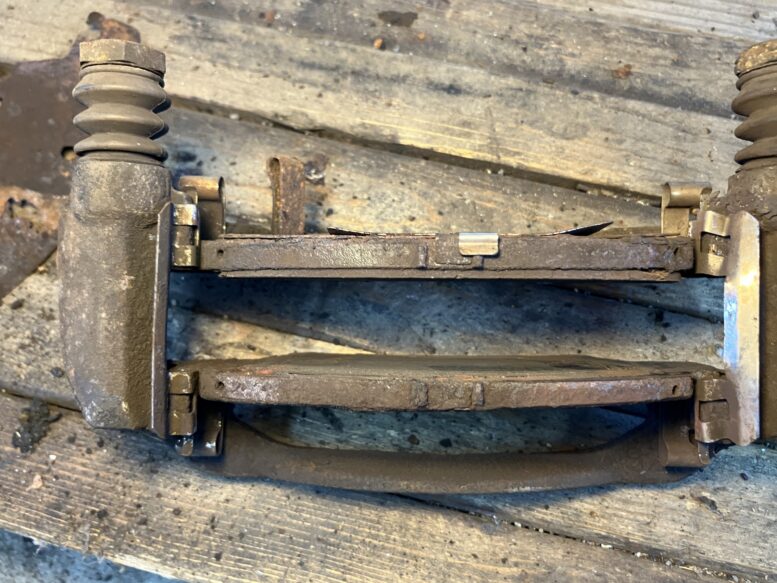
When I got home, I put the car up on the mid-rise lift and immediately saw that the right right rotor was scored. A quick peek at the pads showed they were worn out—the inner one was paper-thin, and the outer one was worn down to bare metal.
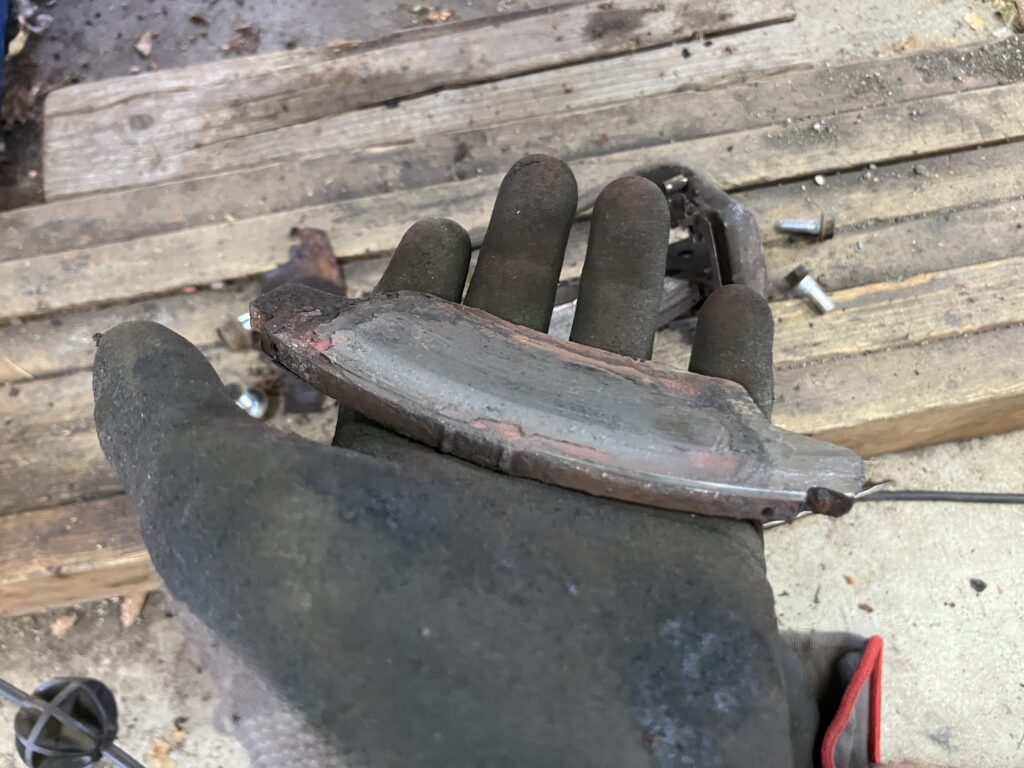
Yeesh!
One of my Hack Mechanic mantras is that doing things yourself like changing your own oil and swapping your own winter wheels and tires gives you the opportunity to give your car a well-check, and if you asked me if I’d looked at the Honda’s brake pads when I put the warm weather wheels back on the spring, I would’ve resolutely and honestly said “Of course.” Apparently I hadn’t done this in quite some time. Shame on me. I guess I’ve grown too accustomed to the brake pad warning lights coming on in the BMWs.
But to fix it, I rapidly got into the issue of “the rhythm of repair,” a phrase I first coined in a January 2012 Roundel magazine piece. This is the dynamic under which most do-it-yourselfers operate. It’s the balance between saving money versus getting the car back in service quickly. I long ago noticed that if I need to take a car into a repair shop, it’s typically at least an hour to drop it off and get back, and then the same when picking it up. That’s two hours. I can get a lot fixed in two hours. Thus, easy surgical-strike repairs are a natural to do yourself. In the hazy pre-internet days, your choices for parts sources were the dealer or trusted aftermarket vendors who advertised in Roundel or some other publication, and in the later case you made a phone call and waited. Now of course it’s nearly all click-and-buy, and as much as I loathe Amazon, I use it quite a bit because the delivery times are clearly stated and generally reliable.
One rhythm-of-repair issue is mild scope creep. That is, even if you know you need rotors and pads, do you also need calipers? Brake hoses? Backing plates? To ward this off, I first used the big slip-joint pliers to press both pistons back into their calipers and make sure they weren’t seized, inspected the brake hoses for cuts and flexibility, and verified that the backing plates weren’t rusty shells. All were fine, so rotors and pads it was.
If you and/or your partner are working Joes and Janes and the car needs to be back on the road tomorrow morning, sometimes you have no choice but to go to a dealership and pay their prices. That wasn’t the case here, but out of curiosity I checked: Honda’s list price on rotors and pads came to $350. So, nope. Searches on the big-box car parts stores for house-brand parts were about half that. But Amazon’s price on a set from Detroit Axle was just $67 with two-day shipping. Since I could give Maire Anne my E39 530i and drive the FrankenThirty or the Z3 for a few days, this was fine.
I then set about pulling the rotors off from the hubs, and immediately ran into trouble. On BMWs, the rotors are generally held on with a recessed set screw with an Allen-head fastener that generally spins off with a bit on an impact wrench, but on the Honda, there were two Phillips screws. You really don’t want to strip these threads, because if you do, you have no alternative but to drill the heads off.
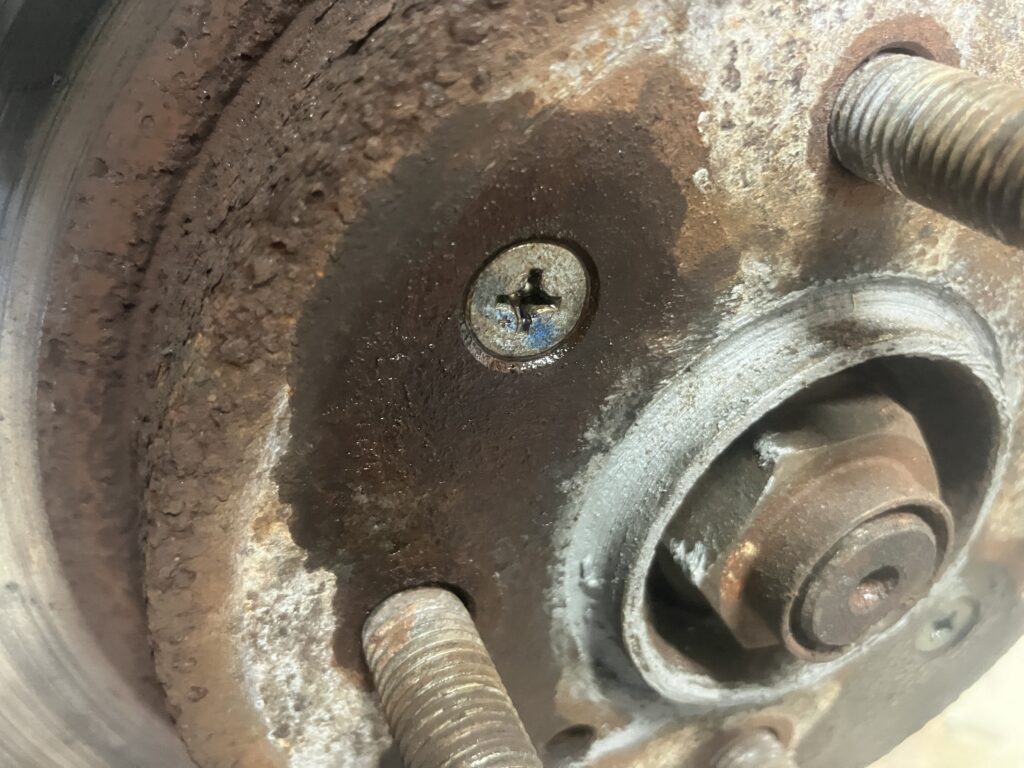
Man these were a pain.
If they’re seized, set screws like this are problematic because the recess means that it’s difficult to get penetrating oil or heat directly on the seized threads. I pulled out a tool I had in my toolbox but don’t think I’d ever used before—a hand impact driver. This is a neat old-school device that when you smack the end with a hammer, that force is translated into an impact-twist on the other end. There’s little need to use it on a traditional bolt, as a six-sided socket on an impact wrench is unlikely to slip, but on a Phillips-head fastener, it’s exactly what the doctor ordered because the hammer-hitting not only delivers a twist, but also keeps the bit seated in the grooves. The one I have is ancient and actually has a 1/2″ square drive on the end for big sockets, so I had to adapt it down to a Phillips bit which made it ungainly, but with patience, heat, and repeated smacking, I got all four screws off without stripping them.
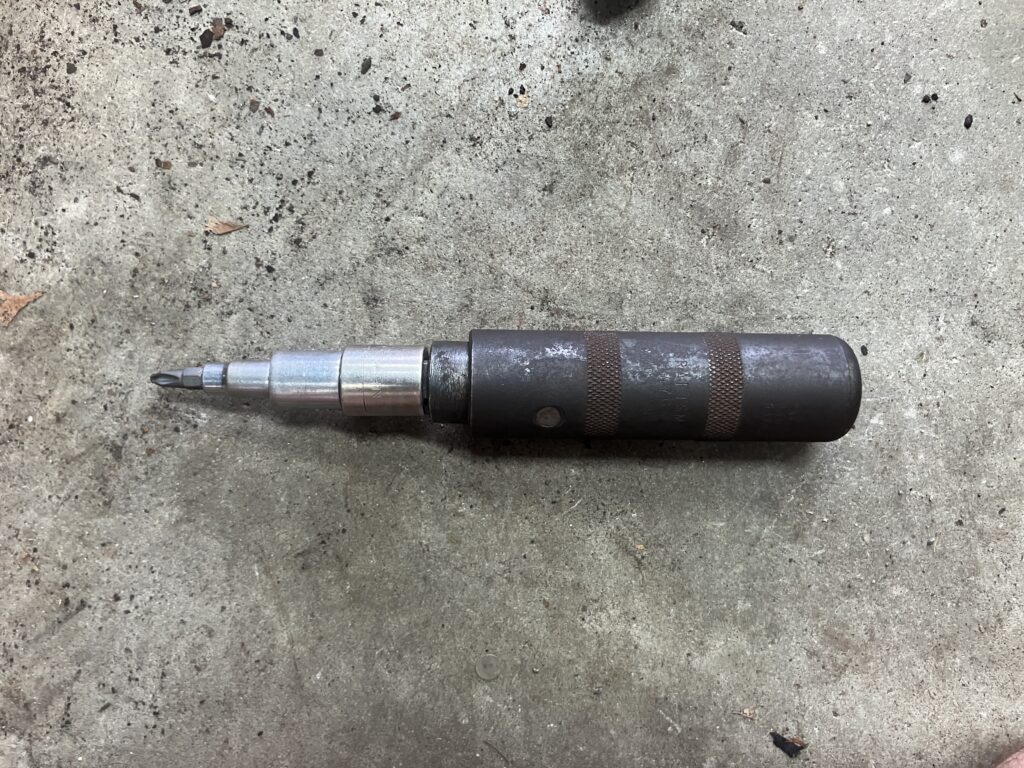
The old-school hand impact driver to the rescue.
The next day, the rotor/pad kit came. The outer shipping box looked fine, so I was surprised to find that the inner box with the rotors in it was torn. I opened it and carefully inspected the rotors, and found that one of them had a bad gash in it.
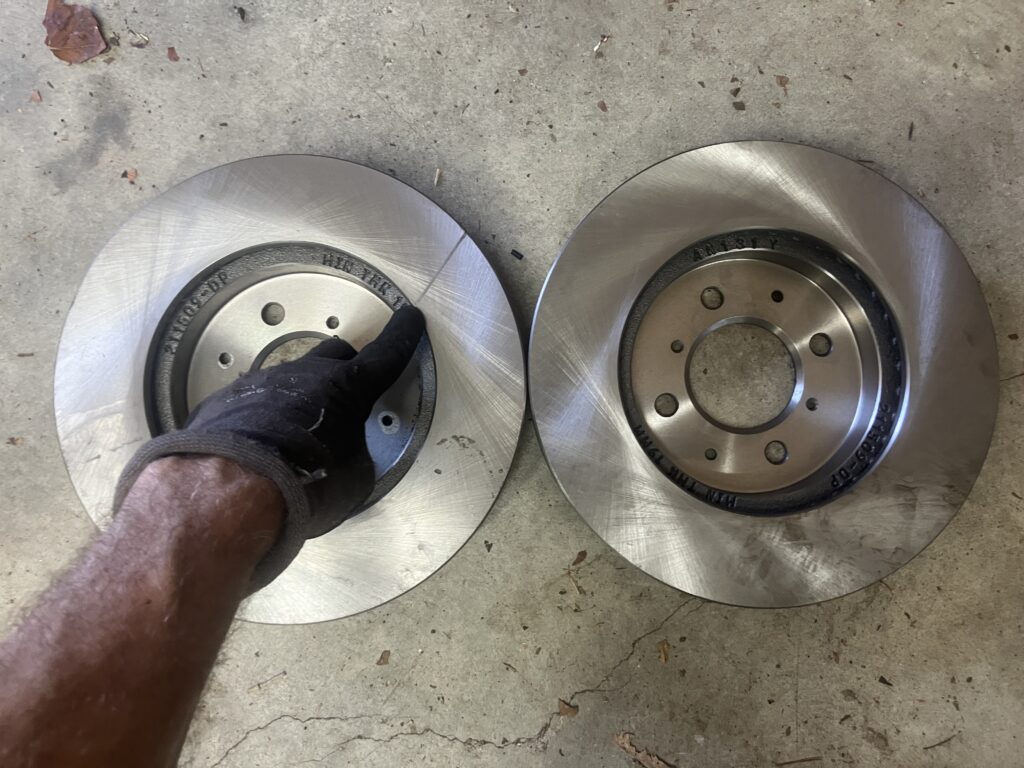
I guess that’s a slotted rotor, but unintentionally.
It was now Saturday, and the shipping for another set was estimated to arrive on Wednesday. Again, the need for the car wasn’t acute, but come on—a Honda Fit occupying prime real estate on the mid-rise lift in my garage for six days? I don’t think so.
After setting up the return of the damaged merchandise, my first reaction was to put another set on order, and run down to AutoZone and buy the cheapest set of pads they have and throw them on along with the original rotors “just for now.” Their website showed a set of $28 pads in stock. Perfect. Unfortunately, when I compared them to mine before paying for them, they were clearly the wrong pad, and their next-most-expensive pad set was $60. Nope.
So I went back home, looked at rotors and pads individually on Amazon, and found an a la carte set of Bendix pads and ACDelco rotors, each with next-day delivery, for about a hundred bucks. I clicked and bought, they arrived undamaged, and I had everything back together on Sunday morning.
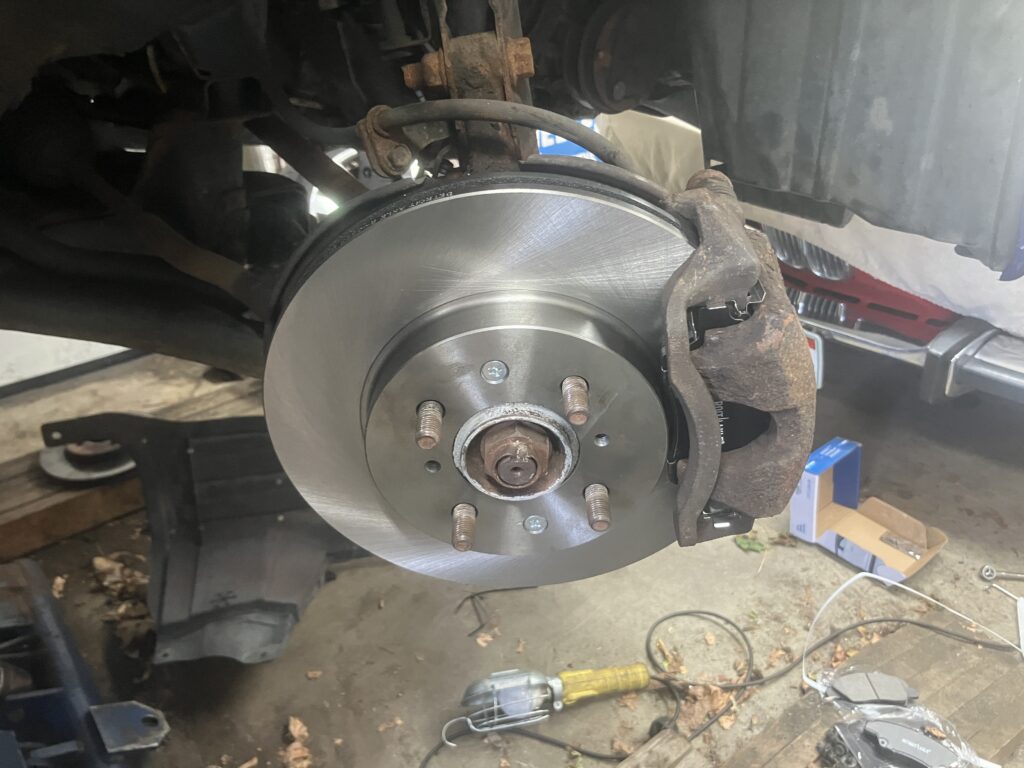
You can see the nose of my red E9 peeking out. It’s thinking “The HONDA is on the lift? Are you freaking KIDDING me?”
The point in all of this is that even on something as simple as a front-pads-and-rotors job, the rhythm of repair can trip you up, and things can rapidly go from “Ha! I’ve found the most cost-effective solution arriving in an acceptable amount of time!” to “I DON’T CARE HOW MUCH I NEED TO PAY—WHAT DO I NEED TO DO TO LAY MY HANDS ON THE PARTS I NEED RIGHT NOW?” I was glad that this didn’t fall into the latter category.
—Rob Siegel
____________________________________
Rob’s newly-expanded book The Best Of The Hack Mechanic™: 40 years of hacks, kluges, and assorted automotive mayhem, is available on Amazon here. His other seven books are available here on Amazon, or you can order personally-inscribed copies (including the new Best Of) from Rob’s website, www.robsiegel.com/books.