No matter how many years you’ve worked on cars (or most anything else mechanical, for that matter) and how much experience you’ve had with a particular make or model, what looks like an obvious diagnosis isn’t always the right one. Occam’s Razor—the simplest solution is usually the correct one—was paraphrased by my father-in-law and automotive mentor, “Mike, if you see hoofprints, think horses, not zebras”
But that doesn’t always apply. Sometimes those hoofprints are zebras, or at least an ungulate less common than a horse. I’m still learning this.
My automotive education wasn’t helped in the beginning by my choice of vehicles; my first car was a 1959 Renault 4CV, bought in my innocent/ignorance. It was three years old and had low mileage, and cost less than a Ford or Chevy twice its age. Over its 14 years as my daily driver, it provided me with a wealth of experience in diagnosing and repairing things automotive—always frequent, sometimes strange. As a result, I thought that all cars were screwed together like French cars, but they aren’t—so I’d often fail to find horses.
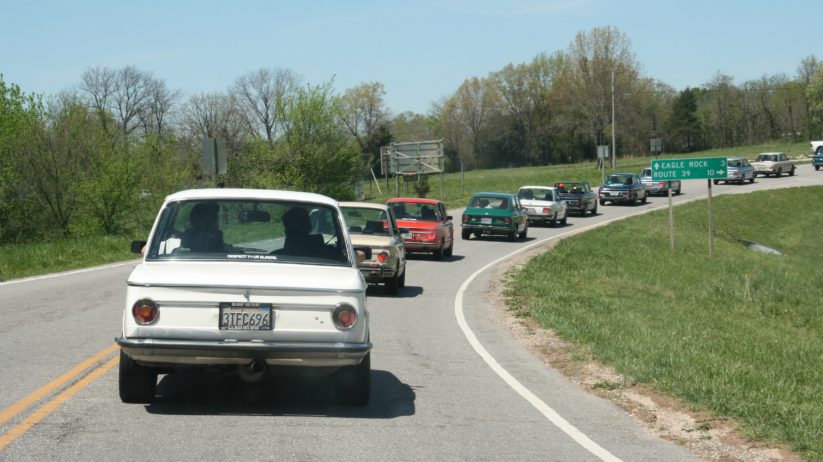
When I purchased my first BMW 2002, I had to re-learn many things, but those zebras occasionally made—and still make—guest appearances. The 2025 Mid-America 02Fest at Eureka Springs, Arkansas, provided several learning experiences.
For several months, Ludwig, my ’73 2002, had a persnickety driver’s door lock; I had to wiggle the key up and down to either unlock or lock the door. Turning the key was difficult, to the point where I was afraid of breaking it off in the lock. I chalked it up to 52 years and many key turns. I wasn’t looking forward to delving into the door, removing and dismantling the handle, and then re-keying a spare lock cylinder to match.
During my Mid-America trip, however, I used a spare key set—and the lock functioned perfectly. When I compared the key I’d been using for, oh, the past 25 years or so with this unworn one, I could see the difference. Several hours of door dismantling saved; Occam’s Razor validated.
On that same trip, I was in the company of my friend Jim Denker, who owns a Sahara sunroof ’73 identical to mine. After arriving, Jim told me that he would hear a periodic clunk when hitting a bump. It wasn’t speed-sensitive, so it most likely wasn’t anything in the drivetrain—engine, transmission, or driveshaft—so it was probably suspension-related. Jim thought it was emanating from the right front, so several of us descended on that corner.
Reaching behind the wheel, one investigator thought he felt a stone wedged between two spring coils. Wedged in tight enough, especially at the upper or lower portion of the spring, it could cause the sound whenever the spring was compressed. Our conclusion: It’ll probably fall out when you hit a big bump, but in the meantime, it shouldn’t be more than an annoyance.
A couple of the guys watching this diagnosis, though, weren’t so sure. Finally Logan, younger and more limber than the rest of us, crawled under the car to take a closer look: no stone. He discovered a zebra, in the form of a loose strut cap!
On a BMW 2002 (and many subsequent models) with McPherson-strut suspension, that cap is threaded onto the strut tube’s top, and holds the suspension’s innards together; Jim’s strut was unscrewing itself. None of us—even with a combined several centuries of 2002 wrenching—had ever seen this happen; it’s usually just the opposite: Those threads become so rusty that they can hardly be unscrewed in order to replace the front shock insert.
Fortunately, a properly wielded large pair of slip-joint pliers tightened the cap. The clunk vanished. Lesson learned: Don’t jump to conclusions without a thorough investigation. Zebras may be lurking.
The final lesson is one also learned at Mid-America 2025. Father and son Jim and Brody Raguckus had driven their ’73 tii from western Michigan and joined our caravan in Dayton. Like the other seven caravan cars, it ran flawlessly during the two-day trip, until we were a mile from our destination, when it just quit. The engine would crank, but would not fire. This meant that it wasn’t an overall electrical problem, it was something in the engine. Fortunately, the caravan included two other tii owners familiar with troubleshooting the complex but normally very reliable Kugelfisher mechanical fuel injection. A sudden engine shutoff could indicate either ignition or fuel problems. The ignition was quickly found innocent; there was a spark at the plugs. That left a fuel issue; in this case, fuel was delivered by an under-the-car electric pump.
Sure enough, with the ignition on, there was no soft hum from the pump.
As with any electrical glitch on a 2002, the first thing to check is the relevant fuse. A visual inspection pronounced it unblown, so the problem had to be a seized or otherwise non-functioning fuel pump. Larry Gray, another caravan member and tii driver, had a spare fuel pump (“I don’t leave home without one”), so he retrieved it from his parts stash and prepared to install it.
But before under-car crawling commenced, Doug Fautschy, the other tii caravan member, said, “Let’s check the fuse again.” With the 2002’s bullet fuses, looking good and actually functioning are two different things, the latter being the most important.
A quick cleaning of both fuse and its clip: the pump hummed to life. Occam’s razor for the win.