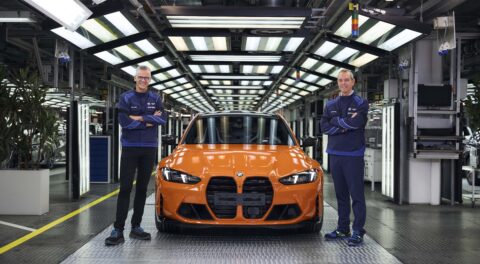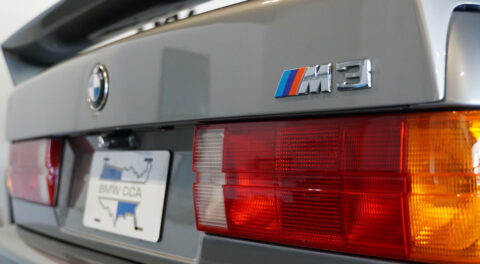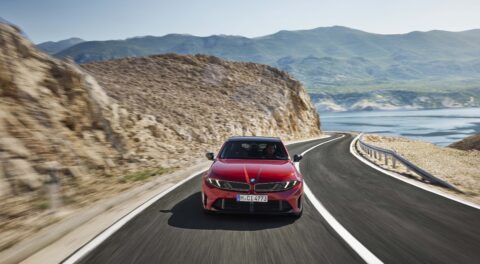
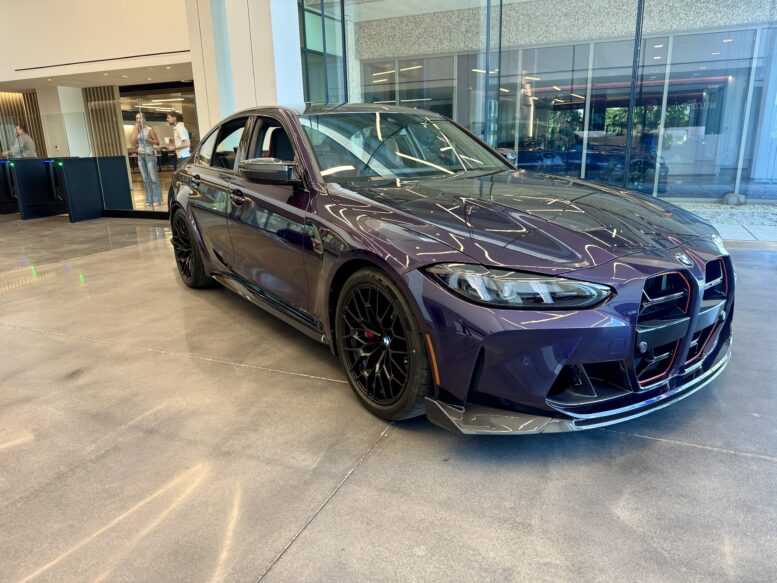
Scott Stirling is a long-time BMW CCA member and BMW CCA Club Racing participant. He also happens to be BMW’s product planning specialist for the 3 Series, 4 Series, and X3. That means he also oversees the EV and M variants of those models, like the M3. This past week saw the release of the M3 CS Handschalter, an M3 CS with a six-speed manual and rear-wheel drive that will only be sold in the U.S. and Canada. With 473 hp and 408 lb-ft, it’s not as quick as the original M3 CS, but with the manual gearbox and rear drive, it’s a lot more involving. Isn’t that what matters?
This car isn’t just Stirling’s idea, he pushed Munich to build it while keeping it quiet in the U.S., secretly working on it as a passion project behind the scenes for nearly three years. I sat down with Stirling at BMW NA’s HQ after the reveal, with the only Techno Violet CS Handschalter in the country as a backdrop, to find out more about how it came to fruition.
Travis Okulski: This is the first North American special edition M3 since the Lime Rock?
Scott Stirling: From a model perspective, this is the first special model since the E36 Lightweight. Lime Rock—and this isn’t meant pejoratively—is a paint and upholstery operation. It doesn’t get the stroker (V-8) that the GTS got or anything, while this has special equipment on it that makes it more dynamic. So that’s kind of the internal distinction between a special edition and a special model. So this is the first special model since the Lightweight, but within the encompassing of special cars, Lime Rock would be the last special edition that was U.S.-only.
TO: How did the idea come up?
SS: You have to go back to the first version of the G80 M3 CS, the 2024 model. I was probably under a year within this role when that car came out. We got our pre-pro and I got to drive the car for the first time. We also happened to have a normal M3 in the fleet. So we got to drive them back to back and just the level of sharpness and enhanced kind of communications, this realness of the car was immediately apparent. And, being myself, I didn’t want this car, this specialness, to only be all wheel drive, automatic transmission. I wanted it rear wheel drive and a stick. So that kind of kicked off a conversation.
We have these normal meetings with Munich about our future outlook on product, Where do we see there being potential? And just kind of through one of these working sessions this was brought up as a potential future product. That conversation happened, I don’t know how many times, but essentially over two, two and a half years there was a constant, “Hey, we think this works. Hey, we think this works. Hey, we think this works.” And then finally at one point, we aligned correctly and they said yes.
TO: So it’s been a long time coming.
SS: Three years. Three years in July.
TO: Wow. And so, you go to Munich and you tell them, “I want this. ” How hard is it to get them to agree? Especially because it’s fewer than a thousand cars. Is there leftover CS parts to make it happen?
SS: No, this wasn’t just leftover parts. Part of the issue was whether or not they could make some of the parts. There was an initial concern about the mold for the hood.
Would it continue to support production? I don’t know if they had to make a new mold or if they were able to utilize the old ones, but as far as the conversations go, there’s a lot of things that come into play. It’s the business case; we’re a public company so the financials need to make sense.
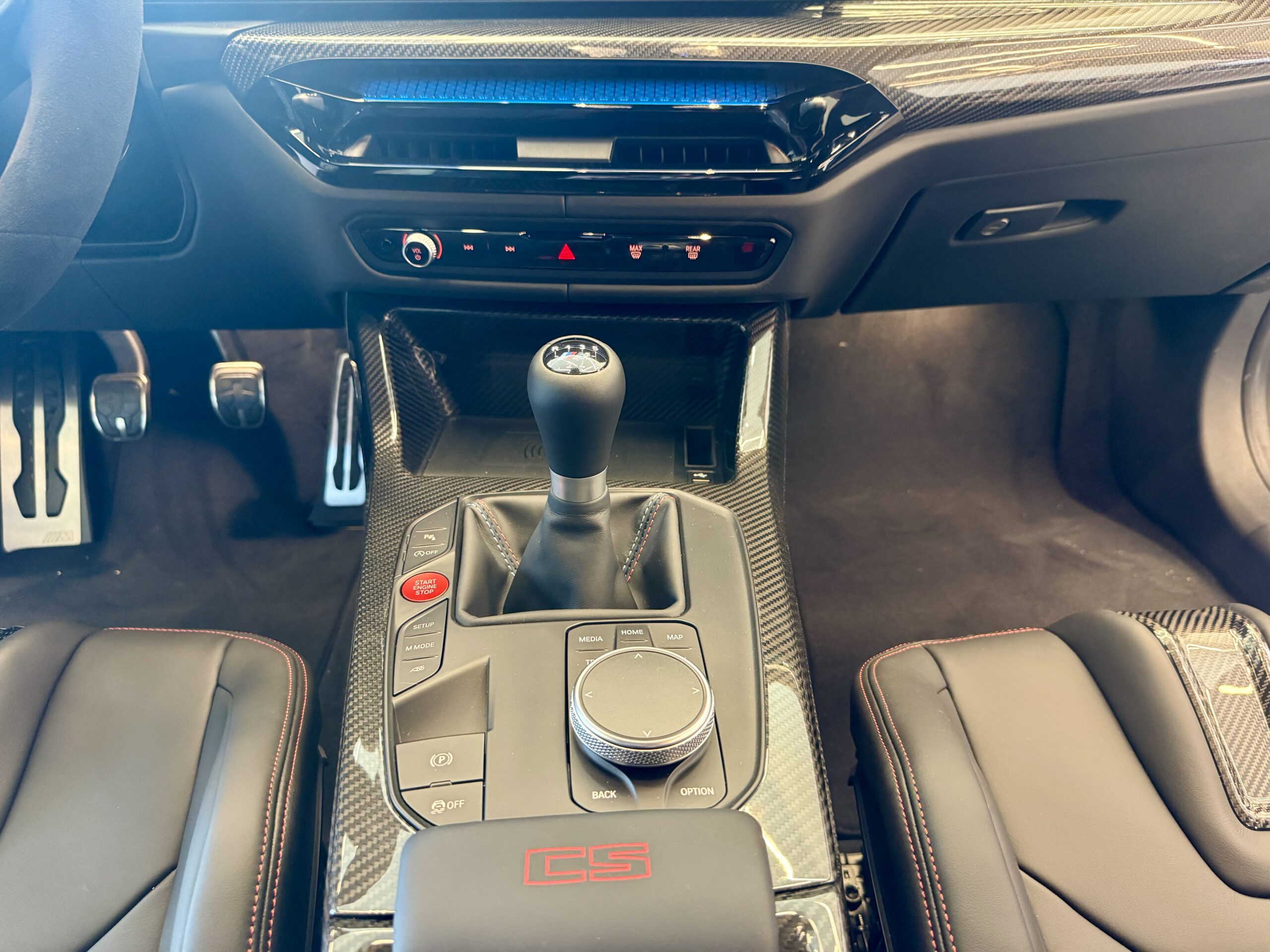
It’s also an engineering exercise. Do the engineering departments have the capacity to add an extra project? While it has a lot of parts transfer because it’s real wheel drive and manual transmission, there’s obviously some engineering that needs to be done. The center tunnel is a big portion of that. Visually it looks the same, but where the shifter is placed is different. So that needed a different mold.
Then there’s a whole conversation from a company perspective, what does this car represent for the organization and how does it reflect on us? This was kind of one of the open points that we had a lot of discussion about. From a U.S. perspective, we didn’t view the fact that we couldn’t get more horsepower out of the car and the car won’t be faster than insert model here as an issue.
We view that the objective of the car as different and those concerns didn’t exist for us. It did exist from Munich. There was some convincing that needed to be done that it was going to work. And I think that, just based on the social media feedback, it’s going quite well.
TO: From what I heard, the E38 740i Sport was a rogue project. The product planner at the time and Albert Biermann just ripped parts from different global markets, threw it on a 7, and then brought it to one of the dev drives that the board comes to. Did you have to go rogue at all? Did you have to throw together a sort of prototype here that was based on a rear-drive car with some CS bits on it as a proof of concept for Germany?
SS: No, I wish. That would’ve been a lot of fun. I would’ve loved to have built something in my garage. From a rogue perspective, I was really the only person pushing this. Obviously I had the support of my manager, but from a U.S.-perspective, we kept this really, really quiet. We didn’t really even tell the executives about it until it was fully ready. Munich told us “We can do this. We just need your final approval.” Then you need to get pricing approval from everyone.
So from that perspective, you can call it rogue, but really this was like a passion project for me in addition to my normal responsibilities. But from what they did in Munich, most of it was the initial convincing that this is good for the company and that this is going to be a very successful project overall.
TO: Why an M3 and not an M4?
SS: Given the production cycles, this is the last model year of G80, so this was my only opportunity. M3 is my favorite moniker regardless if it’s a four door. I own two M3s right now. So from a nerd and personal standpoint, doing the M3 was not more important, but it meant more to me. Do I think it would look really good on M4? Yeah. Will that happen? I don’t know.
TO: So it could.
SS: Theoretically.
TO: What’s the same as the base car? What’s the same as the CS and what’s unique to this car?
SS: The roof is direct carryover. All those cars start with the carbon roof. The buckets that are in the car are the same transfer of just different upholstery on them. Really the only thing in the interior that you can’t order today is the trans tunnel
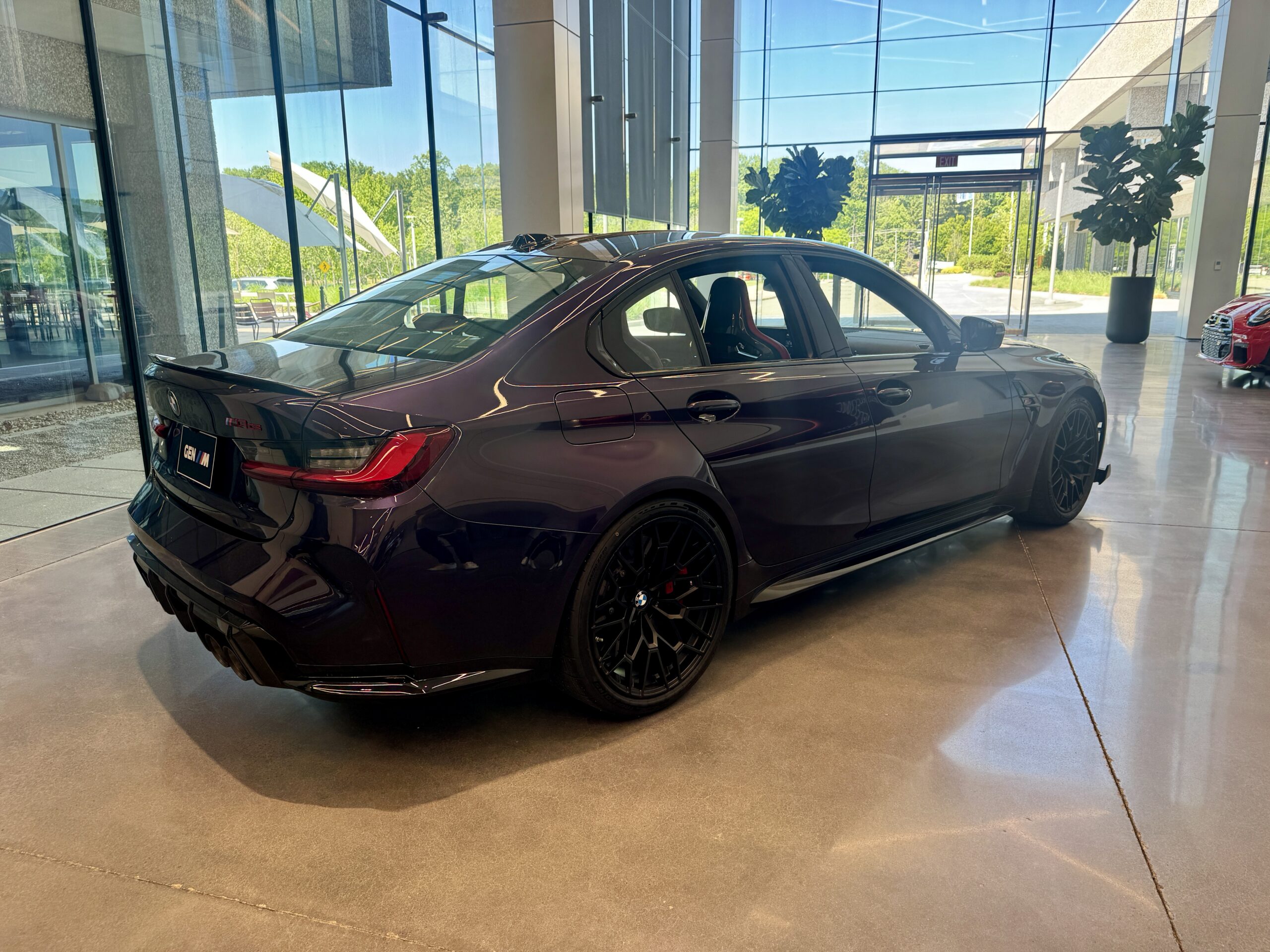
All the other equipment on the car interior wise is the same. Exterior is a lot different. So the wheels you can only get with the CS, particularly the gold version of the wheels. You can only get the Ultra Track Tire, it’s a Cup 2R equivalent. Carbon ceramic brakes with the red caliper are a moniker of only our special models. CS and CSL only are where those can come in. And then you get into the hood and the splitter, which are both carbon, those are specific to the CS models.
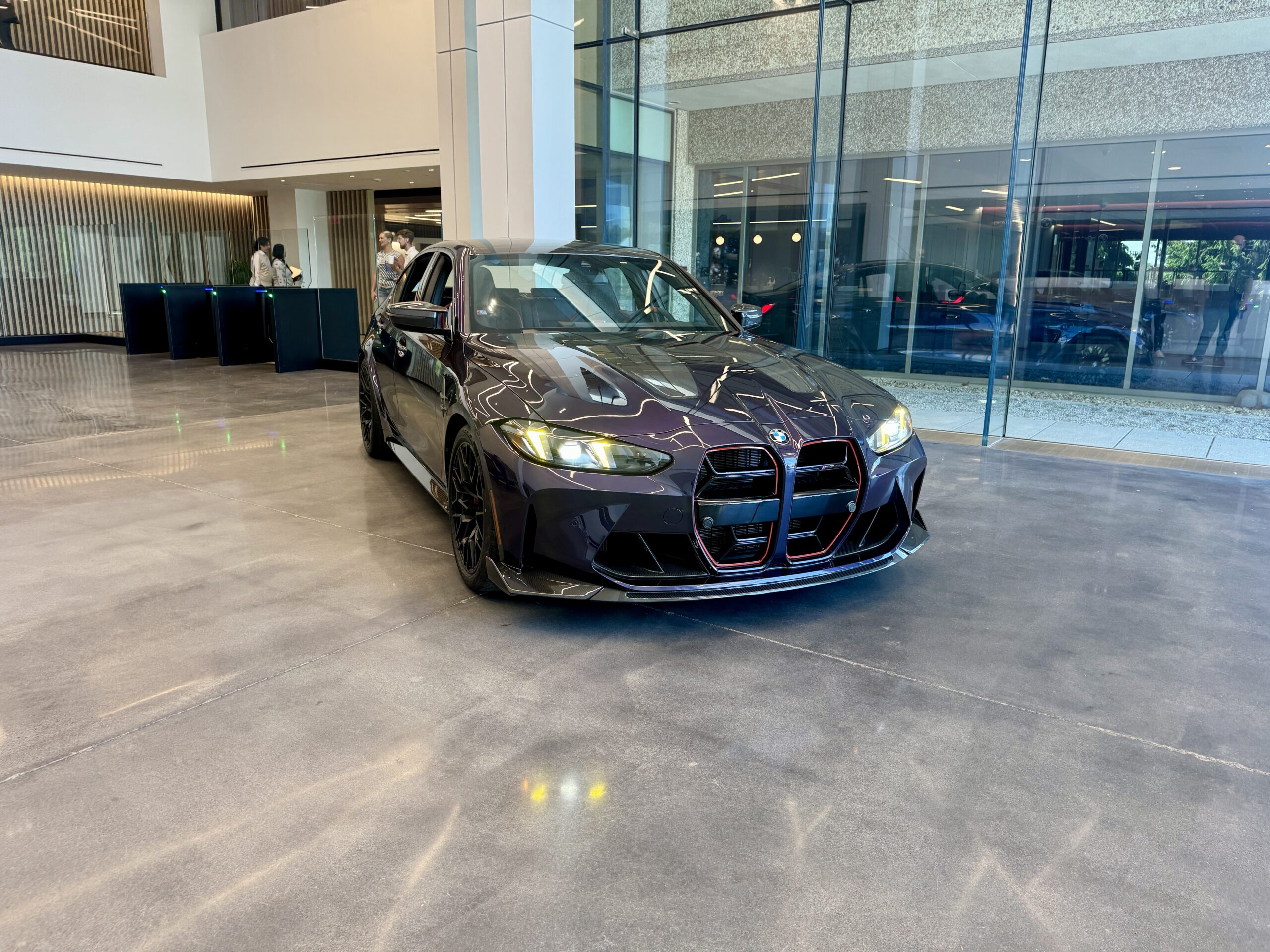
The diffuser is specific to CS, as is the titanium exhaust. The rest of the carbon exterior package, so mirror caps, the inlets for the brake ducts and the gurney are generally orderable through the normal exterior carbon package and then the headlights. Headlights are with the yellow slashes. That’s actually one of the big call outs from how you can tell other than exterior colors. Old M3 CS versus new one because that was a pre-LCI car. Marketing calls them snake eyes now. If you see the snake eyes, it can only be a manual. And then that geometry is a tie back to what the race cars get. So that’s a CS calling card as well.
The strut brace in the front is specific to the CS model. That is actually a fun tidbit on the car. That is standard on the other cars, but that is optional on this car. Because of how compressed the development timeline was for homologation, that part wasn’t going to be ready in time to do the standard profile homologation, so we had to make that optional. There was a conversation about if we should include it and I took the stance that if the other ones had it, we have to have it.
I was really happy to get that. Shock absorbers are shared with the CSL. The springs are shared with the M2CS. Again, because it’s rear wheel drive, we get to lower it six millimeters. So that was a big benefit. The bump stops/auxiliary springs are the same as the M2CS. The sway bars are carryover from G80, just from a development target perspective, there wasn’t a need to change them. Axle links in the rear are shared with M2CS. Again, that’s because of the lowering. The engine mounts are shared with the CSL. The trans mounts are carryover from the base car and then all the controllers on the car, steering, chassis, engine and, technically the gearbox controller is a human now, so that also changes, but those are all specific to that car.
Finally it has different camber. They didn’t provide me with a figure, but it does increase slightly for that car.
TO: This is something that you’ve had so much input, time, and secret time into, so how did that feel to finally see and drive it?
SS: It’s really hard to separate the emotional side. You build things up in your head and this is what it’s going to be. And does that drive just validate those, what you’ve built up or how do you be objective with it? So in an attempt to be objective, it kind of accomplished everything that I wanted. The front end in particular is way sharper. That’s my favorite thing.
You can feel how sharp it is and it does exactly what you want it to be. I just thought the chassis control was really impressive. The car that I drove at Willow Springs was on the track tires. It was really well balanced. It was very predictable. Even with traction control completely off. I don’t really slide cars around that much. And for someone who’s not experienced how easy that car was to [slide], you dive in at speed towards the apex and you put more power down, the back just kind of ticks out and it wasn’t this violent where you’re trying to control a horse. It was just, “Oh, okay. I can feel the car moving and this is where it stops and okay, now we need to start to unwind and just kind of go. ” I was really impressed with how well it did all that. Again, it validated what the idea was when we drove the first car to the first car being the original CS to this.
So, for me, it’s a big accomplishment and it checks the boxes that I wanted it to check.
TO: The things that this car’s missing, the all-wheel drive and the power, it doesn’t seem to matter from your perspective while you’re driving.
SS: There was an article recently that came out recently, and it talked about modern cars and expectations of power and how to be extreme, everything that doesn’t have a thousand horsepower is a failure.
I don’t take that ideology. I think cars today are so fast that you can have something that doesn’t check the box on every numbers exercise, but still provides the level of engagement and joy and kind of creates your own enthusiasm. And that’s what I felt with this. As a driver, I don’t need more power. I couldn’t push a car to its absolute limits in the way that Connor De Philippi could. And my personal view is that if you’re not that person who is able to really push the car to its limits at a lower power level, you don’t really need more
It’s not that it doesn’t matter. It’s not the most important thing. The car is really fast. It’ll rip off a screaming lap time, I’m sure, but it is still reasonable by modern standards.
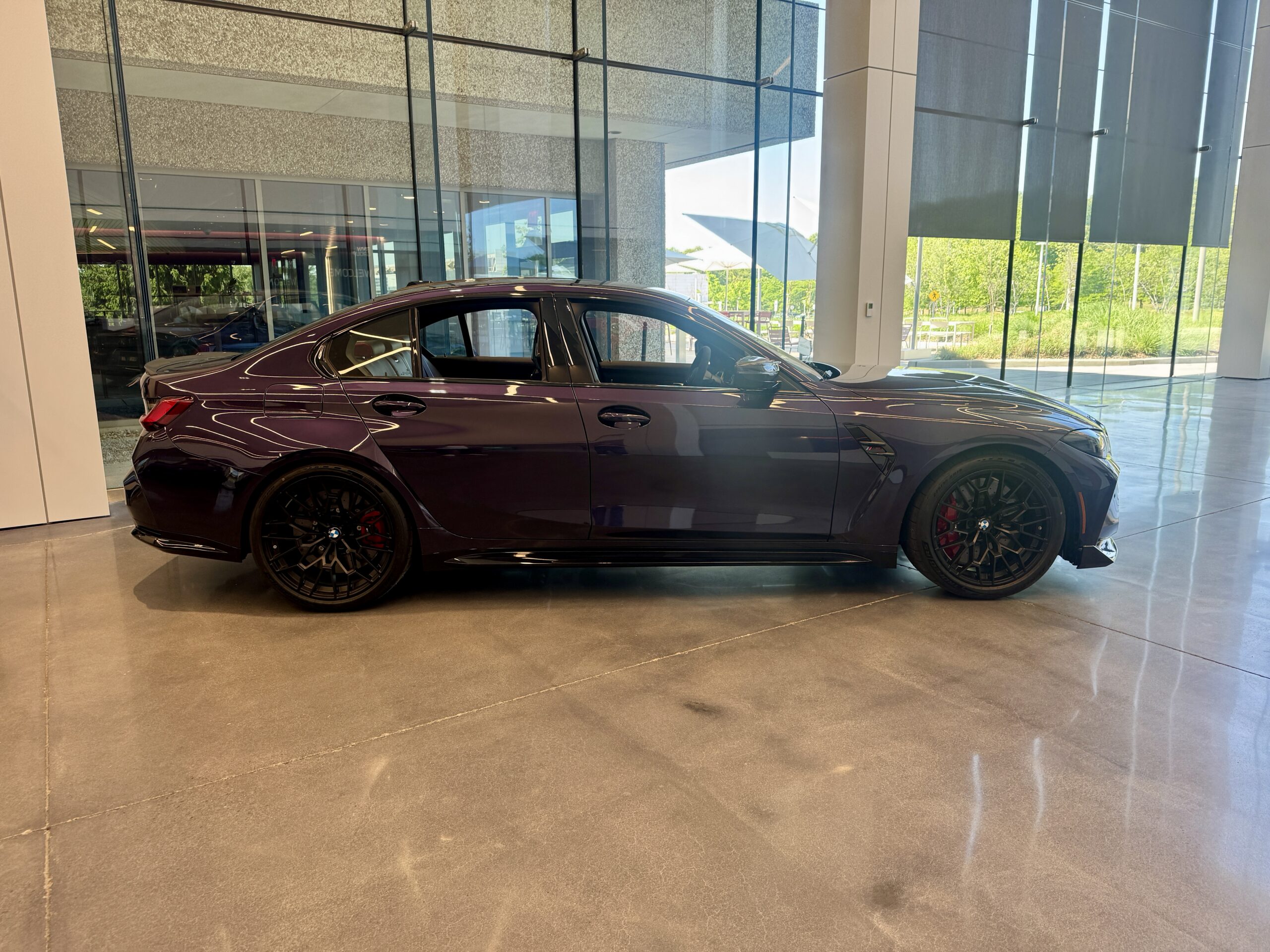
TO: It seems like this car is aimed right at the people in the BMW CCA, right? Was that in your mind at all?
SS: Yeah. If you have a club racing license, I hope that you buy one of these, but I know of three, potentially four club racing people who are going to buy this car.
My hope is that this car is purchased by people like CCA members, enthusiasts who will go and drive the car. The car isn’t meant to sit. It should have miles on it. The exhaust should be turning blue. It’s titanium, so if you heat it up enough it changes colors. I hope every one of them changes colors and that people in the CCA in that mindset buy the car.
TO: If the car does really well here, let’s say, when orders start being taken, it sells out, which I would expect would probably happen. Does that then tell Munich, “Hey, maybe we should try this sort of formula in other countries.” Do we work as the test bed for that? Or is it the sort of thing where our market is unique in terms of manual desire combined with the purchasing power and volume that would be needed to support a car like that? Is it something that could only happen as a perfect storm here or does a successful launch here then potentially mean there could be more for the rest of the world?
SS: I think as the biggest M market in the world, I certainly think that we are looked at as a temperature indicator on what could or could not work. Volume is limited, right? So is it a flash in the pan or is it indicative of a larger trend? I do think that it gives us more ammunition like, “Hey, we were right on this. We should do something like this. ” So we do have a bit more sway because of the size of our market and the purchasing power. The other thing though, just specific to the manual, U.S. emissions homologations are much leaner than they are in, let’s just say Germany or the U.K. So for us, it gives us a bit more leeway to be able to continue to offer things like this.
This interview has been edited for length and clarity.