Welcome to Tech Talk, where our resident BMW tech Nick Owen answers all your pressing BMW technical questions, frustrations, and issues. Have a question for Nick? Email him at techtalk@roundel.org. Let’s get into it.
Fault Codes
I have a 2010 BMW X5 3.0 with the N52. Codes p0012 and p0015 have been coming up in the scanner for over a year, and I’ve been unable to get the truck to pass inspection.
The following have been performed:
- Engine replacement at 217,000 with 130,000 unit
- Replaced transmission 217,000
- Both intake/exhaust solenoids replaced
- Both intake/exhaust camshaft sensors replaced
- Oil change and new oil filter housing
- Oil pressure sensor replaced
As you can see, I’ve dropped thousands on this vehicle. Any advice on how to clear this code will be greatly appreciated.
Patrick
The codes stored in the vehicle are related to camshaft timing. If solenoids and sensors have been replaced, then you’re going to have to look at the timing itself. You will need to remove the valve cover and have the appropriate camshaft timing tools to verify it’s correct. If it is correct, then it’s possible your VANOS units are failing. Those will cause the faults you have stored.
One more question for you regarding this situation. Do I need a particular scanner to reset this code? I just have a general scanner, I’m not sure that it can erase permanent BMW codes.
Permanent code means the issue is consistent enough to store a “hard fault.” Your scanner is capable of resetting the faults, once the issue is rectified. As long as the timing is out of spec, the DME is going to store the faults and turn the light on. Once the issue is fixed, properly, you will be able to clear the faults.
Oil Level Sensor Readings
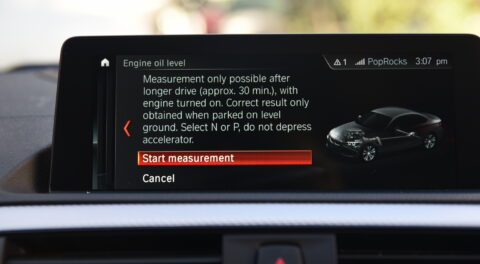
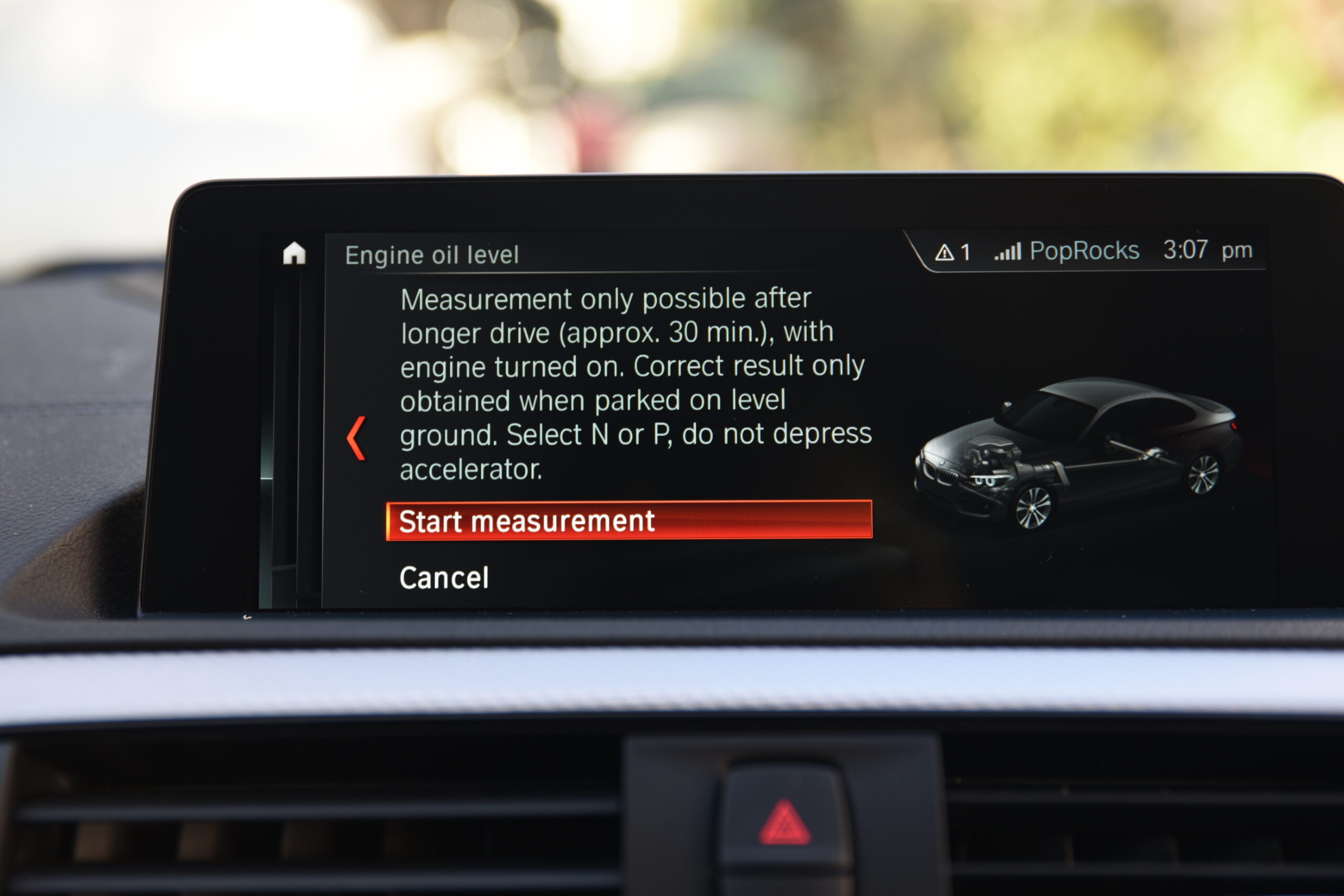
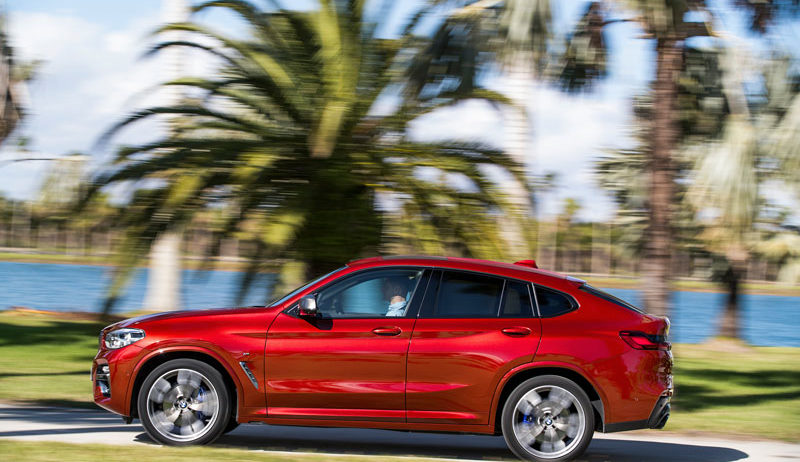
Throughout the history of our X4, the engine oil level has stayed at “max” between oil changes. The last oil change (performed by a new shop) was done at 47,200 miles. I did not verify the oil level at that time; however, I initiated the iDrive oil level check at 50,000 miles and it showed the oil level to be just a bit above “min.” (There are no obvious oil leaks on the outside of the engine. Additionally, the engine is running perfectly at idle, and other speeds, so maybe no big interior oil leaks either.)
So, I added a quart of oil. Checking the level multiple times after long drives, there was no change in the indicated level. Not wanting to overfill in case of a malfunctioning oil level sensor, I did not add any more.
The X4 now has 52,500 miles and will be taking it in soon for an oil change. As a test, I added another quart of oil. Again, no change in the indicated level after driving multiple times. I am thinking about asking that the oil level sensor be replaced when the oil is changed. A good idea? Is it common for an oil level sensor to “kind of fail” rather than just die?
Cindy and Lars Bengtson
The oil level sensor can start to fail and be unable to perform an oil level check, so that is a plausible scenario. I would agree it’s a good idea to replace it at the next oil change in order to rule out that possibility.
With that said, and not to put this out there, but sometimes when the N20 timing chain guides fail, they can lodge pieces into the oil pump pickup screen, and this will cause the oil level sensor to not be able to check the oil level. Therefore, when the technician goes to replace the oil level sensor, ask them to use a borescope to see if there are any pieces of timing chain guide stuck in the pickup screen.
An update: The oil level sensor was replaced at the time of the next oil change. All now appears to be well. iDrive oil level check reads “Max.”
Brake Squeal
The car is a 2018 M240i with Brembo brakes and about 41,000 miles. The brake fluid has been replaced every two years and changed with Motul RBF600 before track events. The pads are/were Performance Friction 08 pads which I recommend for anyone serious about track events. The problem is squeal on the left front. I decided to reinstall the pads to correct the squeal, but the squeal is still there. All four pistons seem to move in and out without any binding.
Suggestions?
Mark Fiumara
When does the squealing occur? Parking lot speeds? Light or medium brake application? Does it go away under heavy braking?
A few things come to mind, but the main thing is either one of the caliper pistons isn’t retracting enough or there are high spots or deposits on the rotor from the track pad. Before we do anything, have you gone out and done a few hard stops in which ABS engages? Sometimes this will free up the brake pad in the caliper since they float. Another thought is to swap the brake pads in the caliper or swap them from the RF to LF and see if the symptom changes. If It’s still on the LF then I would suspect caliper sticking.
The squealing occurs at low speeds such as when I am coming to a stop. There’s no pulsing in the brakes, so I think the rotors are fine. It doesn’t do it under heavy braking but if I’m at speed and lightly press the brake the squeal will sometimes occur. I’ll find a nice spot to get up to speed and slam on the brakes so ABS kicks in. I’ll let you know what happens.
Unfortunately, that is a byproduct of the M Sport brakes which can occur at slow speeds or light brake pedal application. My theory is that the pistons don’t retract enough and they tend to drag the brake pad on the rotor. The upside is good brake response.