I haven’t had a lot of flashing in my past. Not that kind—I mean updating the software in a control module. (Well, didn’t really have the other kind in my past either). I believe that there was just one time I needed to contact BMW coding guy Sam Aleksanyan and have him program a used ABS module to work with my VIN, and it wasn’t a big deal.
But in general, flashing is a key-on procedure that can take long enough that you risk draining the battery during the process. The prescribed way to do it is to connect the battery to a “flashing power supply” that delivers 50 to 100 amps of clean current. When I worked at Bentley Publishers, we had an expensive Midtronics unit that lead mechanic and writer Charley Burke often used to deliver the big key-on amperage needed by his BMW E60 5 Series when he was re-flashing its control modules.
Fast-forward to last fall. As I wrote about here, I installed electric air conditioning in my 1969 Lotus Elan +2 that included an electrically-driven compressor that runs off the alternator rather than being driven by a belt off the crankshaft. The reason I did it was because, unlike on a vintage BMW, there was no second groove on the crank pulley to run a conventional belt-driven compressor, and even if I had a two-groove pulley machined, there was no source for a compressor bracket nor room to bolt one to the block in the cramped engine compartment. This is not something I recommend doing in a 2002 or other vintage BMW, but for the Elan +2, it made sense at the time, though I’ll need to wait for warm weather to know how well the thing actually works. The configuration also required installation of a high-output alternator, and careful wiring of a new separate circuit with beefy 4-gauge copper battery cable for the compressor (you wouldn’t want all that current coursing through any of the Lotus’ existing 56-year-old wiring).
But as I was nearing getting it operational last fall, I had a problem. My garage is attached to the house, my wife has an exquisitely sensitive sense of smell, and even if the garage doors and windows were open, running the Lotus in the garage to charge and troubleshoot the a/c triggered her nose. I tried running the car in the driveway instead, but that it didn’t solve the problem—fumes came in through the second-floor windows. Because the compressor is electric, it doesn’t need the engine to spin it, but between the compressor and the evaporator and condenser fans running, the draw is nearly 80 amps, which will drain the battery in short order if the engine is off and the alternator isn’t supplying the current.
There are a few ways to supply this kind of power. Modern flashing power supplies appear to be the best solution, but they’re pricey, with units from Midtronics, Samlex, and Clore retailing for about $1500. Plus, the ancient control-module-free Lotus didn’t really need the kind of clean ripple-free charger that a flashing power supply delivers. So in theory I could just use a battery charger. However, traditional chargers aren’t really designed to supplant the battery while there’s a load on it, and even if they were, few supply this kind of continuous amperage. I used to have one of those big Craftsman roll-up chargers that advertised a “boost mode” of 120 amps, but that’s typically only for 30 seconds to a few minutes. Another option is “RV power converters” that are designed to convert 120 VAC shore power to the 12 VDC that many of the coach systems. Brand-name units are in the $350 range and unbranded ones on eBay and Amazon dipping under a hundred bucks, but you get what you pay for, and many of these have one-star Amazon reviews saying “Used a few times, then died.”
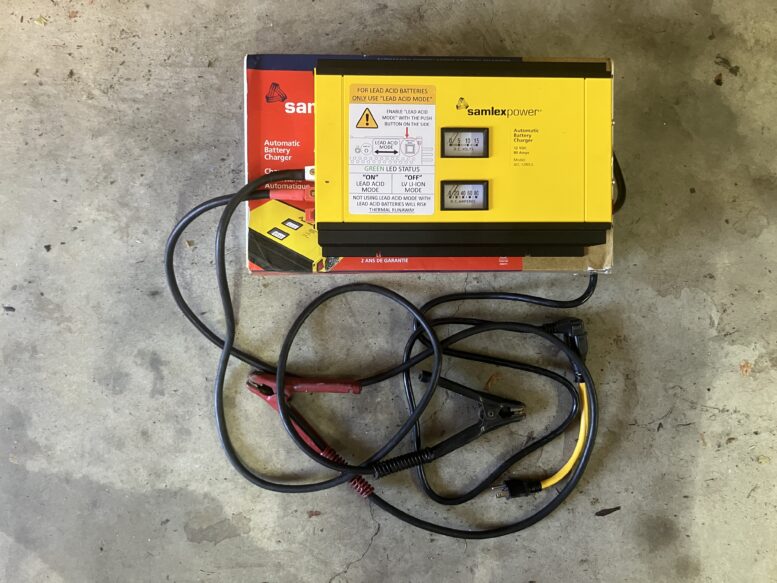
I was going to pull the trigger on one of the mid-priced RV units when one of those against-all-odds things happened: I saw a Samlex 1280UL charger / flashing power supply on Facebook Marketplace in Hartford for $150. I messaged the guy and said “If I drove down there right now and put a hundred bucks in your hands, any chance that would be enough?”
“Sure!” was his delightful reply.
Amazingly, the unit was in the original box and appeared to be unused. He said he bought it for a project he never got to, and was thrilled to be moving it along to someone who would use it.
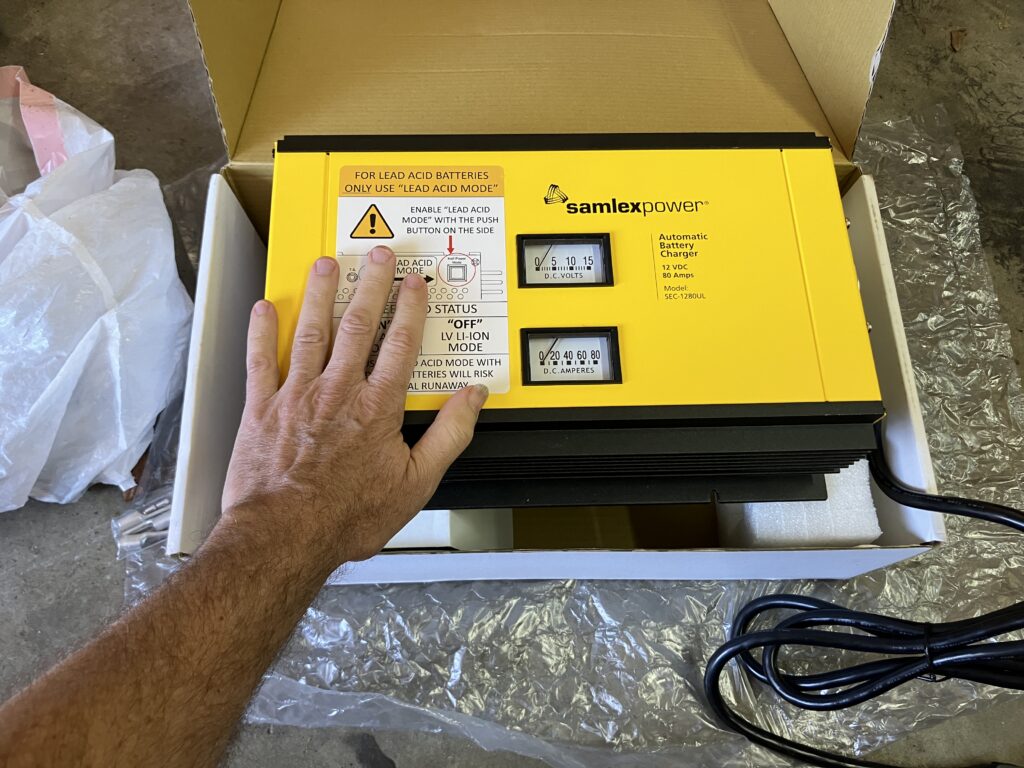
My hand is shown for perspective. This thing is beefy!
I didn’t realize that the Samlex didn’t come with cables and alligator clamps to connect it to the battery, so I needed to make those. Fortunately it did come with the crimp-on pin connectors that slid into the terminal block. I’d purchased a simple hammer-crimper when I did the cabling for the compressor, so it was an easy matter to take a set of 2-gauge jumper cables, cut them, and hammer-crimp the pin connectors onto the ends.
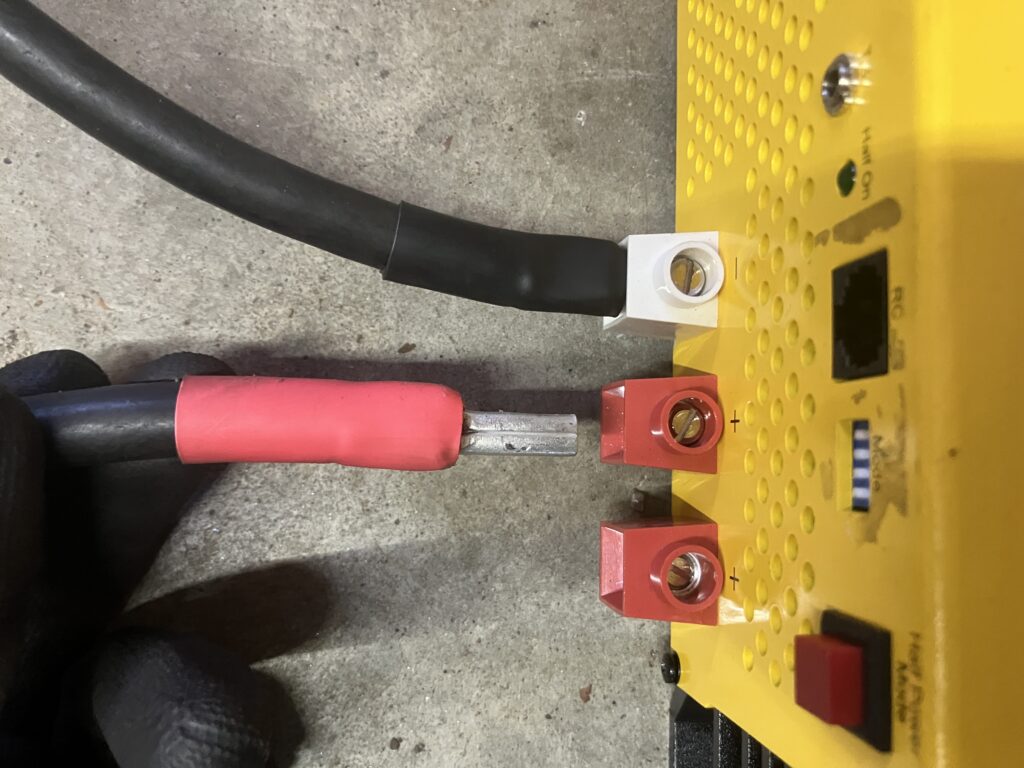
I’m not always a, you know, hack.
I then mounted the Samlex against the back wall of the garage so that, with the Lotus backed in, the cables could easily be attached to the trunk-mounted battery. As the Samlex is also a high-quality traditional battery charger, I’m sure that some of the other cars will also take advantage of it in that location.
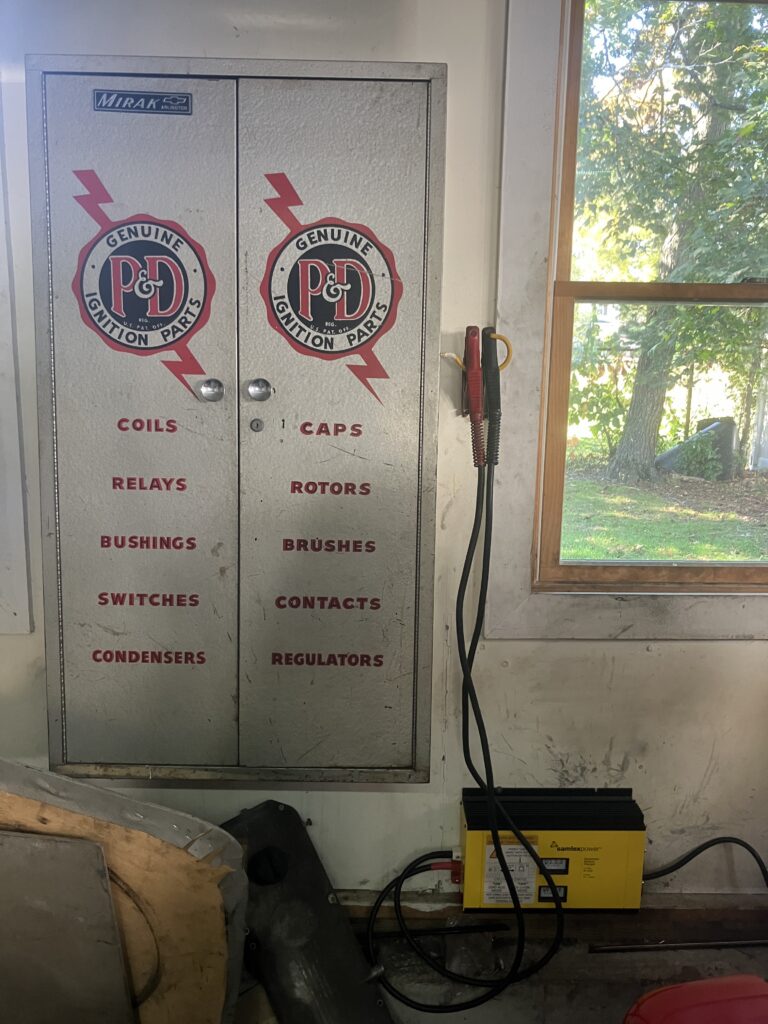
Nice to have a new tool in a convenient spot.
I used the Samlex last fall to get the electric a/c charged without fuming up the house, but had issues with the system that went unresolved before autumn rolled in and put the whole thing on hold. But when there was a spurt of unseasonably warm weather the week before last, I gave things another try. With the Lotus and the Samlex already in position, it was a trivial matter to just hook up the jumper cables, set the Samlex to power-supply mode, and fire the a/c back up.
With a vent temperature gauge stuck into the evaporator, I saw (and felt) the system cooling off, but then it stopped. It turned out that the compressor itself had switched off. I chased the problem with a multimeter, and found that although the power supply was putting out nearly 14 volts, under the full amperage load of the a/c system, the voltage was sagging down under 12 volts. It was reaching the compressor, but it was an under-voltage condition which caused the compressor to shut itself down.
Although I was surprised that this happened, I’ve experienced problems similar to this with dead batteries in winter. Indeed, I’ve told and re-told the story of buying my 2003 E39 530i on a 15-degree winter day because the seller insisted it had an electrical problem because it wouldn’t start with a jump, and I said that, due to cold weather, high resistance in jumper cables, corrosion on the terminals, and a poor bite of the alligator clamps into them, sometimes you need to pull out the dead battery, clean the contacts, and drop in a fresh battery to get it to start (and I was right). But this was a balmy day, and everything looked corrosion-free. Was it a problem in the Samlex itself?
I tried connecting the alligator clamps directly to the electric compressor’s terminals, but there was wasn’t anything big enough for the clamps to bite onto. So I made a second set of cables for the Samlex with ring connectors on them instead of clamps, and temporarily wired them to the power and ground to the compressor.
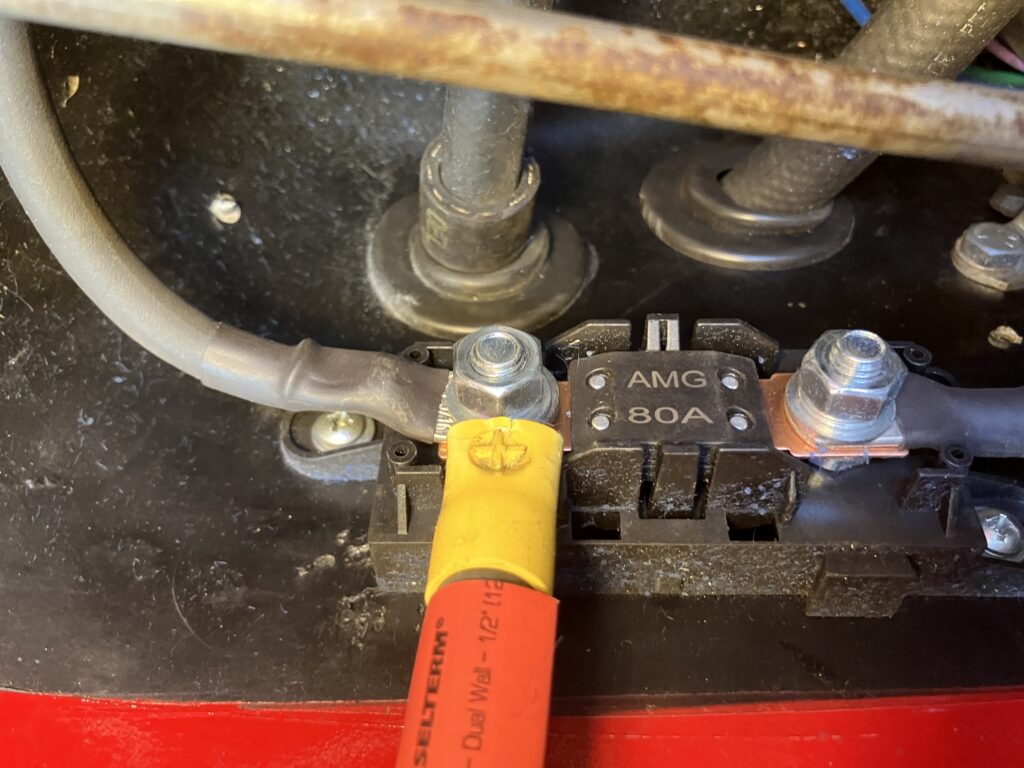
The hot side of the Samlex attached directly to the mega fuse feeding the compressor…
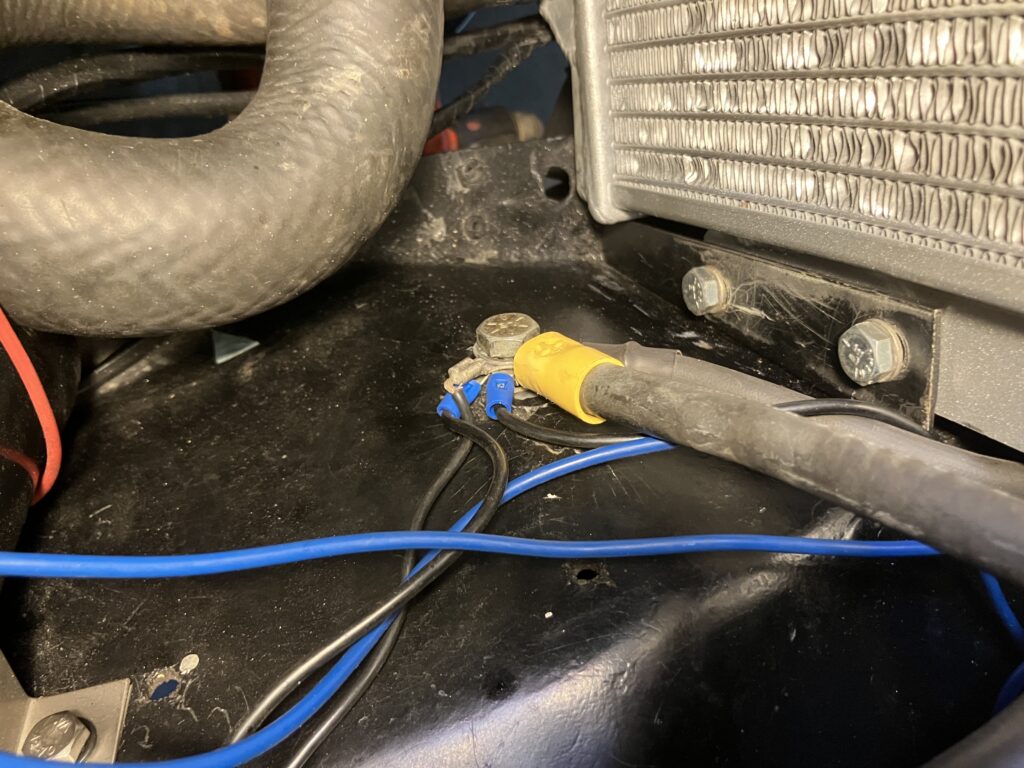
…and the ground side attached directly to the compressor’s ground lug.
The difference was astonishing. I got a sustained 13.5 volts at the compressor, and the vent temperature quickly plumetted to 32 degrees.
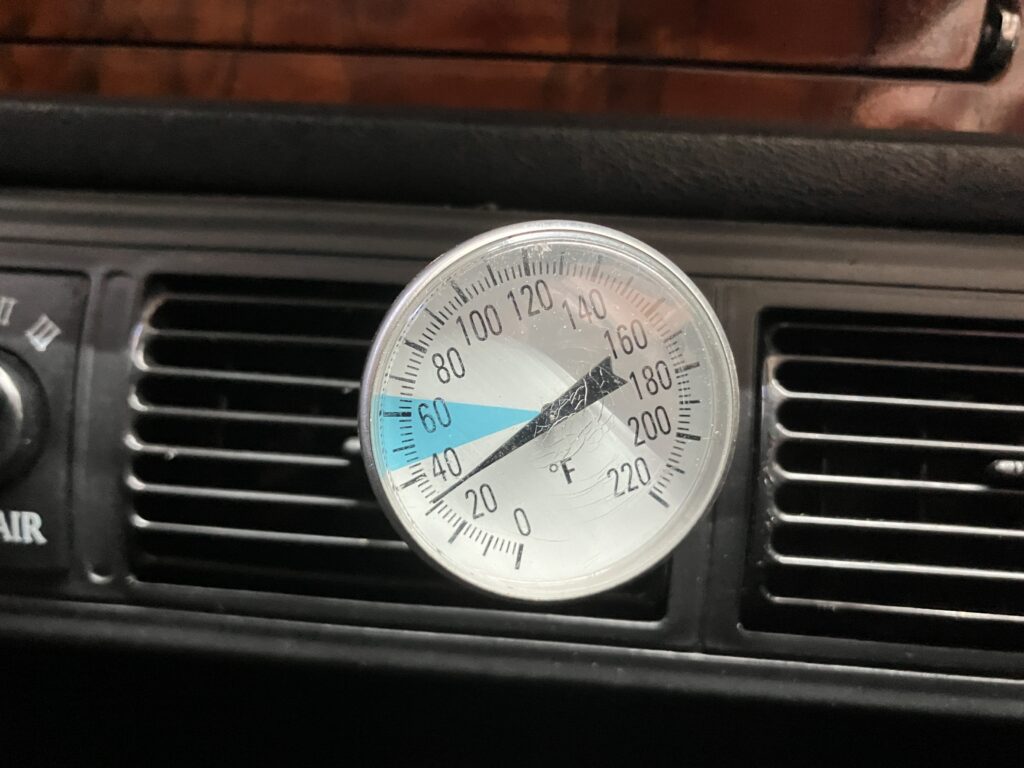
Yeah baby!
And then the compressor shut off. I could hear its whine spin down, and saw the vent temp gauge start to rise. I assumed that all that amperage had blown the maxi-fuse, and didn’t know what to make of it when the fuse was fine. But then I realized that this was the a/c evaporator assembly doing exactly what it was supposed to do—it was shutting off the voltage to the compressor when it detected the coils beginning to freeze. After about 30 seconds, it came back on.
The jury is still out on the electric a/c as a whole, but this was a good lesson on the whole issue of voltage drops and voltage sag. Just because I had run new 4-gauge copper cabling between the Lotus’ new high-output alternator and the compressor (and ground), that didn’t mean that jumper-cabling the Samlex to the battery and relying on the likely-original starter cable from the battery to the engine compartment (and the battery-negative-to-frame-to-engine connection) was going to get a sustained 14 volts to the compressor.
But if I ever have to flash any of the control modules in any of the modern BMWs, I do have the right power supply. As long as the alligator clamps on those jumper cables get a good bite into the terminal posts.
—Rob Siegel
____________________________________
Rob’s latest book, The Best of The Hack Mechanic, is available here on Amazon, as are his seven other books, including Just Needs a Recharge: The Hack Mechanic Guide to Vintage Air Conditioning. Signed copies can be ordered directly from Rob here.