September announced itself with a few things. Cool air. The trees beginning to change color. And Zelda the Z3 and the FrankenThirty needing inspection stickers.
I checked the Z3’s lights, wipers, and horn, and all worked, so down to the inspection station it went. To my surprise, they failed it because the wiper blades were bad. But the inspector was correct, and “bad” was generous—there were strips of loose rubber just flappin’ in the breeze. In my defense, hey, who drives a convertible in the rain? But two new blades later, and everything was fine.
Next was the FrankenThirty. I went through the same exercise—lights, wipers, and horn.
I said horn.
Oh dear.
Fortunately, troubleshooting a horn has to be about the most straightforward of all electrical troubleshooting activities. That is, as long as you understand relays.
As I’ve written about many times, a relay is a switch controlled by low current so high current doesn’t need to be run into the passenger compartment. Terminals 86 and 85 on the low-current circuit control an electromagnet that connects terminals 30 and 87 on the high-current circuit. Feed 12V to 86 and ground 85 (or vice versa), and the electromagnet is energized and pulls the contact from 30 into 87. If 30 is being fed 12V, this sends 12V to 87, which then powers whatever it is you’re trying to turn on. (For a more detailed description of relays, see this piece.)
Horn circuits are different than most because, as shown in the illustration below, the switch on the low-current side of the relay is on its ground side, not the 12V side. This is because it’s easy to have the push button in the center of the steering wheel complete the circuit by grounding it through the steering column. Thus, if the horn doesn’t work, the problem is either in the horn itself, the relay or its wiring, or the ground connection through the column.

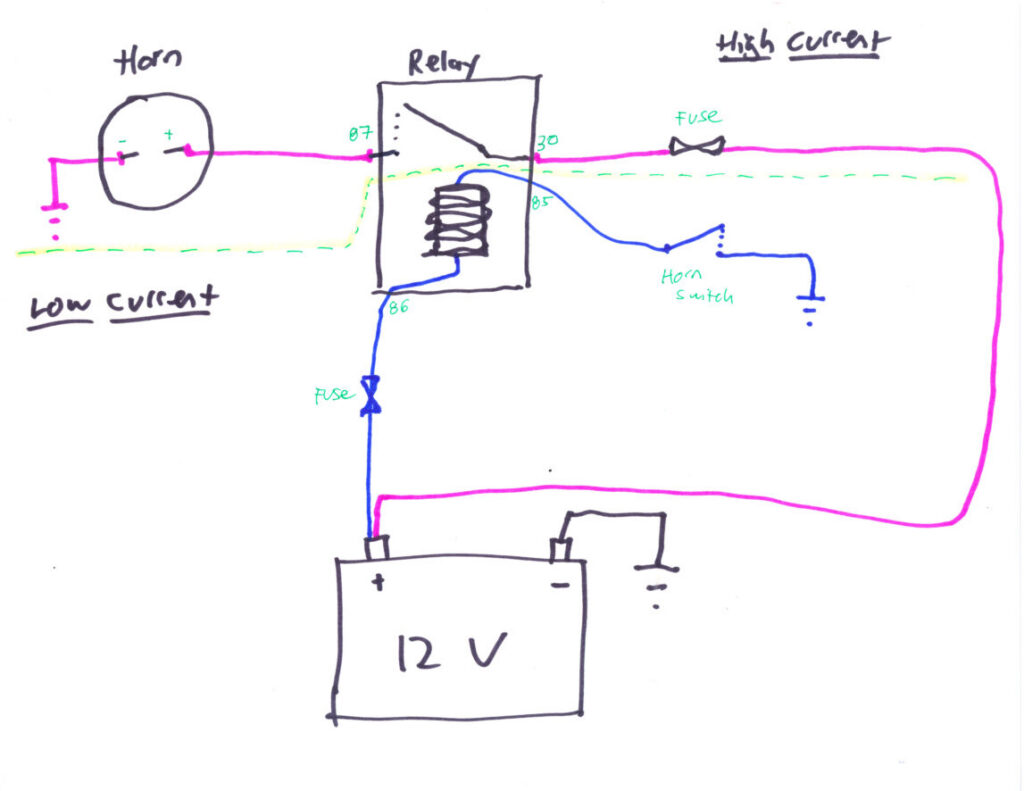
Your basic near-universal horn electrical diagram with the horn button on the negative side of the low-current circuit.
On any car I’ve ever worked on, to avoid having a wire that twists around when you turn the wheel, there’s a circular electrical track that makes contact with a sprung pin. Which one is where varies with make and model. On my E9 coupe, the circular track is on the back of the steering wheel and the sprung contact is mounted behind it on the steering column. On a 2002 and both of my Lotuses, it’s the other way around.

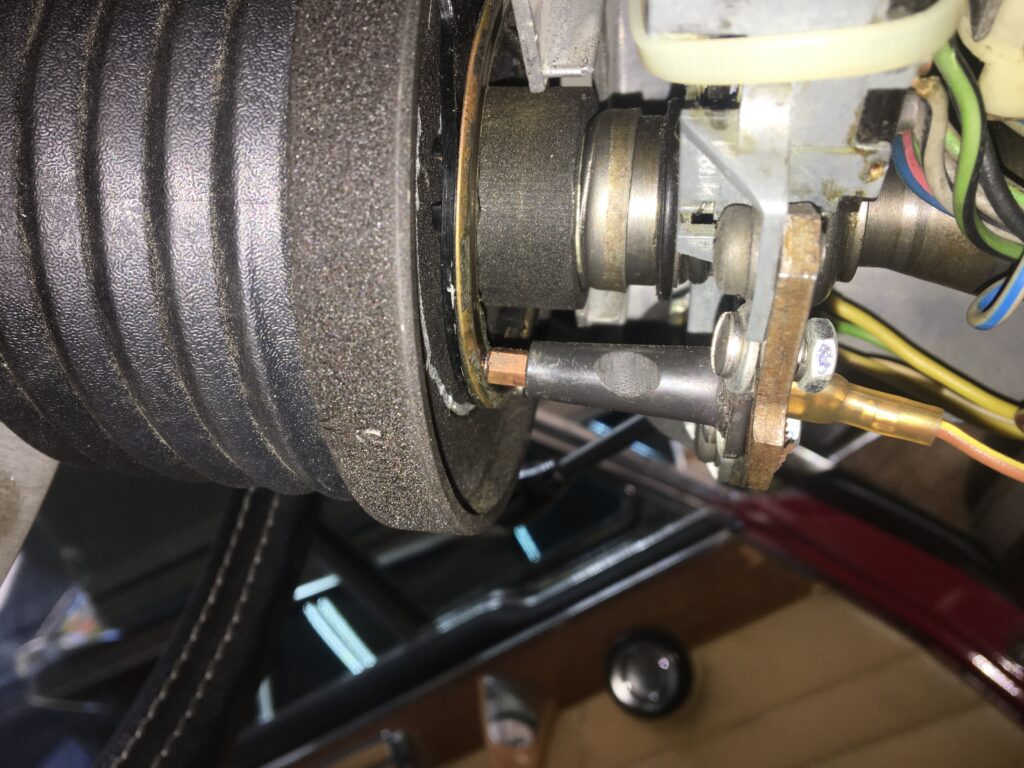
An intimate underside view of the column-mounted horn contact pin and wheel-mounted ring in my E9.
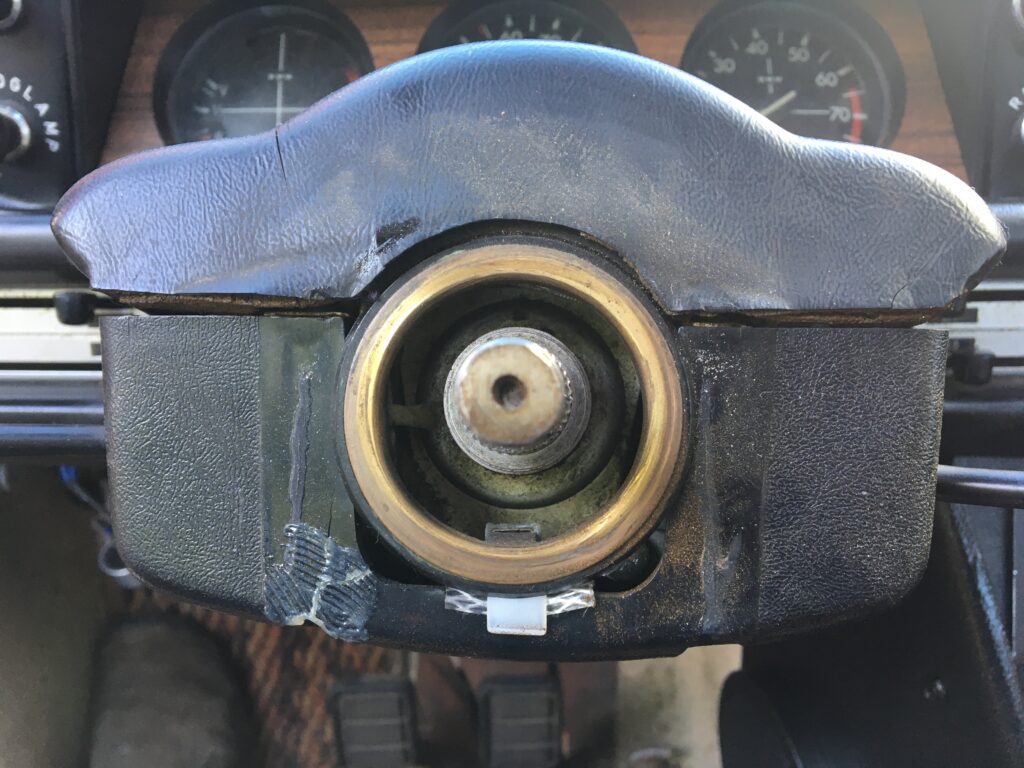
The reverse arrangement with the column-mounted contact ring on a 2002.
My experience is that, on 2002 and E9-era BMWs, the problem is most often with the horn itself. You can verify this with a voltmeter by measuring the voltage delivered to the horn, but it’s usually pretty obvious because when you hit the horn button, you can hear the relay click and the horn let out a faint sad blurt. Sometimes you can free up the stuck diaphragm by fiddling with the screw in the center, but usually wind up replacing it with some $10 generic horn.
On the FrankenThirty, though, I was surprised by the fact that there was no clicking sound at all from the K2 horn relay. I swapped it with the identical K1 low-speed fan relay, and it made no difference. Since no fuses were blown, I was concerned that I had a wiring issue.

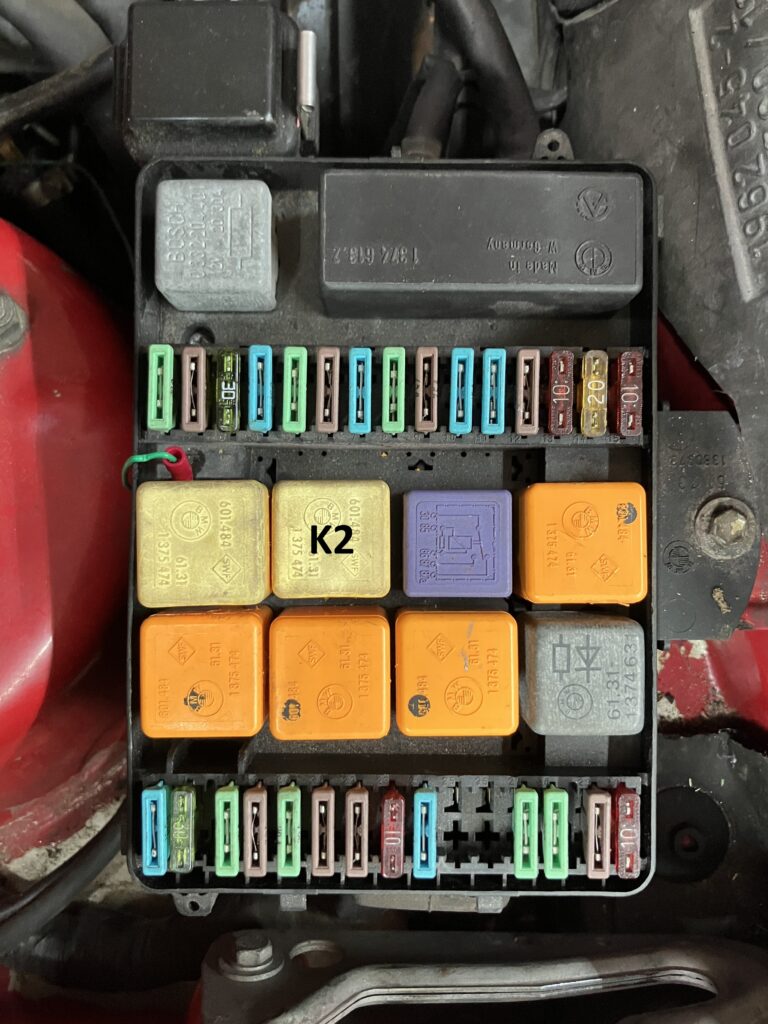
The K2 horn relay in the E30. (FYI the thin green wire heading off to the side from the K1 relay is something I needed to install a few years ago to ground the low-current side of the low-speed fan circuit and make it work. For more information, see https://bimmerlife.com/2025/04/15/e30-a-c-rejuvenation-part-viii-electrical-system/)
If you’ve never futzed around with troubleshooting relays and their wiring, there’s a trick to it. You pull out the relay, hold it in the same orientation that it would be when it’s plugged in, and look carefully at the DIN-standard terminal numbers printed on the bottom next to the legs.
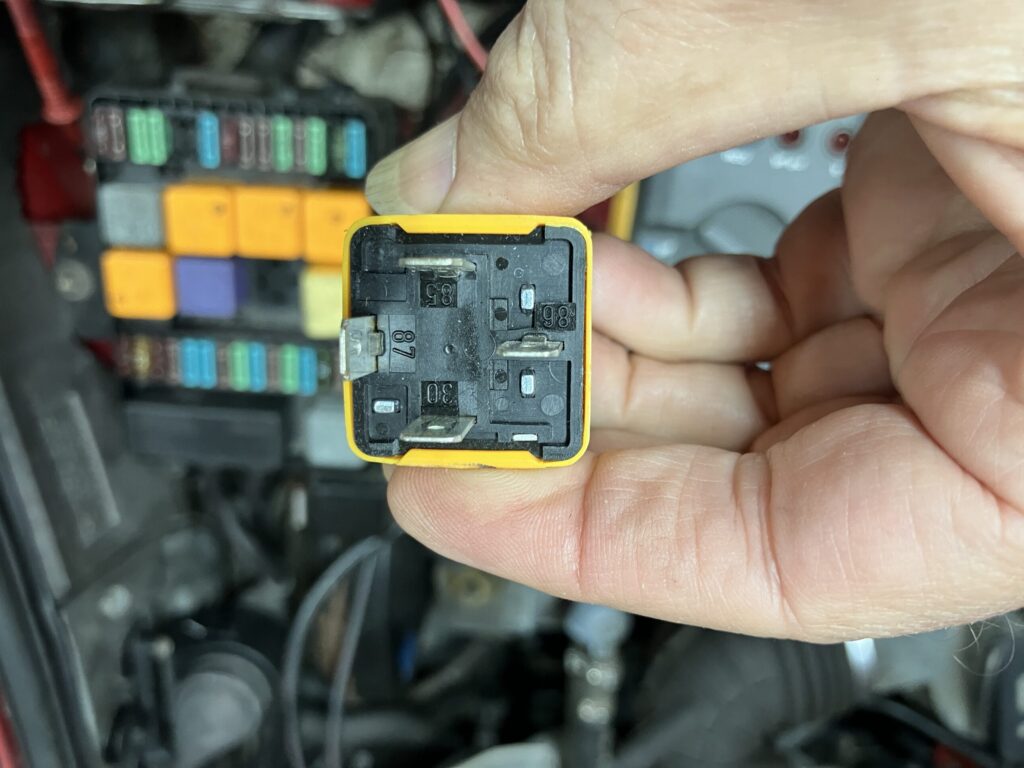
Sorry that the numbers and the photo are upside-down. I’m trying to be consistent with what follows.
Then you write those numbers down on a small piece of paper, but because the you’re holding the relay upside down, the terminals are horizontally flipped, so you need to transpose the numbers side-to-side so they’ll correspond correctly with the terminal numbers of the socket. Capiche?
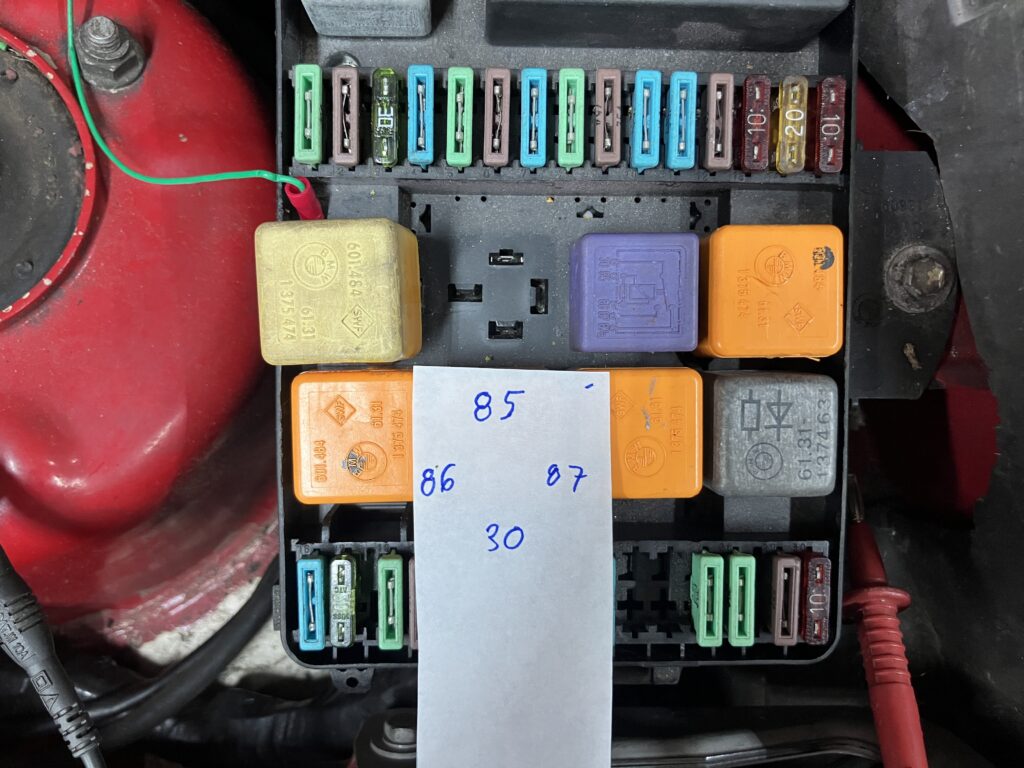
Do it carefully. Get it right.
You can now trouble-shoot the high-current and low-current sides of the relay circuit separately. Crack the key to the accessories setting, take a voltmeter, and measure the voltage between terminal 30 and ground. There should be 12V there. Once you’ve verified this, you can take a jumper wire and connect it across 30 and 87. This will bypass the relay and power whatever it is the relay is supposed to turn on. The “jumper 30 to 87” trick is used most often to bypass fuel pump relays (I mean, no one ever wants to turn on the horn and leave it on, except maybe in New York), but it’s also an essential troubleshooting step. When I did this, the horn blared to attention, so the problem had to be on the low-current side. (For extra credit: If jumpering 30 to 87 doesn’t blare the horn, you check for voltage at the horn. If it’s there, then the horn is bad. If it’s not, then you have a wiring issue between 87 and the horn.)
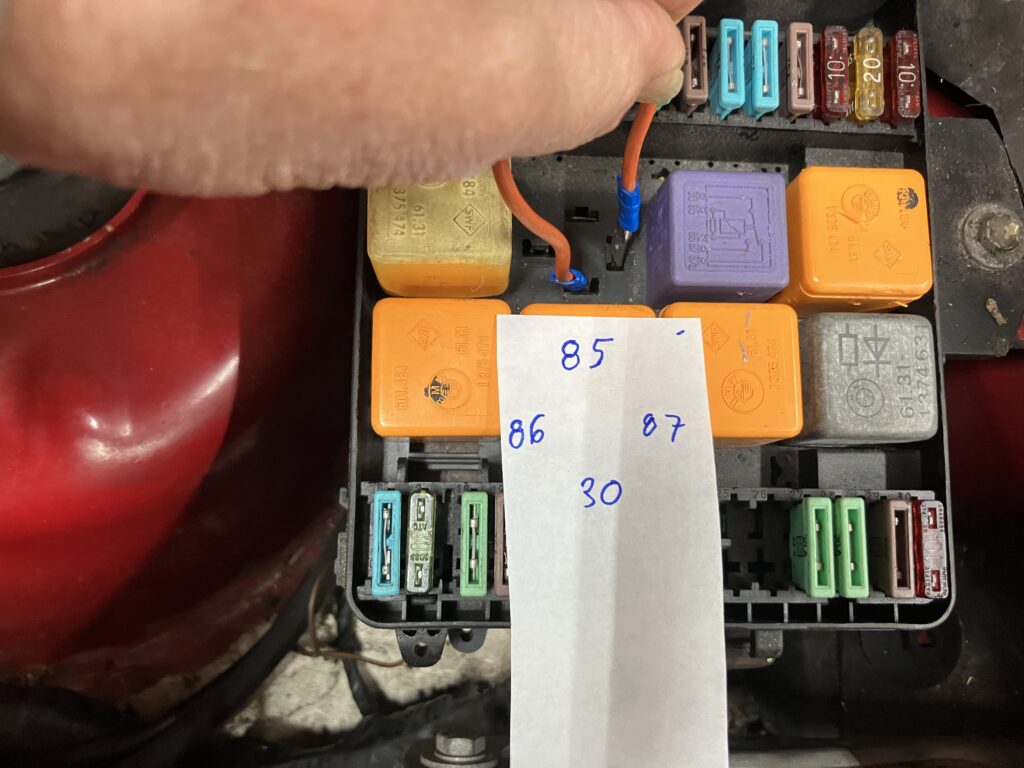
The essential jump-30-to-87 trick.
Next, moving to the low-current side, I used the voltmeter to verify the presence of 12V on 86. Finding it, I then set the meter to measure resistance and checked for continuity between 85 and ground while I leaned inside the car and pressed the horn button. The meter read “OL,” which stands for “over limit,” meaning infinite resistance, meaning no continuity, meaning that pressing the horn button wasn’t grounding the circuit.
Gotcha.
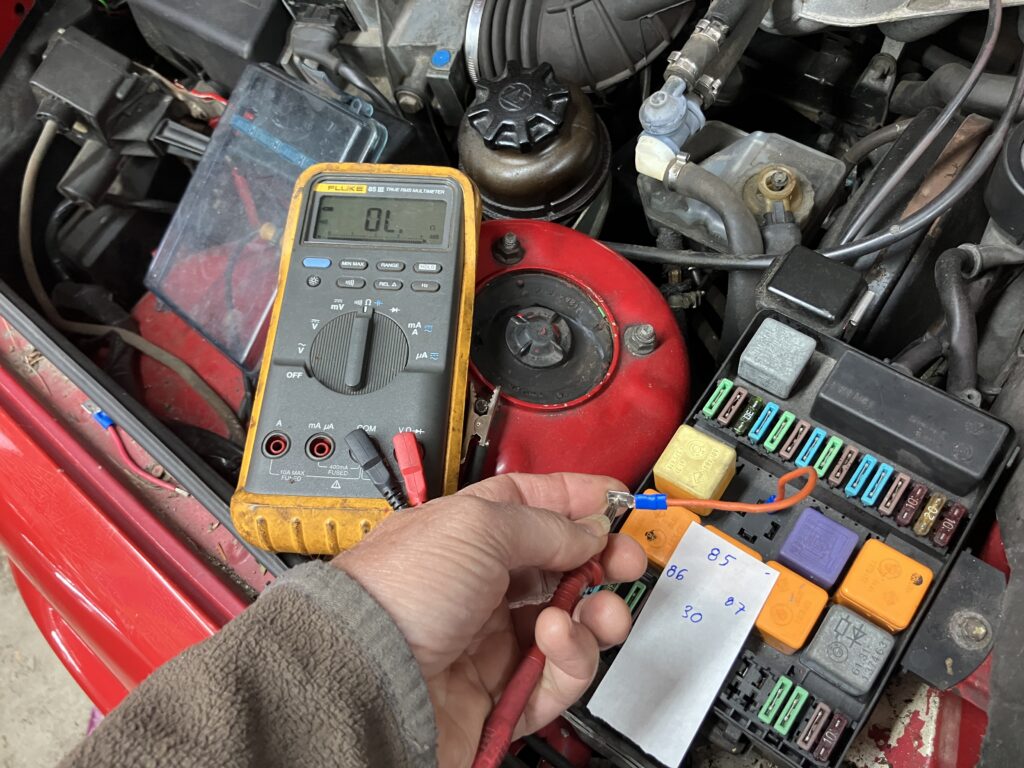
I love these definitive multimeter tests.
So, a horn-grounding issue, eh? I associate these with old cars. Yes, I realize that the E30 is now nearly 40 years old, but rightly or wrongly, I still think of it as nearer to being a modern car than a vintage one. Okay then, 22mm socket on an impact wrench to spin the steering wheel nut off, lift off the wheel, let’s see what we have here.
In my best George Takei voice, “Oh my.”
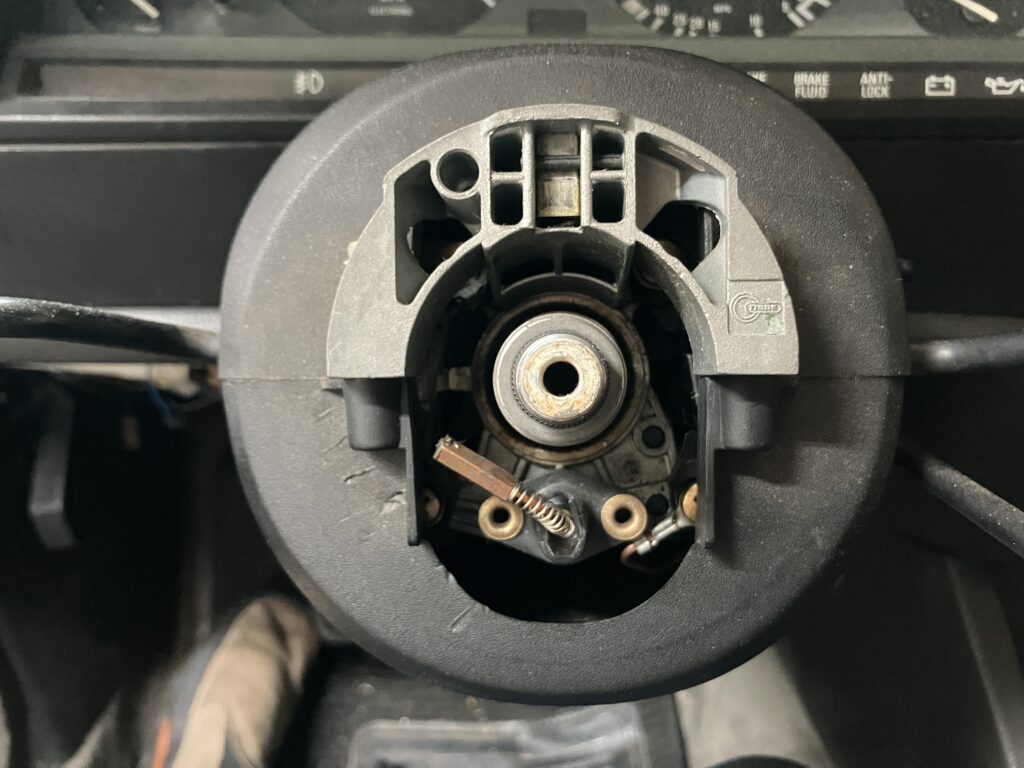
That deserves a second “Oh my.”
Obviously this is an E9-style horn contact configuration with the sprung contact mounted on the column and the circular ring on the back of the steering wheel. The plastic cylinder in which the contact slides had broken off, leaving the spring and the contact pin dangling. When I checked on Realoem, I learned something that I never knew: This part (p/n 32331350750) is used by the Neue Klasse sedans, the E3, E9, E12, E23, E24, E28, E30, and even the M1, and that the reverse arrangement on the 2002 is odd man out. You can see that the contact is riveted onto a larger metal assembly, which is the piece that holds the ignition cylinder. This rang a bell, and in fact if you scroll back and look at the photo of the horn contact in my E9, you can see not only that I’ve replaced the rivets with screws and nuts, but that there’s a washer on the right-hand screw because that ear of the contact’s plastic housing had cracked.
So, the horn contact on the E30 has exactly the same problem as it does on every other vintage BMW except the 2002, and for some reason, this fact hadn’t percolated up to my working consciousness.
Well, okay, now I know. Let’s get one of these on order and be done with it.
What?? No longer available? Are you kidding me?
Okay, well, used then.
What? People on eBay want over sixty bucks for ones with cracked ears?
“Oh my” doesn’t quite convey my annoyance.
All righty then. Let’s swing into Hack-it-together-get-it-past-inspection mode. I took a stiff piece of heat-shrink tubing of the correct diameter, pressed it over the remaining stub of the plastic housing, trimmed it to length to hold the spring and the contact, and shrunk it.
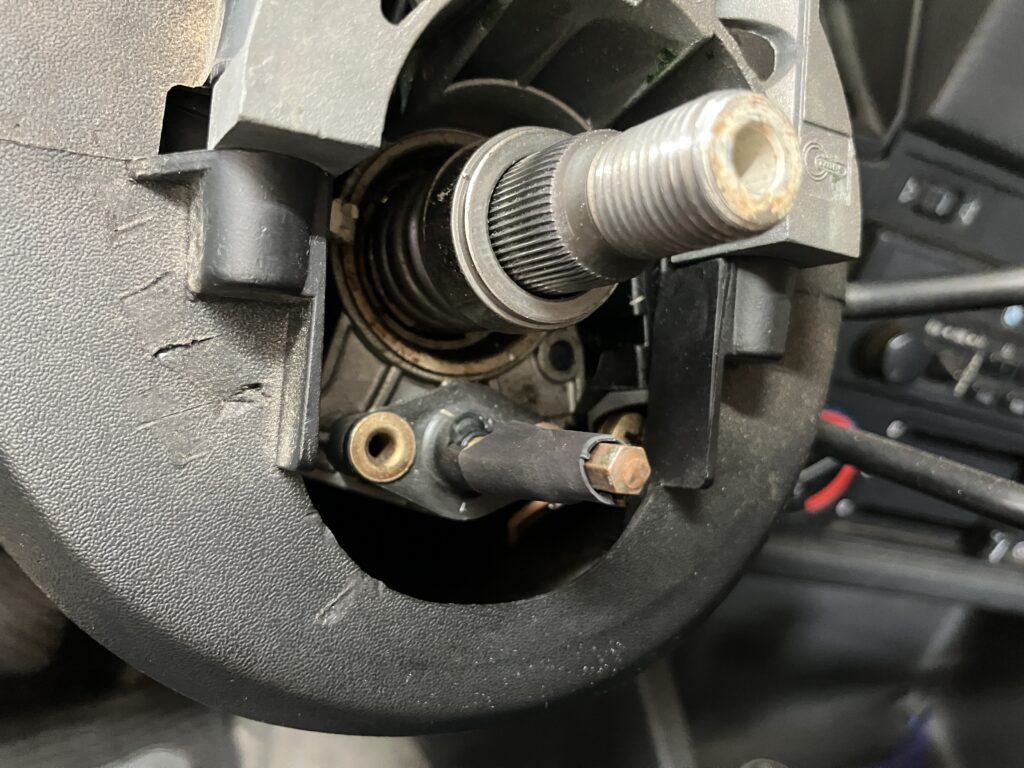
It’s certainly Hack-worthy.
While this should limp the car through inspection, there’s little question that it will fail, so I’ll do more searching and decide which too-expensive used part to pony up for. To paraphrase a television show of my youth, “Tune in next week. Same Hack time, same Hack channel.”
—Rob Siegel
____________________________________
Rob’s newly-expanded book The Best Of The Hack Mechanic™: 40 years of hacks, kluges, and assorted automotive mayhem, is available on Amazon here. His other seven books are available here on Amazon, or you can order personally-inscribed copies (including the new Best Of) from Rob’s website, www.robsiegel.com/books.