
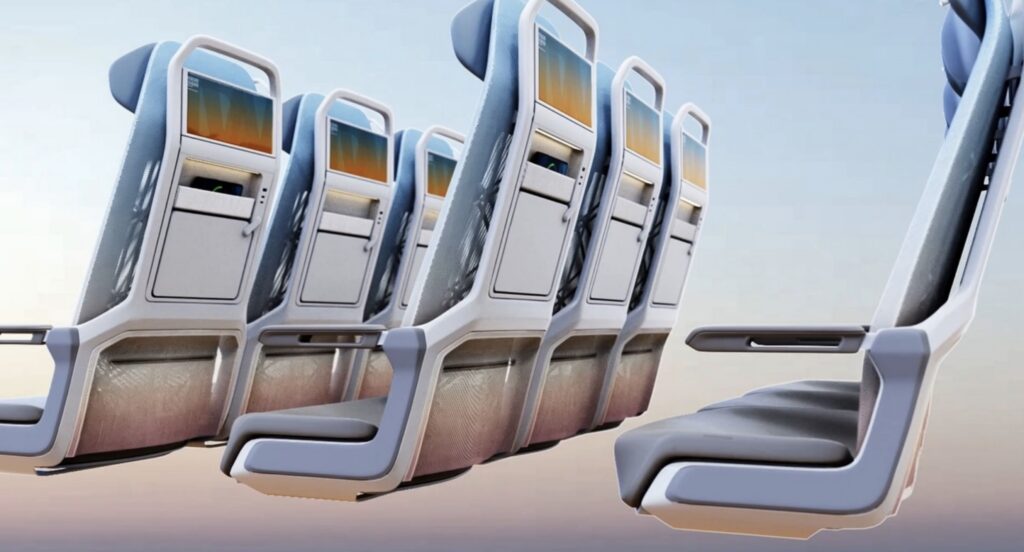
BMW’s Designworks studio is no stranger to aircraft designs. It’s been working with airlines to help improve first-class and business class cabins for more than a decade, including doing the first-class cabin for Singapore Airlines’ Boeing 777-300ER in 2012. However, according to the Airline Passenger Experience Association (APEX), it’s now turning its attention to the little guy—economy class. More specifically, its attention is turned to the seats. With its new Spaceframe seat design, BMW Designworks is looking to radically improve the flying experience of the average traveler.
Since most of us normies are relegated to the back half of the plane, in cramped economy-class seats, this new Designworks project is actually far more impactful than any of its first-class projects. Spaceframe is meant to not only increase the space that passengers have but to also mercifully improve seat comfort in several different ways.
The core idea behind Spaceframe is to create a lighter, slimmer, and more functional modular seat design that can be used for short, medium, and long-haul flights. Additionally, it needs to last a decade or so, while still being upgradable as in-flight entertainment (IFE) technology improves.
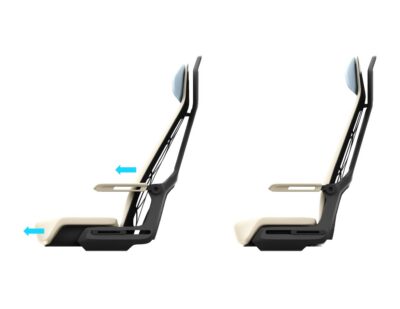
At its core the Spaceframe seat is a lightweight exoskeleton that features suspended cushions on a secondary structure. So the seat and backrest cushions are on a separate structure that’s connected to the main exoskeleton, giving passengers comfort similar to a modern high-quality office chair. More importantly, Designworks actually wants passengers to recline without having to worry about disturbing the passenger behind them. It’s sort of an unwritten rule that you don’t recline your seat in economy, because it ruins the day of the person behind you. But BMW wants a “guilt-free recline,” according to Designworks Associate Director of Strategy and Partnerships Nathan Portlock. And it achieves that by allowing the secondary structure to slide forward, away from its exoskeleton, and then recline. So the main seat frame doesn’t move, but the cushions do.
Spaceframe also needs to have modular features for IFE screens, cupholders, charging ports, and any other accessories airlines might want to add. That way, they can continuously be upgraded over the years without needing to be replaced.

BMW Designworks
BMW Designworks knows that just designing a great seat means nothing if it doesn’t also save airlines money. This is corporate America, after all, so passenger comfort is far less important to airline execs than profit. A longer useful life saves the airlines money, but so does weight. If each seat is significantly lighter, times hundreds of seats, that’s a significant reduction in fuel-burn costs, saving even more money. And simpler designs that are easy to repair saves even more precious dollar bucks. All of that savings creates more incentive for airlines to pick this design up and save our backs from sky high misery.
This is still just a concept design, and BMW Designworks is currently in the process of finding an airline partner and supplier to help bring it to life. But if it does, you can drive to the airport in a BMW and still ride in one of its seats while in the air. Let’s just hope they’re more comfortable than BMW M’s carbon fiber sport seat.