
I’m still not quite over my RSV (and thanks to those who have sent me get-well emails), and the garage is still snowed in, so we’re still in non-wrenches-on-bolts mode.
And thanks to Mike Self and Tom Jones for alerting me that I was completely wrong last week when I said that the 2000C and CS weren’t sold in the U.S. through the Hoffman dealer network. They were. I just assumed that the fact that my car that had four round headlights instead of the long glass-covered lights was because it and others like it were gray market conversions.
What I’d like to talk about this week is my surprising conclusion that the question “On my de-smogged and Weber’d 2002, which vacuum port do I connect the distributor’s vacuum advance to?” has a definitive answer.
Many of us have gone through this, or at least stumbled through it in the unburned-hydrocarbon-distant past. We bought an early to mid-1970s 2002 or other vintage car that had EGR plumbing, a smog pump, a tangle of vacuum hoses, little solenoids against the firewall, and a big dashpot on the carb to slow the closing of the throttle. We removed all of it, and replaced the two-barrel Solex with a Weber 32/36. The simple modern performance setup. Nice and clean. All that was left was to connect a single vacuum hose directly between a port on the carb to the vacuum advance diaphragm on the distributor.
Which port do you use?
First, note that even on the distributor side, it’s not as simple as I thought. I’d long thought that, on 2002s, there were straight mechanical advance distributors on the ’72 and ’73 2002tii, mechanical plus vacuum retard used on the ’74 tii, mechanical plus both vacuum advance and retard on all ’75s and California ’76s, and mechanical plus vacuum advance on everything else. When I bought Hampton, my very original ’73 2002, I was stunned to find that it had a vacuum retard dizzy, and was convinced that it had crept in there via some well-meaning budget repair (see “The Mutant Distributor.”) I later found references on bmw2002faq.com that vacuum retard was used on more 2002s than I ever thought.
Hampton was one of those cars that, when I bought it, still had the EGR plumbing installed, the solenoids and control relay against the firewall, and a variety of vacuum lines, but had a Weber 32/36 and some but not all of the vacuum lines were plugged. I initially felt that the emissions stuff, even non-functional, was a testament to the car’s originality and wanted to leave it there, but eventually pulled it out as I was concerned that the EGR was causing vacuum leaks (it broke in half when I removed it). It seemed that the obvious thing to do was to buy a used vacuum-advance distributor and connect it to one of the ports on the Weber.
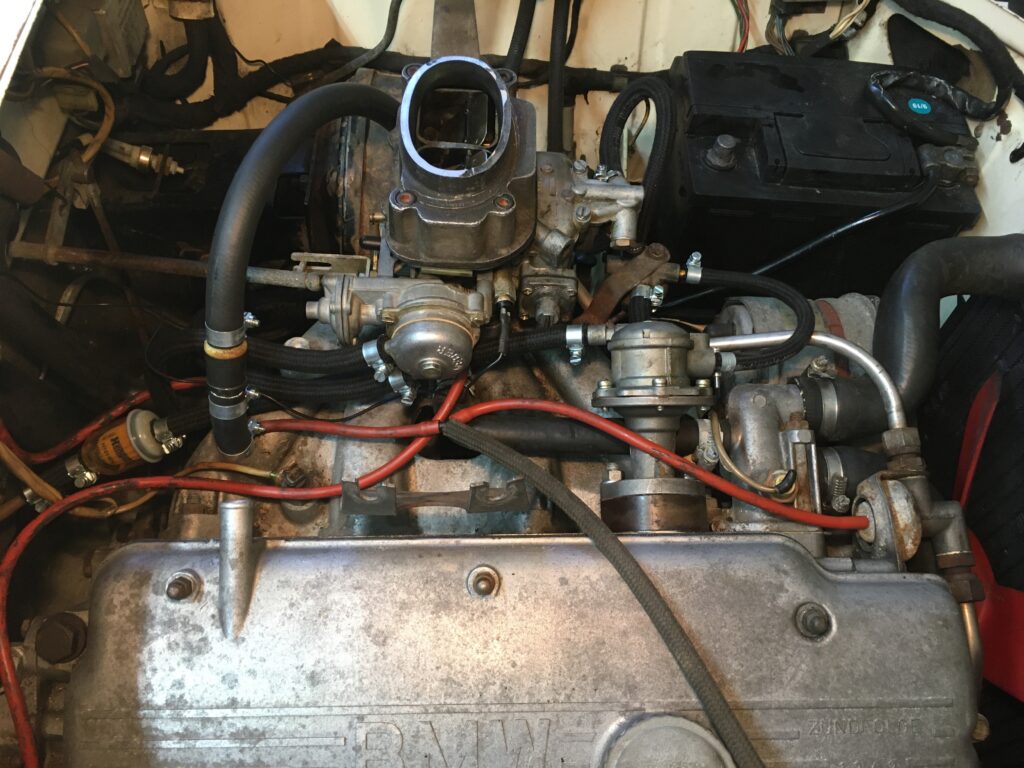
Yup, it still had all that.
So I did, but the question of which vacuum port to use led me to go down the rabbit hole of learning the distinction between manifold vacuum (below the throttle plates) and ported vacuum (above the throttle plates). I found this post from 2008 on bmw2002faq.com where Tom Jones dug into it from the standpoint of smog-compliant California Weber conversions. The diagram below clearly shows the dizzy’s vacuum pod as connected to manifold vacuum, but it doesn’t specify whether it’s a vacuum advance or vacuum retard dizzy. (You could say that, since the vacuum pod is on the right side of the distributor body, it’s a retard distributor, but that may be reading far too much into the diagram.)

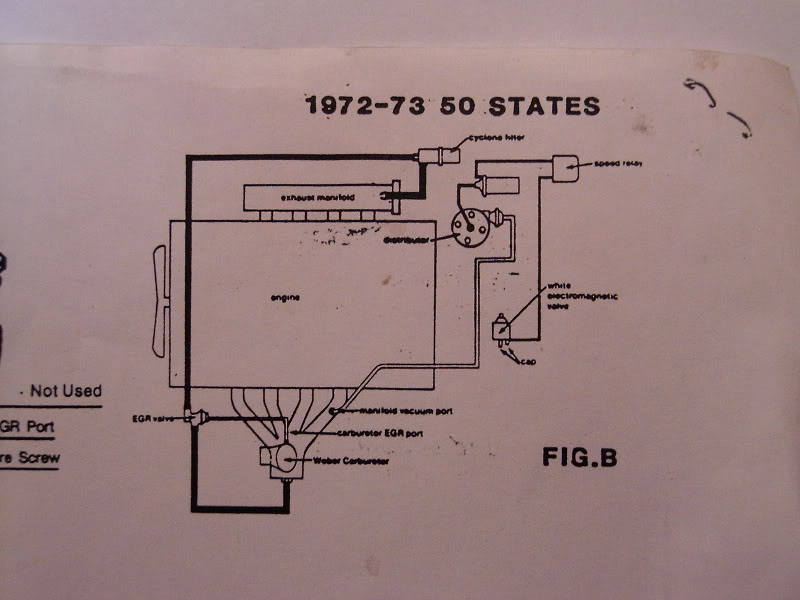
Manifold vacuum. Maybe. (photo Tom Jones, bmw2002faq.com)
Let me back up half a step. My understanding is that the impression that many of us had back in the day that the purpose of vacuum advance is to provide extra advance during acceleration is mistaken or at least misleading. That’s when you don’t want a big slug of advance advance, as too much advance under load causes pinging. My understanding is that you want extra advance during even-throttle cruising to keep the engine cool and help fuel economy, and that you may want more of it at idle, as the mechanical advance may not be bringing in enough of it at low rpm.
But here’s the thing. Emission controls came in earlier than we tend to think, the centrifugal advance curves and vacuum pods of the distributors on US models were designed to meet those standards (generally along with relays and solenoids that cut the vacuum in and out depending on a variety of rpm and load conditions), but now, 50+ years later, with the rest of the emissions stuff removed and the internals of the distributor in who knows what condition, the body of opinion from what I’ve read about a whole variety of vintage cars is that there’s not a monolithic answer to the “ported or manifold vacuum” question. It simply depends on too many variables. On Hampton, I did install the used vacuum-advance dizzy I bought, tried plumbing it with both manifold and ported advance, and in the end, put the original vacuum retard dizzy back in because I thought the car accelerated better with it.
I’ve long timed my cars by first shining a timing light on any timing or TDC mark and revving the engine to make sure the mark moves (it’s astonishing how many old distributors have centrifugal advance that no longer works at all), plugging the vacuum lines, timing it to spec (25 degrees BTDC at whatever rpm is recommended) to get it in the ball park , then reconnecting the vacuum lines, driving the car under unrealistically high load conditions (like throttle mashed at 40mph in 4th gear going up a hill), advancing the timing if I hear no pinging, and backing it off if I do. I’m now more circumspect about reconnecting the vacuum lines at all unless I first know exactly what they’re doing and under what conditions.
If you want more information, you can find where I posted the question a few years back on bmw2002faq.com, and read four pages of highly-detailed answers from knowledgeable experienced folks. I wasn’t kidding when I said it was a rabbit hole.
—Rob Siegel